
Gates Warns of 20-Year AI Transition Marked by Winners, Losers and Labor Disruption
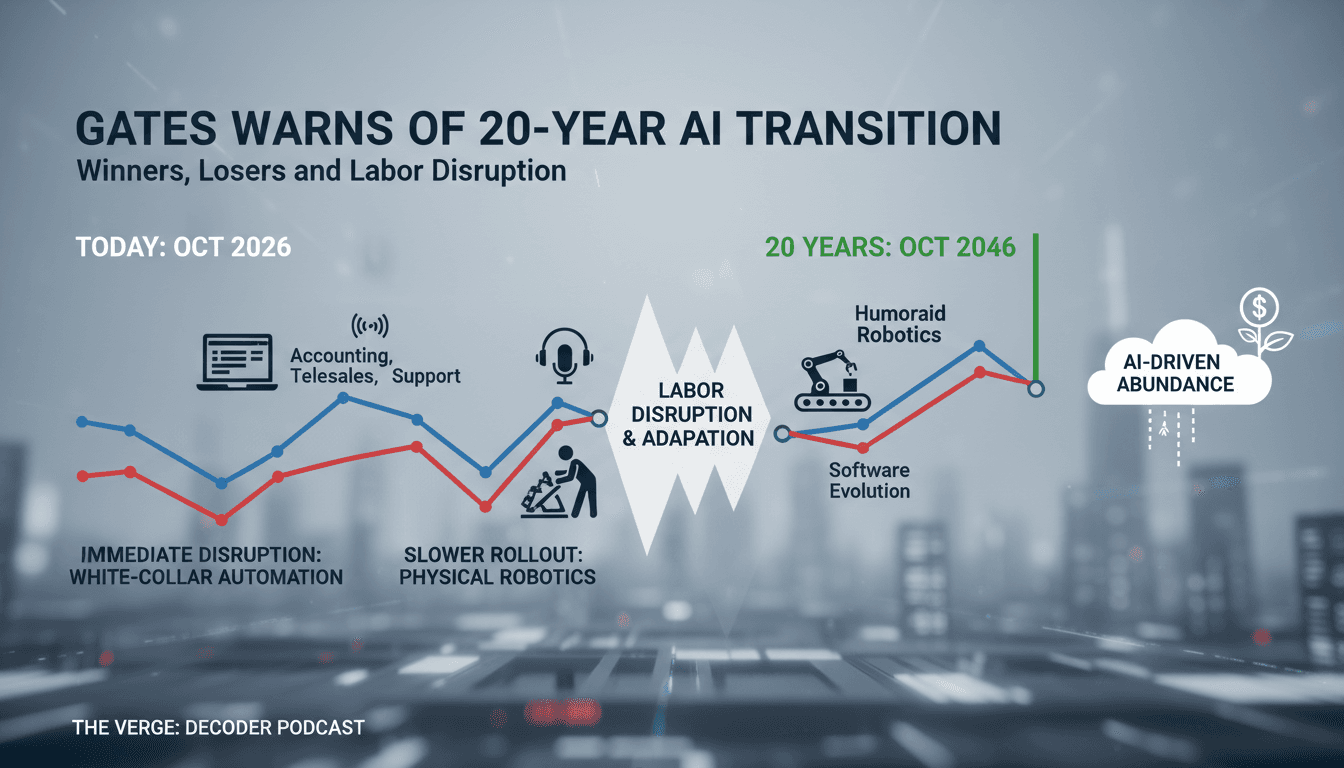
Why it matters
The compression of enterprise operating costs through algorithmic execution forces a structural redistribution of labor value across both services and industrial workflows over the next 20 years.
What happened (in 30 seconds)
- A 20-year transition timeline defined: On October 22, 2026, Microsoft co-founder Bill Gates stated on *The Verge's Decoder* podcast that artificial intelligence will trigger a 20-year period of economic and social disruption before reaching broad abundance.
- Sequential labor market exposure: Gates outlined that software automation will first absorb knowledge-work functions including accounting, telesales, and customer support, followed by humanoid robotics entering physical domains like construction, agriculture, and surgery.
- Human-reserved designations suggested: To manage displacement and maintain human purpose, Gates raised the prospect of societies explicitly protecting specific domains—such as arts, childcare, sports, and food preparation—for human workers.
The context you actually need
- Prior warnings compressed the timeline: In August 2026, Gates warned of acute white-collar job displacement within two years, with broader systemic labor pressures materializing within four years.
- Simultaneous benefits and liabilities: Unlike historic industrial transitions that evolved across multiple generations, Gates noted that the productivity gains and disruptive displacements of AI arrive concurrently.
- Unresolved alignment assumptions: The path to an abundance economy relies on technical alignment, an outcome Gates characterized as an assumption rather than a guaranteed reality.
What's really happening
The economic mechanism behind Gates’ 20-year horizon is driven by direct margin optimization. Software models now execute high-volume cognitive tasks radically cheaper, faster, and more accurately than salaried professionals. Enterprise incentives heavily favor substituting expensive human labor in structured analytical workflows. When accounting, customer service, and telesales processes are automated, operating expenditure drops immediately. However, this dynamic compresses middle-tier corporate payrolls before new value-generating positions can be absorbed elsewhere in the economy.
This disruption unfolds in two distinct phases: informational and physical. The current phase targets screen-based white-collar roles where digital output requires no hardware translation. The subsequent phase involves deploying physical automation—specifically humanoid robotics—into capital-intensive, manual sectors like construction, agriculture, and surgical intervention. Because physical robotics requires capital expenditure, specialized manufacturing, and safety verification, its diffusion curve lags digital software deployment. This delay creates a multi-speed labor displacement cycle.
The central friction is structural velocity. In previous economic shifts, agricultural workers transitioned to manufacturing plants over several decades, allowing educational pipelines and capital markets to rebalance organically. With AI, capital efficiency decouples from domestic employment counts almost overnight. Because software distributes globally at zero marginal cost, the good and bad economic externalities arrive at the same time. The benefits aggregate to capital allocators and enterprise software platforms, while the downside lands on workers whose routine analytical output is commoditized.
Furthermore, Gates emphasized that the concept of an abundance economy—where material shortages cease to dictate market pricing—remains theoretical until the 20-year bridge is crossed. In the interim, societies face resource misallocation and identity disruption. If productivity margins concentrate among model operators while displacement accelerates in white-collar hubs, systemic equilibrium demands structural policy interventions. The proposal to carve out human-reserved domains in fields like early childhood care, sports, and creative arts illustrates the core dilemma: free-market incentives optimize for automation efficiency, meaning human employment in routine tasks can only persist through deliberate structural choices.
Who feels it first (and how)
- White-collar corporate operations: Teams in corporate accounting, routine compliance, telesales, and tiered customer support face direct margin compression within a 2- to 4-year window as algorithmic workflows replace salaried seats.
- Global service-and-finance hubs: International commercial centers—such as Dubai, where regional finance, logistics, construction, and hospitality form the core economic base—face simultaneous operational restructuring across knowledge work and industrial labor.
- Physical labor and skilled trades: Construction crews, agricultural workers, and specialized medical technicians retain longer buffer windows, insulated until humanoid hardware reaches scale, cost parity, and operational precision.
- Human-centric service sectors: Professionals in early childhood education, specialized culinary trades, athletics, and cultural arts gain structural relevance as societies consider reserving interpersonal functions exclusively for human staff.
What to watch next
- Corporate SG&A budget restructuring: Look at quarterly financial disclosures for reductions in internal administrative overhead paired with rising enterprise software capital expenditure, signaling direct displacement of routine cognitive roles.
- Humanoid robotics trial milestones: Watch industrial pilot programs in high-liability environments like commercial construction sites and outpatient surgical suites to measure when physical automation begins matching software-level cost efficiency.
- Policy frameworks on labor reservations: Monitor whether municipal or national jurisdictions propose labor market protections, quota designations, or incentives for human-reserved categories in caregiving and cultural sectors.
Gates projects a 20-year transition period defined by distinct economic winners and losers before an abundance paradigm can be realized.
Digital white-collar tasks will experience acute labor displacement years before humanoid robotics achieves operational scale in construction, agriculture, and healthcare.
Whether institutional policymakers will successfully implement human-reserved job classifications or alternative mechanisms before private-sector labor displacement accelerates beyond retrain capacity.
Frequently Asked Questions
- Why it matters?
- The compression of enterprise operating costs through algorithmic execution forces a structural redistribution of labor value across both services and industrial workflows over the next 20 years.
- What happened (in 30 seconds)?
- A 20-year transition timeline defined: On October 22, 2026, Microsoft co-founder Bill Gates stated on *The Verge's Decoder* podcast that artificial intelligence will trigger a 20-year period of economic and social disruption before reaching broad abundance. Sequential labor market exposure: Gates outlined that software automation will first absorb knowledge-work functions including accounting, telesales, and customer support, followed by humanoid robotics entering physical domains like construct
- What's really happening?
- The economic mechanism behind Gates’ 20-year horizon is driven by direct margin optimization. Software models now execute high-volume cognitive tasks radically cheaper, faster, and more accurately than salaried professionals. Enterprise incentives heavily favor substituting expensive human labor in structured analytical workflows. When accounting, customer service, and telesales processes are automated, operating expenditure drops immediately. However, this dynamic compresses middle-tier corpora
- Who feels it first (and how)?
- White-collar corporate operations: Teams in corporate accounting, routine compliance, telesales, and tiered customer support face direct margin compression within a 2- to 4-year window as algorithmic workflows replace salaried seats. Global service-and-finance hubs: International commercial centers—such as Dubai, where regional finance, logistics, construction, and hospitality form the core economic base—face simultaneous operational restructuring across knowledge work and industrial labor. Phys
- What to watch next?
- Corporate SG&A budget restructuring: Look at quarterly financial disclosures for reductions in internal administrative overhead paired with rising enterprise software capital expenditure, signaling direct displacement of routine cognitive roles. Humanoid robotics trial milestones: Watch industrial pilot programs in high-liability environments like commercial construction sites and outpatient surgical suites to measure when physical automation begins matching software-level cost efficiency. Polic
Stock market news, investing ideas, and trading analysis.
"TheStreet provides market news and retail-investor-focused analysis."
— A47 Editor
Bill Gates warns of 'winners and losers' over next 20 years, even in 'very best case'
Bill Gates, co-founder of Microsoft, warns that artificial intelligence will produce clear winners and losers over the next 20 years, even in the most favorable scenario. He says AI could eventually bring abundance, but only after a period of signifi...
Business and tech news excluding paywalled content.
"High-volume business/tech outlet with frequent AI coverage."
— A47 Editor
Bill Gates predicts 20 years of turmoil before AI creates 'true abundance'
Bill Gates has predicted that the next 20 years will be "as tumultuous a period as there's been in human history," even as he says artificial intelligence will eventually help solve many of the world's problems and create "true abundance." His remark...
English-language reporting on Saudi politics, policy, and society.
"Saudi Gazette reflects mainstream Saudi institutional perspectives."
— A47 Editor
Bill Gates warns AI could trigger 20 years of economic and social upheaval
Bill Gates has warned that artificial intelligence (AI) could lead to two decades of economic and social upheaval, fundamentally altering employment landscapes and daily life. In a recent interview, he expressed concerns about the transition period, ...