
Anthropic S-1 Filing Grants Founders 50.1 Percent Voting Control Through Class F Share
Why it matters
The separation of voting power from economic ownership at a projected valuation of $1.5 trillion to $2 trillion structurally insulates frontier artificial intelligence development from public shareholder oversight.
What happened (in 30 seconds)
- The S-1 filing submitted: On October 26, 2026, San Francisco-based Anthropic filed its S-1 registration statement with the U.S. Securities and Exchange Commission to list on the Nasdaq under the ticker symbol ANT.
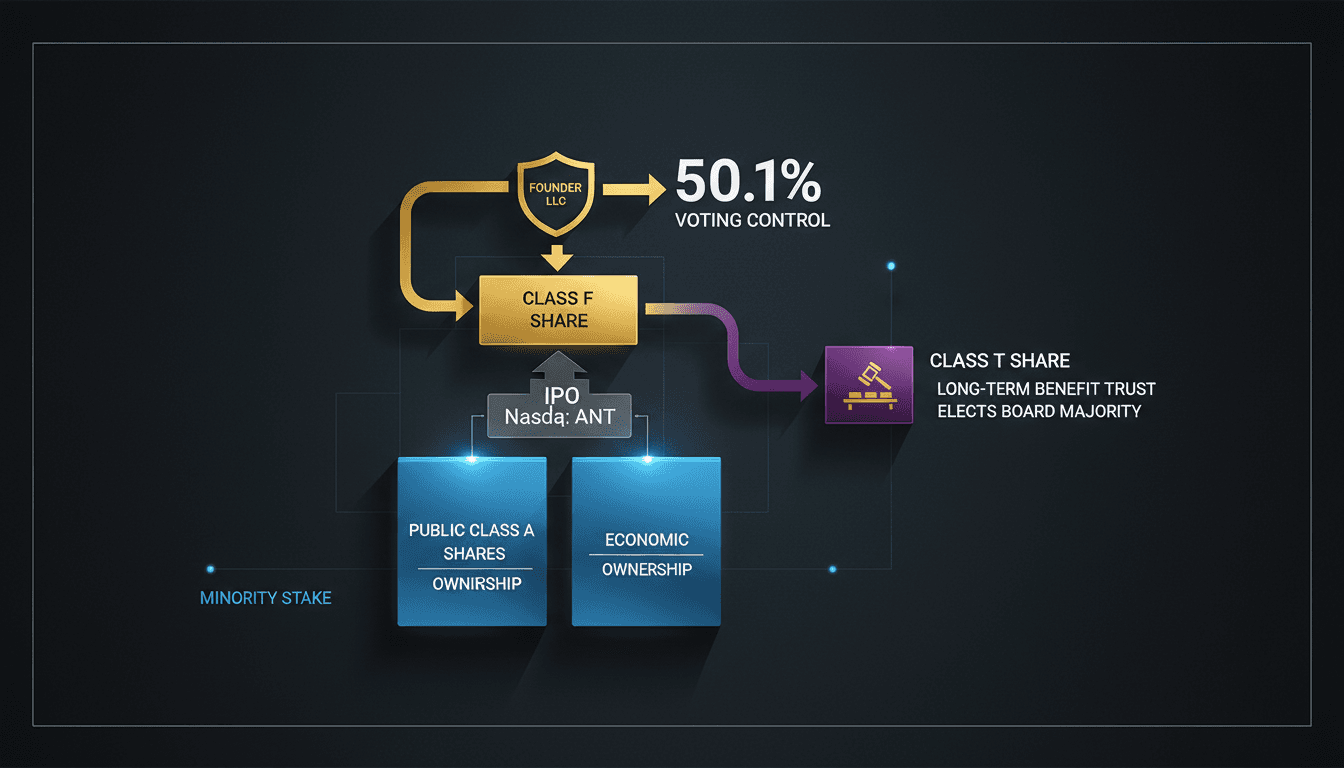
- Absolute voting control retained: Seven co-founders established 50.1% voting authority over ordinary corporate matters through a single Class F share housed within Founder LLC, independent of their 1.4% to 1.5% individual economic stakes.
- Dual-layer mission governance implemented: An independent Long-Term Benefit Trust holds a dedicated Class T share empowered to elect a majority of the board of directors, ensuring adherence to the company's public-benefit framework.
The context you actually need
- Precedent in modern technology listings: Multi-class equity architectures have shielded executive leadership from short-term financial cycles since the 2000s, reflecting mechanisms deployed by firms such as Meta and SpaceX.
- The public-benefit corporation foundation: Founded in 2021, Anthropic integrated public-benefit commitments into its corporate charter to prioritize safe and responsible artificial intelligence deployment over rapid monetization.
- Controlled company exemptions on Nasdaq: Listing under a structure where more than 50% of voting authority sits with a unified entity exempts the organization from standard exchange mandates requiring an independent board majority or compensation committee oversight.
What's really happening
The mechanics of Anthropic’s public listing decouple financial contribution from corporate agency. In conventional public equity offerings, capital allocation purchases proportional governance rights. Under the Class F structure detailed in Anthropic’s S-1 filing, public investors purchasing Class A shares receive one vote per share, yet aggregate outside ownership cannot alter fundamental strategic decisions or board composition.
By placing 50.1% of ordinary voting authority into a single Class F share assigned to Founder LLC, the seven co-founders—including Chief Executive Officer Dario Amodei and President Daniela Amodei—secure outright operational supremacy. This authority exists despite each founder holding an economic stake of roughly 1.4% to 1.5%. The remaining foundational governance rests within the Class T share assigned to the Long-Term Benefit Trust, an independent body designed to elect a majority of the board of directors. Consequently, traditional public investors are granted pure economic exposure without a mechanism to enforce capital-allocation discipline or influence product roadmaps.
This dual-tier architecture addresses an operational tension: frontier artificial intelligence development demands continuous, high-volume capital expenditure to finance compute capacity and research infrastructure, yet public market expectations routinely reward quarterly cost containment and immediate margin expansion. To access institutional public markets without compromising long-term research trajectories, Anthropic’s leadership insulated the executive team from shareholder activism, proxy contests, and hostile takeovers.
Furthermore, the filing incorporates continuity mechanisms that permit each founder to confidentially designate up to 10 potential successors. This succession planning ensures that voting authority does not disperse or revert to standard institutional hands over time, extending founder-aligned control across multiple operational cycles. For the broader capital market, this solidifies a model where equity functions essentially as non-voting growth capital, transferring the operational risk of frontier development to public markets while retaining internal control over technology deployment and safety guardrails.
Who feels it first (and how)
- Institutional asset managers: Portfolio allocators benchmarked to major indices must accept zero operational influence and constrained corporate governance rights when purchasing Class A shares.
- Enterprise software buyers: Chief technology officers and commercial partners gain counterparty stability knowing Anthropic's commercial policies and safety commitments cannot be abruptly dismantled by activist investors.
- Public equity retail traders: Retail market participants gain liquid price exposure to a company targeting a valuation between $1.5 trillion and $2 trillion, but hold negligible collective voting leverage.
- Frontier AI competitors: Competing technology firms evaluate whether the Class F and Class T share framework becomes the mandatory benchmark for late-stage private technology companies navigating future public offerings.
What to watch next
- Nasdaq controlled company classification approval: Market confirmation that exchange authorities accept the single Class F share configuration without demanding adjustments to minority shareholder protections.
- Pricing and allocation of Class A equity: Institutional book-building metrics to assess whether fund managers apply a governance discount to the planned $1.5 trillion to $2 trillion valuation.
- Successor designations within Founder LLC: Disclosures or filings clarifying the implementation process for the confidential succession lists established by the seven co-founders.
The single Class F share grants 50.1% ordinary voting power to Founder LLC; individual founders own between 1.4% and 1.5% economic stakes; the Class T share enables the Long-Term Benefit Trust to select a majority of board members.
Institutional demand will absorb the governance restrictions to secure pure-play portfolio exposure to frontier artificial intelligence infrastructure at scale.
Whether institutional index providers will impose weighting penalties on Class A shares due to the concentration of voting control inside Founder LLC and the Long-Term Benefit Trust.
Frequently Asked Questions
- Why it matters?
- The separation of voting power from economic ownership at a projected valuation of $1.5 trillion to $2 trillion structurally insulates frontier artificial intelligence development from public shareholder oversight.
- What happened (in 30 seconds)?
- The S-1 filing submitted: On October 26, 2026, San Francisco-based Anthropic filed its S-1 registration statement with the U.S. Securities and Exchange Commission to list on the Nasdaq under the ticker symbol ANT. Absolute voting control retained: Seven co-founders established 50.1% voting authority over ordinary corporate matters through a single Class F share housed within Founder LLC, independent of their 1.4% to 1.5% individual economic stakes. Dual-layer mission governance implemented: An i
- What's really happening?
- The mechanics of Anthropic’s public listing decouple financial contribution from corporate agency. In conventional public equity offerings, capital allocation purchases proportional governance rights. Under the Class F structure detailed in Anthropic’s S-1 filing, public investors purchasing Class A shares receive one vote per share, yet aggregate outside ownership cannot alter fundamental strategic decisions or board composition. By placing 50.1% of ordinary voting authority into a single Cla
- Who feels it first (and how)?
- Institutional asset managers: Portfolio allocators benchmarked to major indices must accept zero operational influence and constrained corporate governance rights when purchasing Class A shares. Enterprise software buyers: Chief technology officers and commercial partners gain counterparty stability knowing Anthropic's commercial policies and safety commitments cannot be abruptly dismantled by activist investors. Public equity retail traders: Retail market participants gain liquid price exposure
- What to watch next?
- Nasdaq controlled company classification approval: Market confirmation that exchange authorities accept the single Class F share configuration without demanding adjustments to minority shareholder protections. Pricing and allocation of Class A equity: Institutional book-building metrics to assess whether fund managers apply a governance discount to the planned $1.5 trillion to $2 trillion valuation. Successor designations within Founder LLC: Disclosures or filings clarifying the implementation p
U.S. business news, corporate developments, and economy.
"The Wall Street Journal is respected for deep financial and economic reporting with a center-right editorial perspective."
— A47 Editor
We’re Living in the Age of the Imperial CEO
The Wall Street Journal reports that Anthropic, the AI company behind the Claude chatbot, is going public with a share structure that keeps its founders in control, joining other high-profile technology companies that have adopted similar arrangement...
Tech business coverage, major deals, product launches, and Silicon Valley trends.
"WSJ’s tech section offers authoritative reporting on the intersection of technology and business, including exclusive industry analysis."
— A47 Editor
We’re Living in the Age of the Imperial CEO
The base article, titled "We’re Living in the Age of the Imperial CEO," reports that Anthropic is going public with a share structure that keeps its founders in control, joining other high-profile technology companies pursuing listings under similar ...
Consumer tech and culture with frequent AI coverage.
"Influential tech outlet covering AI products and policy."
— A47 Editor
Anthropic is asking Wall Street to believe in AGI
Anthropic has filed its S-1 registration with the U.S. Securities and Exchange Commission to go public on the Nasdaq under the ticker ANT, giving investors a first detailed look at the finances of the company behind the Claude AI models. The filing i...
Tech news, reviews, and analysis of consumer electronics, science, art, and culture.
"The Verge is a technology-focused media outlet known for in-depth reporting, product reviews, and coverage of the intersection between technology and culture."
— A47 Editor
Anthropic is asking Wall Street to believe in AGI
Anthropic has filed its S-1 registration with the U.S. Securities and Exchange Commission to go public on the Nasdaq under the ticker ANT, giving investors a first detailed look at the finances of the company behind the Claude AI models. The filing i...
Consumer tech and culture with frequent AI coverage.
"Influential tech outlet covering AI products and policy."
— A47 Editor
Anthropic’s business plan: Build God or die trying
Anthropic's business plan, as reflected in its S-1 filing with the U.S. Securities and Exchange Commission ahead of a planned Nasdaq listing under the ticker ANT, appears to provide the financial justification for spending as much as possible on comp...
Tech news, reviews, and analysis of consumer electronics, science, art, and culture.
"The Verge is a technology-focused media outlet known for in-depth reporting, product reviews, and coverage of the intersection between technology and culture."
— A47 Editor
Anthropic’s business plan: Build God or die trying
Anthropic's business plan, as reflected in its S-1 filing with the U.S. Securities and Exchange Commission ahead of a planned Nasdaq listing under the ticker ANT, appears to provide the financial justification for spending as much as possible on comp...
Technology business and AI-related headlines.
"Data-driven tech newsroom with global scope."
— A47 Editor
Anthropic IPO May Spark AI Rally as Short Bets on Tech Pile Up
Wall Street's recent risk aversion toward stocks may have opened the door to a sharp rebound in technology shares if Anthropic PBC's planned initial public offering revives enthusiasm for artificial intelligence, according to Bloomberg Technology. Sh...
Technology business news, market impacts, and innovation trends.
"Bloomberg is a premier financial and tech news provider, respected for its in-depth reporting and analytical rigor."
— A47 Editor
Anthropic IPO May Spark AI Rally as Short Bets on Tech Pile Up
Wall Street's recent risk aversion toward stocks may have opened the door to a sharp rebound in technology shares if Anthropic PBC's planned initial public offering revives enthusiasm for artificial intelligence, according to Bloomberg Technology. Sh...