
Big Tech Capex Surpasses $740 Billion as Negative Free Cash Flow Triggers Market Sell-Off
Why it matters
The era of equity markets granting unconditional subsidies for artificial intelligence infrastructure has officially ended, exposing core business units to margin compression and debt burdens.
What happened (in 30 seconds)
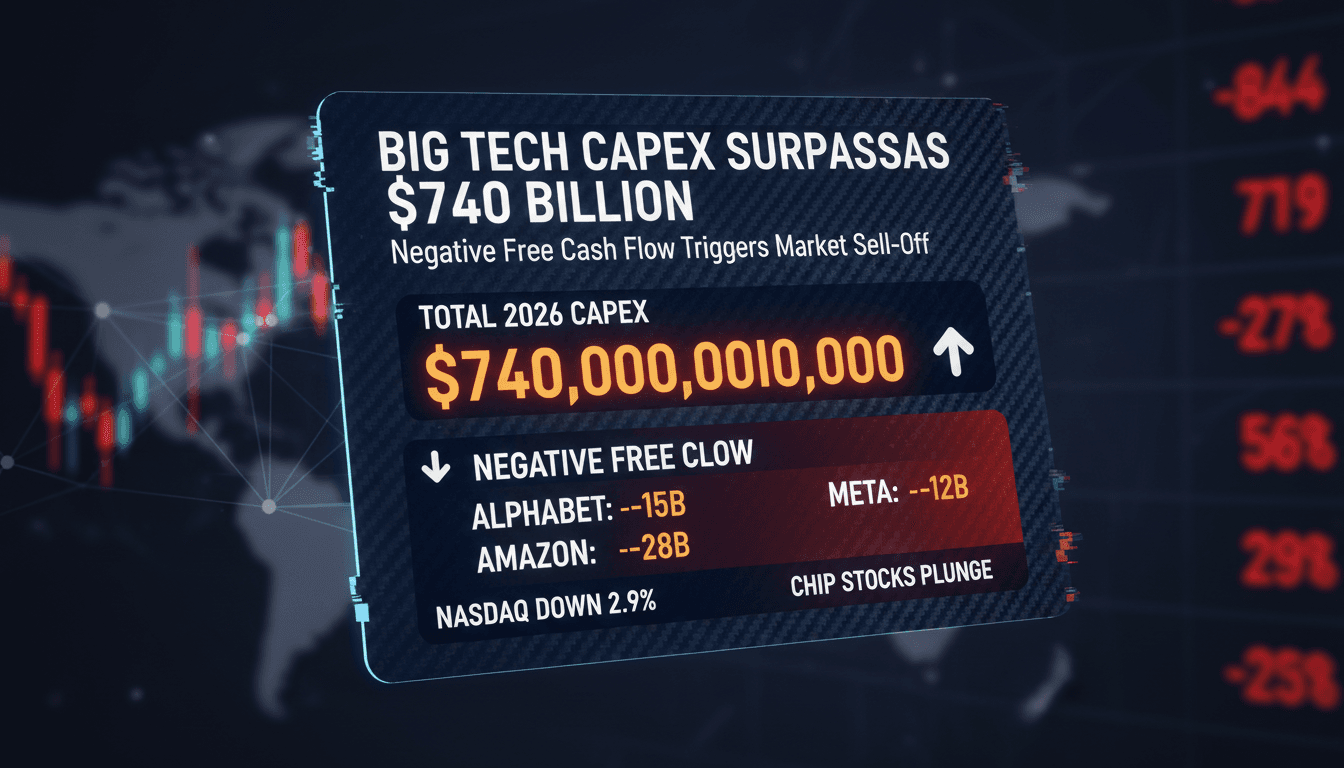
- Record capex plans hit balance sheets: Alphabet, Amazon, Meta, and Microsoft disclosed combined 2026 capital expenditures exceeding $740 billion targeted at data centers and custom silicon.
- Cash flow turned negative across the board: Alphabet recorded negative free cash flow of $9.1 billion in Q3, Amazon logged $42.4 billion in negative free cash flow across 12 months, and Meta reported a $2.1 billion quarterly deficit.
- Markets responded with a broad sell-off: The Nasdaq fell 2.9% on October 30, 2026, driven by chip supplier pullbacks including Qualcomm (-11%), Broadcom (-5%), and Nvidia (-4%), while Alphabet faced compounded equity losses following an earlier $500 billion valuation drop.
The context you actually need
- The early phase rewarded infrastructure spend: In previous operating cycles, equity analysts rewarded Big Tech for aggressive capex as a direct proxy for future market leadership in generative technology.
- Core revenue engines are decelerating: The heavy investment in data centers arrives just as primary corporate revenue drivers, including core digital advertising, register slowing growth rates across major operators.
- Debt markets carried the operational deficit: To fund infrastructure deployment without liquidating balance-sheet reserves, the four major hyperscalers raised a combined $326 billion in debt throughout 2026.
What's really happening
The underlying economic mechanics of the artificial intelligence buildout have crossed an inflection point. For three years, hyperscalers operated under an asymmetric incentive structure: the penalty for underinvesting in compute capacity was perceived as terminal obsolescence, while the cost of overbuilding was obscured by positive operational cash flows from digital advertising and cloud enterprise suites.
That buffer has now eroded. When Alphabet allocates $51.4 billion to capital expenditures in a single quarter—driving toward an annualized run rate of up to $205 billion—it directly outstrips the operational cash generation of its advertising engine. Amazon’s trailing 12-month negative free cash flow of $42.4 billion against $220 billion in capex guidance, combined with Meta’s projected $145 billion in annual capital spending, demonstrates that infrastructure acquisition has decoupled from revenue realization.
This capital allocation cycle differs fundamentally from prior platform transitions. In cloud transitions, server architecture depreciated over longer durations, and tenancy could be expanded incrementally with measurable customer additions. AI infrastructure mandates front-loaded acquisition of short-lifecycle silicon and energy-intensive data centers that incur sustained operational expenses from day one. When combined debt issuances across Alphabet, Amazon, Meta, and Microsoft hit $326 billion in 2026, fixed debt-servicing obligations entered balance sheets that were previously net-cash fortresses.
The dynamic introduces severe structural tension for suppliers. While semiconductor manufacturers benefited from direct capital expenditure capture, public equity markets are now discounting the sustainability of that procurement loop. Nvidia's 4% drop, Broadcom's 5% decline, and Qualcomm's 11% drawdown reflect the reality that hardware vendors cannot sustain gross margins if their primary counterparties face investor pressure to cap infrastructure outlays.
Microsoft presents the structural counter-indicator: while maintaining positive free cash flow, the company revised its capex guidance downward due to capacity constraints and delays. This reveals the bottleneck trap facing hyperscalers. If they cut spending, they fail to deliver deployment milestones; if they accelerate spending to hit timelines, their negative free cash flow compounds. With private market liquidity also showing signs of strain—highlighted by investor scrutiny surrounding Anthropic’s public offering plans—the entire AI supply chain is transitioning from speculative capacity building to capital discipline.
Who feels it first (and how)
- Big Tech finance and operations teams: Leadership at Alphabet, Amazon, and Meta must implement aggressive cost-control initiatives elsewhere in their organizations to stem negative free cash flow.
- Semiconductor and hardware suppliers: Hardware giants like Nvidia, Qualcomm, and Broadcom face immediate order re-evaluations and pricing friction as hyperscalers reassess their 2027 procurement targets.
- Enterprise software buyers: Corporate procurement leads negotiating cloud and AI tooling will encounter higher enterprise pricing as cloud providers attempt to monetize infrastructure investments and protect margins.
- Global tech-heavy investment funds: Asset managers across New York, London, and regional hubs like Dubai exposed to US technology equities will experience indirect portfolio volatility as market multiples adjust downward.
What to watch next
- Hyperscaler Q1 2027 capex revisions: Watch whether Alphabet and Amazon scale down their annualized targets below $205 billion and $220 billion; downward revisions will signal a formal reduction in hardware procurement cycles.
- Corporate debt issuance yields: Track the interest premiums demanded on the next tranche of Big Tech debt issuances after 2026’s $326 billion total; rising yields will force immediate capital rationing.
- The Anthropic public offering trajectory: The pricing and performance of Anthropic's IPO will serve as the primary barometer for private-to-public capital availability for pure-play model developers.
Alphabet, Amazon, Meta, and Microsoft have committed over $740 billion to 2026 capex, leading to quarterly negative free cash flow at three of the four companies and $326 billion in new corporate debt.
Big Tech leadership will slow the pace of peripheral infrastructure expansion in 2027 to stabilize free cash flow and satisfy institutional investors.
Whether enterprise monetization of AI software can accelerate rapidly enough to justify current infrastructure depreciation schedules before debt service demands capital reallocation.
Frequently Asked Questions
- Why it matters?
- The era of equity markets granting unconditional subsidies for artificial intelligence infrastructure has officially ended, exposing core business units to margin compression and debt burdens.
- What happened (in 30 seconds)?
- Record capex plans hit balance sheets: Alphabet, Amazon, Meta, and Microsoft disclosed combined 2026 capital expenditures exceeding $740 billion targeted at data centers and custom silicon. Cash flow turned negative across the board: Alphabet recorded negative free cash flow of $9.1 billion in Q3, Amazon logged $42.4 billion in negative free cash flow across 12 months, and Meta reported a $2.1 billion quarterly deficit. Markets responded with a broad sell-off: The Nasdaq fell 2.9% on October 30,
- What's really happening?
- The underlying economic mechanics of the artificial intelligence buildout have crossed an inflection point. For three years, hyperscalers operated under an asymmetric incentive structure: the penalty for underinvesting in compute capacity was perceived as terminal obsolescence, while the cost of overbuilding was obscured by positive operational cash flows from digital advertising and cloud enterprise suites. That buffer has now eroded. When Alphabet allocates $51.4 billion to capital expenditur
- Who feels it first (and how)?
- Big Tech finance and operations teams: Leadership at Alphabet, Amazon, and Meta must implement aggressive cost-control initiatives elsewhere in their organizations to stem negative free cash flow. Semiconductor and hardware suppliers: Hardware giants like Nvidia, Qualcomm, and Broadcom face immediate order re-evaluations and pricing friction as hyperscalers reassess their 2027 procurement targets. Enterprise software buyers: Corporate procurement leads negotiating cloud and AI tooling will encou
- What to watch next?
- Hyperscaler Q1 2027 capex revisions: Watch whether Alphabet and Amazon scale down their annualized targets below $205 billion and $220 billion; downward revisions will signal a formal reduction in hardware procurement cycles. Corporate debt issuance yields: Track the interest premiums demanded on the next tranche of Big Tech debt issuances after 2026’s $326 billion total; rising yields will force immediate capital rationing. The Anthropic public offering trajectory: The pricing and performance o
Startup news with frequent AI coverage.
"Covers launches, funding, and product updates in AI."
— A47 Editor
Cracks are emerging in the AI spending boom
Big Tech companies are pouring billions into AI infrastructure, but mounting debt, negative cash flow and growing investor skepticism are raising questions about whether the AI spending boom can be sustained, according to TechCrunch.
Curated tech headlines including AI stories.
"Influential aggregator surfacing the day’s top tech/AI links."
— A47 Editor
Microsoft, Alphabet, Amazon, Meta, and Oracle returned just 9.3% of cash to shareholders in the first three quarters of 2026, a 15-year low amid AI spending (Patturaja Murugaboopathy/Reuters)
Microsoft, Alphabet, Amazon, Meta, and Oracle returned just 9.3% of their cash to shareholders in the first three quarters of 2026, the lowest share in 15 years, even as the companies generated record cash flows, according to Reuters reporting by Pat...
Market-moving headlines impacting equities, bonds, and related risk assets.
"Real-time catalysts and volatility drivers across indices and sectors."
— A47 Editor
Big Tech returns smallest share of cash to shareholders in 15 years, given AI spending
Big Tech companies are returning the smallest share of cash to shareholders in 15 years as heavy spending on artificial intelligence absorbs their capital, according to Investing.com. The development comes amid a broader market selloff in which techn...
Technology business and AI-related headlines.
"Data-driven tech newsroom with global scope."
— A47 Editor
Big Tech’s $750 Billion AI Bet Collides With Slowing Core Growth
Big Tech's roughly $750 billion AI spending push this year is colliding with signs of slowing growth in the core advertising, consumer and retail businesses that have long funded these companies, with some of those core operations reportedly being ca...
Technology business news, market impacts, and innovation trends.
"Bloomberg is a premier financial and tech news provider, respected for its in-depth reporting and analytical rigor."
— A47 Editor
Big Tech’s $750 Billion AI Bet Collides With Slowing Core Growth
Big Tech's roughly $750 billion AI spending push this year is colliding with signs of slowing growth in the core advertising, consumer and retail businesses that have long funded these companies, with some of those core operations reportedly being ca...
Global markets, investing, and macroeconomics from a premier financial newsroom.
"Bloomberg is respected for in-depth financial reporting and data-driven analysis."
— A47 Editor
Big Tech’s Deepening AI Funding Concerns Sink Asian Chip Stocks
Shares of global chipmakers, particularly across Asia, fell as a critical earnings season for the artificial intelligence trade failed to reassure investors, according to Bloomberg. Concerns over soaring infrastructure costs and whether AI-driven dem...
Corporate leadership, finance, technology, and market trends.
"Fortune covers financial trends, leadership, and innovation with a pragmatic editorial approach."
— A47 Editor
Amazon shares sink as spending on AI overshadows growth in cloud unit
Amazon shares sank after the company's spending on artificial intelligence infrastructure overshadowed growth in its cloud unit, Amazon Web Services (AWS), Fortune reported. The base coverage places Amazon among the largest spenders on AI infrastruct...
Editor-curated FT homepage stories spanning markets, business, world, and opinion.
"The Financial Times is a globally respected business publication with a centrist/center-left tone and strong markets focus."
— A47 Editor
Alphabet shares tumble in $500bn rout
Alphabet, the parent company of Google, saw its shares tumble in a sell-off that wiped roughly $500bn from its market value, after the company admitted its 'AI mode' has hurt traditional search while sales and profits undershot expectations, accordin...