
Nasdaq 100 Sheds Over 9 Percent as Investors Scrutinize Hyperscaler AI Capital Expenditure
Why it matters
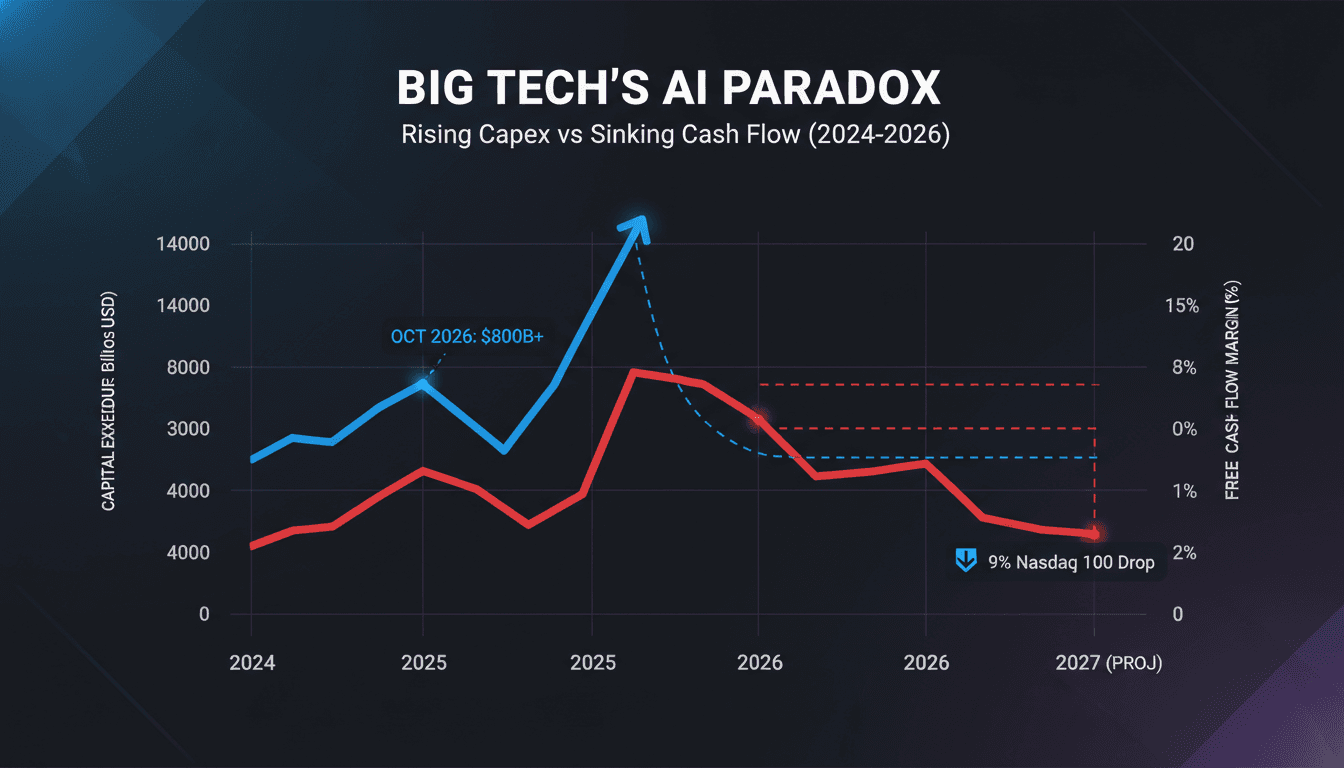
Hyperscalers are redirecting aggregate free cash flow into hardware and facilities at an annual rate exceeding $800 billion, forcing global capital allocators to reassess tech equity risk premiums.
What happened (in 30 seconds)
- The Nasdaq 100 slid over 9% between its peak on 6 October and the end of October 2026, erasing an estimated $2 trillion in market value as third-quarter earnings triggered widespread re-evaluations.
- Hyperscalers signaled severe cash burn, led by Alphabet's 12.6% single-day stock decline following a 26.1% year-over-year earnings-per-share drop, negative free cash flow, and revenue cannibalization from AI search overviews.
- Big Tech shed nearly $900 billion in capitalization within a 48-hour window on 30–31 October as Meta, Amazon, and Microsoft mirrored surging capital expenditures alongside muted cash yields.
The context you actually need
- Asset-light software economics have ended, replaced by heavy physical outlays on specialized chips, data center buildouts, and grid capacity that push cumulative 2026 tech capital expenditure toward $1 trillion.
- Executive warnings materialized quickly, after early signals in September 2026 regarding unmeasured deployment pacing preceded negative free cash flow prints across dominant platform operators.
- Broad market rotation has broadened beyond tech, with financial institutions like UBS noting institutional rotation into non-tech sectors as investors discount extended payback periods on infrastructure.
What's really happening
The late-2026 tech correction is not an indictment of AI demand; it is a structural repricing driven by capital allocation mechanics. For two decades, tier-one technology platforms traded at premium multiples because their operating leverage was near-infinite. Software updates, cloud distribution, and ad-tech networks carried high margins and negligible marginal costs per user.
The buildout of generative AI infrastructure fundamentally inverts this economic architecture. Operating as a competitive hyperscaler now requires continuous, debt- or cash-funded procurement of advanced hardware, high-density real estate, and utility access. Combined 2026 capital expenditures for Alphabet, Meta, and Amazon surpassed $800 billion, with projections extending toward $1.4 trillion in 2027. When enterprise spending shifts this heavily from software distribution to physical industrial assets, free cash flow conversion rates inevitably compress.
The immediate catalyst for the late-October valuation adjustment was the divergence between operational costs and revenue capture. Alphabet's third-quarter numbers exposed a structural tension: incorporating AI directly into core search products actively threatened the legacy ad-click revenue engine while multiplying the underlying computing cost per query. Delivering answers through multi-billion-parameter models increases operational overhead compared to standard index queries, diluting margins before alternative monetization pathways mature.
Simultaneously, investors face a duration mismatch. While semiconductor and cloud revenue metrics remain elevated, end-user productivity gains and monetizable software services are maturing on a multi-year lag. Hyperscalers are purchasing computing capacity today to defend market share against peer encroachment rather than to service immediately accretive customer contracts. As debt and equity markets adjust to cash-flow profiles weighted down by heavy capital outlays, discount rates apply immediate downward pressure to equity valuations. Hyperscalers are operating under an imperative where pausing capex implies ceding strategic ground, forcing them to spend through negative free cash flow despite public market resistance.
Who feels it first (and how)
- Equity Portfolio Managers and Institutional Allocators: Enduring benchmark drags as dominant tech holdings adjust to lower price-to-earnings multiples and reduced share buyback volumes.
- Gulf and International Sovereign Wealth Allocators: Dubai-based wealth offices and global family offices facing portfolio volatility in cross-border tech allocations, accelerating capital rotation into cyclical or income-generating physical assets.
- Enterprise Software Operators: Facing tighter corporate IT procurement timelines as hyperscaler balance sheets absorb higher infrastructure overhead, squeezing tier-two software vendors.
- Venture Capital and Growth-Stage AI Startups: Experiencing stricter funding environments as institutional sponsors apply higher hurdle rates to businesses lacking distinct data moats or positive unit economics.
What to watch next
- 2027 Hyperscaler Capex Guidance Revisions: Whether aggregate infrastructure spending projections remain anchored at the forecast $1.4 trillion mark or face downward corporate revisions.
- Free Cash Flow Stabilization Metrics: The timeline for Alphabet, Amazon, and Meta to return to positive free cash flow generation following elevated infrastructure spending cycles.
- AI Search Margin Compression: Evidence of stabilized unit economics within direct query monetization to offset infrastructure depreciation costs.
The Nasdaq 100 experienced an equity decline exceeding 9% in October 2026, driving a $2 trillion valuation drop driven by rising capital expenditure commitments.
Tech equity multiples will remain compressed relative to their 2023–2025 peaks until enterprise software monetization offsets high infrastructure depreciation.
Whether market resistance will pressure hyperscaler leadership teams to decelerate hardware acquisition pacing or continue prioritizing capacity over near-term balance sheet stability.
Frequently Asked Questions
- Why it matters?
- Hyperscalers are redirecting aggregate free cash flow into hardware and facilities at an annual rate exceeding $800 billion, forcing global capital allocators to reassess tech equity risk premiums.
- What happened (in 30 seconds)?
- The Nasdaq 100 slid over 9% between its peak on 6 October and the end of October 2026, erasing an estimated $2 trillion in market value as third-quarter earnings triggered widespread re-evaluations. Hyperscalers signaled severe cash burn, led by Alphabet's 12.6% single-day stock decline following a 26.1% year-over-year earnings-per-share drop, negative free cash flow, and revenue cannibalization from AI search overviews. Big Tech shed nearly $900 billion in capitalization within a 48-hour window
- What's really happening?
- The late-2026 tech correction is not an indictment of AI demand; it is a structural repricing driven by capital allocation mechanics. For two decades, tier-one technology platforms traded at premium multiples because their operating leverage was near-infinite. Software updates, cloud distribution, and ad-tech networks carried high margins and negligible marginal costs per user. The buildout of generative AI infrastructure fundamentally inverts this economic architecture. Operating as a competi
- Who feels it first (and how)?
- Equity Portfolio Managers and Institutional Allocators: Enduring benchmark drags as dominant tech holdings adjust to lower price-to-earnings multiples and reduced share buyback volumes. Gulf and International Sovereign Wealth Allocators: Dubai-based wealth offices and global family offices facing portfolio volatility in cross-border tech allocations, accelerating capital rotation into cyclical or income-generating physical assets. Enterprise Software Operators: Facing tighter corporate IT procur
- What to watch next?
- 2027 Hyperscaler Capex Guidance Revisions: Whether aggregate infrastructure spending projections remain anchored at the forecast $1.4 trillion mark or face downward corporate revisions. Free Cash Flow Stabilization Metrics: The timeline for Alphabet, Amazon, and Meta to return to positive free cash flow generation following elevated infrastructure spending cycles. AI Search Margin Compression: Evidence of stabilized unit economics within direct query monetization to offset infrastructure depreci
Practical investing ideas, macro commentary, and market strategy.
"MoneyWeek is a UK-based investment magazine focused on actionable insights."
— A47 Editor
Tech selloff: are AI spending concerns justified?
Investors are growing increasingly anxious about AI spending by the hyperscalers, as disappointing earnings reports have wiped trillions of dollars off market values, according to MoneyWeek's coverage of the tech selloff and the question of whether t...
RT is a Russian state-funded network covering global events from a Russian perspective.
"RT is widely criticized for promoting pro-Kremlin narratives and is considered by many to be a state propaganda outlet."
— A47 Editor
AI reality check triggers $2 trillion tech stock rout
US tech stocks have lost roughly $2 trillion in value as investors question whether heavy spending on artificial intelligence development will pay off, according to RT (Russia Today), which reports the sell-off as an "AI reality check."
Corporate leadership, finance, technology, and market trends.
"Fortune covers financial trends, leadership, and innovation with a pragmatic editorial approach."
— A47 Editor
Fears over $828 billion AI capex spending spree help erase $1 trillion in market value
Fears over $828 billion in planned AI capital spending by five major tech companies this year helped erase roughly $1 trillion in market value, as the AI race increasingly consumes cash flow and rattles Wall Street investors.