
Circular AI Vendor Financing Magnifies Tech Equity Volatility as Chipmakers Back Meta Stock Sale
Why it matters
Circular vendor financing among dominant semiconductor and hyperscale firms concentrates systemic risk, ensuring that any slowdown in end-user artificial intelligence monetization cascades across the entire hardware supply chain simultaneously.
What happened (in 30 seconds)
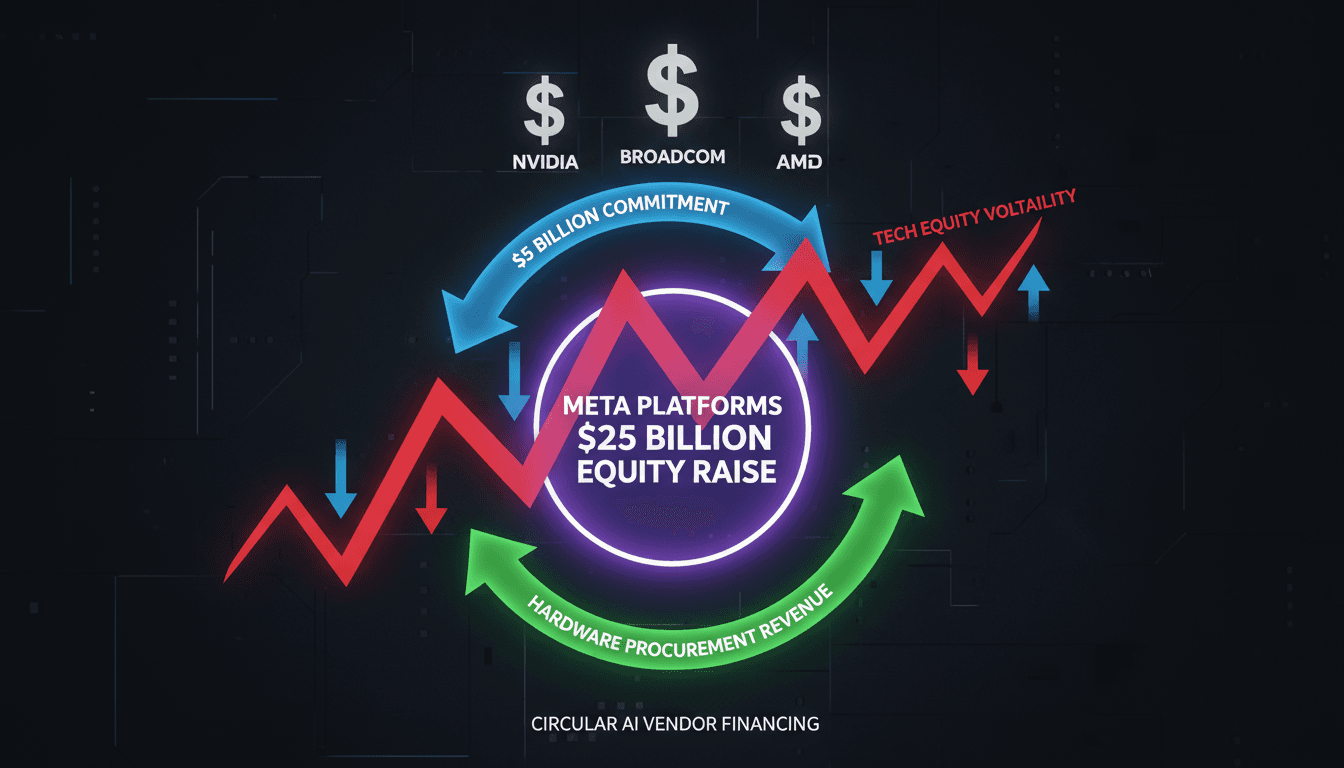
- A $5 billion cornerstone commitment: Nvidia, Broadcom, and AMD collectively contributed $5 billion as cornerstone backers to anchor Meta Platforms' $25 billion stock offering.
- The immediate market reversal: The equity transaction was promptly followed by rising market doubts regarding the scale of infrastructure capital expenditures, erasing weekly stock gains across participating chipmakers.
- The vendor financing warning: Financial analysis published on November 1, 2026, by *The Wall Street Journal* identified the transaction as a modern manifestation of circular vendor financing that amplifies volatility on both the upside and the downside.
The context you actually need
- The post-2022 capex surge: Following the public debut of ChatGPT in 2022, hyperscalers—specifically Meta, Microsoft, Alphabet, and Amazon—dramatically expanded capital outlays on computing processors, physical data centers, and grid capacity.
- Diverging cash flow metrics: Ahead of the current cycle, corporate disclosures showed free cash flow steadily diverging from nominal earnings growth at major tech firms, exposing an expanding spread between capital deployment and realized software revenue.
- Macroeconomic sensitivity: Persistent inflation pressures and elevated benchmark interest rates have reduced market tolerance for prolonged payback periods, subjecting concentrated tech holdings to sharper valuation contractions when growth forecasts soften.
What's really happening
The mechanics behind Meta’s $25 billion equity offering illustrate how artificial intelligence infrastructure spending has transitioned from open-market procurement into an interconnected balance-sheet feedback loop. When Nvidia, Broadcom, and AMD allocate an aggregate $5 billion to buy shares in Meta Platforms, they are not acting solely as passive asset managers seeking equity appreciation. They are actively providing liquidity to one of their primary enterprise customers.
In classic corporate finance, vendor financing occurs when a manufacturer extends credit or capital directly to a customer so the customer can acquire the manufacturer’s inventory. The modern iteration across the semiconductor ecosystem operates through public equity lines. By committing $5 billion as cornerstone participants in Meta’s $25 billion raise, the participating chipmakers help ensure the capital issuance clears smoothly. This preserves Meta's cash reserves, which can then be deployed back into the procurement of processing units, networking hardware, and custom silicon designs supplied by those exact chipmakers.
This dynamic creates a closed financial circuit. For the semiconductor firms, the incentive is obvious: top-line revenue growth, order book stability, and multi-quarter booking visibility justify premium equity valuations. For hyperscalers like Meta, securing institutional support from essential suppliers provides capital stability at a time when enterprise free cash flows are under pressure from continuous computing outlays.
The core vulnerability of this arrangement is operating leverage. In an expansionary cycle, the loop acts as a force multiplier: supplier capital funds customer procurement, customer orders generate record supplier revenues, and expanding supplier valuations unlock additional capital to reinvest in customer balance sheets. However, this structure reverses instantly when revenue assumptions falter.
Because the enterprise revenues recorded by chipmakers are partially underwritten by capital they themselves injected into their buyers, any fundamental drop in consumer or enterprise artificial intelligence spending hits both ends of the transaction. If Meta’s software monetization fails to yield cash flows commensurate with its capital expenditures, its equity value declines. That contraction directly erodes the $5 billion investment held by the chipmakers, while simultaneously forcing Meta to trim future chip orders. The consequence is not isolated commercial disappointment, but compounded equity and credit volatility across the technology sector.
Who feels it first (and how)
- Institutional asset allocators: Equity portfolio managers with benchmark-heavy weightings in mega-cap technology firms face direct portfolio drag as cross-holdings amplify market downturns.
- Semiconductor treasury desks: Hardware manufacturers holding corporate equity positions in their own customer base absorb balance-sheet volatility if client stock prices drop.
- Hyperscale procurement executives: Infrastructure planners face compressed capital spending limits if public markets refuse to absorb secondary equity offerings without direct vendor subsidization.
- Tech-concentrated retail investors: Individual traders exposed to broad tech index funds absorb outsized downside shocks due to the heavy index weighting of the participating firms.
What to watch next
- Hyperscaler free cash flow divergence: Monitor upcoming quarterly earnings filings from Meta, Alphabet, and Microsoft for any widening gap between operating cash flow and infrastructure capex, which signals whether internal revenues can replace external financing.
- Disclosures of subsequent equity rounds: Watch future public debt and equity filings across the hardware supply chain to see if chipmakers continue acting as cornerstone anchors for customer balance sheets.
- Realized enterprise software monetization: Track commercial enterprise software adoption rates, as persistent failure to convert computing capacity into subscription revenue will force immediate reductions in hardware orders.
Nvidia, Broadcom, and AMD committed $5 billion to Meta’s $25 billion equity transaction, immediately preceding a sector-wide tech selloff that eliminated weekly gains for the participating semiconductor suppliers.
Corporate cross-investments between technology suppliers and enterprise customers will face heightened scrutiny from credit rating agencies and institutional risk desks seeking to unpack interconnected balance-sheet risks.
It remains undetermined whether major hyperscalers will scale back their capital expenditure guidance if equity offerings fail to attract diversified, independent third-party institutional capital.
Frequently Asked Questions
- Why it matters?
- Circular vendor financing among dominant semiconductor and hyperscale firms concentrates systemic risk, ensuring that any slowdown in end-user artificial intelligence monetization cascades across the entire hardware supply chain simultaneously.
- What happened (in 30 seconds)?
- A $5 billion cornerstone commitment: Nvidia, Broadcom, and AMD collectively contributed $5 billion as cornerstone backers to anchor Meta Platforms' $25 billion stock offering. The immediate market reversal: The equity transaction was promptly followed by rising market doubts regarding the scale of infrastructure capital expenditures, erasing weekly stock gains across participating chipmakers. The vendor financing warning: Financial analysis published on November 1, 2026, by *The Wall Street Jour
- What's really happening?
- The mechanics behind Meta’s $25 billion equity offering illustrate how artificial intelligence infrastructure spending has transitioned from open-market procurement into an interconnected balance-sheet feedback loop. When Nvidia, Broadcom, and AMD allocate an aggregate $5 billion to buy shares in Meta Platforms, they are not acting solely as passive asset managers seeking equity appreciation. They are actively providing liquidity to one of their primary enterprise customers. In classic corporat
- Who feels it first (and how)?
- Institutional asset allocators: Equity portfolio managers with benchmark-heavy weightings in mega-cap technology firms face direct portfolio drag as cross-holdings amplify market downturns. Semiconductor treasury desks: Hardware manufacturers holding corporate equity positions in their own customer base absorb balance-sheet volatility if client stock prices drop. Hyperscale procurement executives: Infrastructure planners face compressed capital spending limits if public markets refuse to absorb
- What to watch next?
- Hyperscaler free cash flow divergence: Monitor upcoming quarterly earnings filings from Meta, Alphabet, and Microsoft for any widening gap between operating cash flow and infrastructure capex, which signals whether internal revenues can replace external financing. Disclosures of subsequent equity rounds: Watch future public debt and equity filings across the hardware supply chain to see if chipmakers continue acting as cornerstone anchors for customer balance sheets. Realized enterprise software
Markets desk coverage, trading insights, and investor updates.
"WSJ’s markets reporting provides in-depth analysis and context for investors."
— A47 Editor
The Tangled Web of AI Bets Is Reason to Fear Tech Stocks
The Wall Street Journal reports that vendor financing has returned in a new form within the AI trade, with the arrangements magnifying gains on the way up and losses on the way down, raising concerns about the sector's fragility as tech stocks come u...
Tech business coverage, major deals, product launches, and Silicon Valley trends.
"WSJ’s tech section offers authoritative reporting on the intersection of technology and business, including exclusive industry analysis."
— A47 Editor
The Tangled Web of AI Bets Is Reason to Fear Tech Stocks
The Wall Street Journal's technology desk reports that vendor financing has returned in a new form within the artificial intelligence trade, a structure that amplifies gains when AI-linked stocks rise and losses when they fall, raising concerns about...
Curated tech headlines including AI stories.
"Influential aggregator surfacing the day’s top tech/AI links."
— A47 Editor
Sources: neoclouds CoreWeave, Nebius, and Nscale have effectively been shut out of the bond market in recent weeks as lenders and investors demand tougher terms (Wall Street Journal)
Sources cited by the Wall Street Journal report that neocloud providers CoreWeave, Nebius, and Nscale have effectively been shut out of the bond market in recent weeks as lenders and investors demand tougher terms before extending credit.
Tech business coverage, major deals, product launches, and Silicon Valley trends.
"WSJ’s tech section offers authoritative reporting on the intersection of technology and business, including exclusive industry analysis."
— A47 Editor
Wall Street Is Starting to Call the Shots in America’s AI Build-Out
Wall Street lenders and investors are becoming more selective and demanding stricter terms as the AI build-out enters a new phase, according to WSJ Tech's report on the shift in how capital is being deployed to fund AI infrastructure.