
Waymo Commits to Factory-Integrated Toyota bZ4X Robotaxi Platform for Japan and UK Deployment
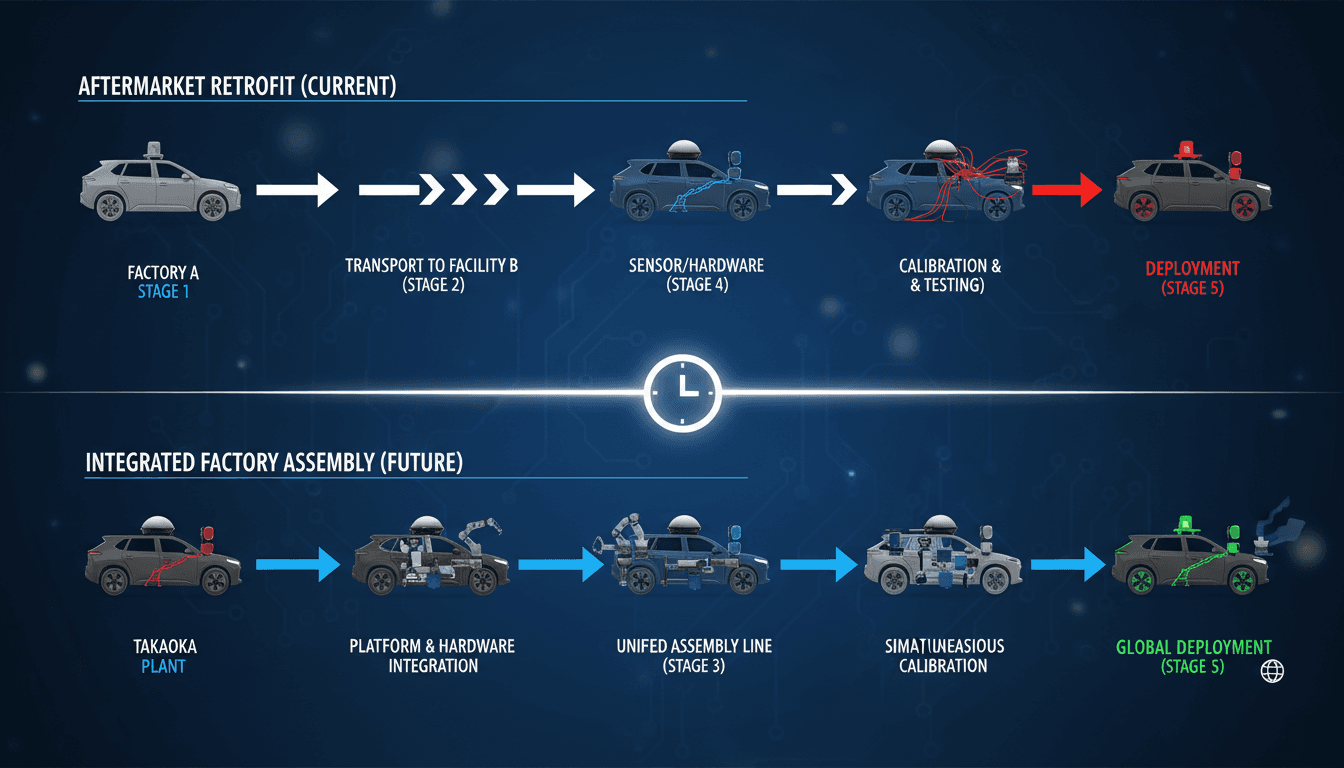
Factory integration shifts autonomous deployment from niche software customization to mainstream automotive assembly line economics.
Why it matters
Moving autonomous driving hardware directly onto automotive assembly lines reduces unit production friction and establishes the operational blueprint for international market expansion.
What happened (in 30 seconds)
- Factory integration confirmed: On October 30, 2026, Waymo and Toyota announced that the all-electric bZ4X SUV will be built at Toyota’s Takaoka plant in Japan with the Waymo Driver hardware installed directly on the assembly line.
- Geographic expansion targeted: The custom-built vehicles will commence testing and validation in Japan in 2027 to prepare for driverless commercial deployment in Tokyo, followed by planned entry into the United Kingdom and additional right-hand-drive markets.
- Rider-specific platform adaptations: The purpose-built bZ4X will feature passenger amenities including increased rear legroom, automatic doors, power liftgate, and ambient lighting, alongside data-sharing exploration with Woven by Toyota.
The context you actually need
- Evolving hardware strategies: Waymo historically relied on retrofitting production vehicles post-assembly—including the Jaguar I-Pace and Zeekr-based Ojai, with a Hyundai Ioniq 5 platform variant forthcoming—which added cost and labor steps before deployment.
- A multi-year progression: The initiative realizes the initial strategic partnership between Alphabet’s autonomous division and Toyota Motor Corporation first disclosed in April 2025.
- Targeting right-hand-drive jurisdictions: Developing a factory-integrated right-hand-drive architecture solves vehicle platform constraints in markets like Japan and the UK, unlocking major international urban territories for commercial deployment.
What's really happening
The transition of autonomous vehicle production from secondary retrofitting facilities directly to original equipment manufacturer (OEM) assembly lines marks a structural shift in autonomous mobility unit economics. Historically, autonomous platform operators have acquired completed production-line vehicles, stripped interior components, and manually spliced compute systems, lidar arrays, and auxiliary power units into the existing chassis. This retrofitting process introduces production bottlenecks, warranty liabilities, and elevated per-unit capital expenditures.
By routing the Waymo Driver directly through Toyota’s Takaoka manufacturing facility in Aichi Prefecture, the vehicle architecture integrates high-voltage compute routing, sensor brackets, and secondary control layers during standard stamping, body assembly, and paint processes. Installing sensors and computers during assembly minimizes manual labor, enhances build tolerances, and simplifies quality assurance.
For Waymo, platform diversification serves as an institutional hedge. Maintaining vehicle programs across multiple OEMs—including existing vehicle streams alongside the upcoming Hyundai Ioniq 5 and now the Toyota bZ4X—prevents single-supplier vulnerability and optimizes platform selection for varying urban topographies and road rules. The bZ4X integration specifically provides Waymo with a native right-hand-drive platform configured from the factory floor for markets where existing left-hand-drive vehicles face commercial or regulatory friction.
For Toyota, the partnership accelerates commercialization timelines for automated mobility without requiring the automaker to exclusively carry the multi-billion-dollar annual software validation burden. Toyota’s zero-accident strategic framework benefits from integrating mature autonomous stacks into its production electric vehicles, while data-sharing initiatives with software unit Woven by Toyota establish a testing pipeline to evaluate automated systems for potential future deployment in personally owned consumer passenger vehicles.
The capital allocation dynamics also reflect changing realities across urban fleet operations. Scaling commercial robotaxi operations requires fleet longevity, high interior durability, and passenger conveniences designed specifically for shared urban mobility—demonstrated by the custom bZ4X platform’s automated doors and enhanced rear compartment spacing. As hardware installation becomes an automated step on factory lines, autonomous mobility transitions from experimental engineering proofs to scalable industrial logistics.
Who feels it first (and how)
- Automotive manufacturing engineers: Assembly specialists at Tier-1 manufacturing plants will need to adapt assembly protocols to incorporate sensitive sensor arrays and compute harnesses alongside standard EV powertrains.
- Urban mobility operators in Tokyo and London: Fleet managers and ride-hailing platforms will monitor the integration timeline to assess fleet supply pressures in dense right-hand-drive transit hubs.
- Autonomous vehicle hardware suppliers: Component providers of lidar, radar, and edge computing will need to certify their hardware to meet OEM factory-line installation standards rather than secondary retrofit specifications.
What to watch next
- Validation milestones in 2027: The operational success and incident metrics of the initial validation fleet deployed on Japanese roads will indicate the commercial readiness of the factory-integrated hardware.
- Regulatory certifications in target territories: Commercial operation in Tokyo and subsequent expansion into the UK hinge on local transport agency type-approvals for driverless platforms without steering-wheel interaction.
- Consumer vehicle integration signals: Progress markers from Woven by Toyota regarding data-sharing and architecture transferability will show whether this commercial fleet technology migrates to personally owned retail vehicles.
The Toyota bZ4X will be assembled at the Takaoka plant with integrated Waymo autonomous hardware, targeting initial operational validation in Japan starting in 2027.
Lowering manufacturing overhead through assembly-line integration will accelerate deployment cycles across target right-hand-drive markets compared to prior retrofitted programs.
The exact commercial launch dates in Tokyo and the United Kingdom, alongside the final regulatory approval timelines required for passenger revenue service without safety drivers.
Frequently Asked Questions
- Why it matters?
- Moving autonomous driving hardware directly onto automotive assembly lines reduces unit production friction and establishes the operational blueprint for international market expansion.
- What happened (in 30 seconds)?
- Factory integration confirmed: On October 30, 2026, Waymo and Toyota announced that the all-electric bZ4X SUV will be built at Toyota’s Takaoka plant in Japan with the Waymo Driver hardware installed directly on the assembly line. Geographic expansion targeted: The custom-built vehicles will commence testing and validation in Japan in 2027 to prepare for driverless commercial deployment in Tokyo, followed by planned entry into the United Kingdom and additional right-hand-drive markets. Rider-spe
- What's really happening?
- The transition of autonomous vehicle production from secondary retrofitting facilities directly to original equipment manufacturer (OEM) assembly lines marks a structural shift in autonomous mobility unit economics. Historically, autonomous platform operators have acquired completed production-line vehicles, stripped interior components, and manually spliced compute systems, lidar arrays, and auxiliary power units into the existing chassis. This retrofitting process introduces production bottlen
- Who feels it first (and how)?
- Automotive manufacturing engineers: Assembly specialists at Tier-1 manufacturing plants will need to adapt assembly protocols to incorporate sensitive sensor arrays and compute harnesses alongside standard EV powertrains. Urban mobility operators in Tokyo and London: Fleet managers and ride-hailing platforms will monitor the integration timeline to assess fleet supply pressures in dense right-hand-drive transit hubs. Autonomous vehicle hardware suppliers: Component providers of lidar, radar, and
- What to watch next?
- Validation milestones in 2027: The operational success and incident metrics of the initial validation fleet deployed on Japanese roads will indicate the commercial readiness of the factory-integrated hardware. Regulatory certifications in target territories: Commercial operation in Tokyo and subsequent expansion into the UK hinge on local transport agency type-approvals for driverless platforms without steering-wheel interaction. Consumer vehicle integration signals: Progress markers from Woven
Consumer tech and culture with frequent AI coverage.
"Influential tech outlet covering AI products and policy."
— A47 Editor
Waymo’s next robotaxi is a purpose-built Toyota bZ4X
Waymo announced that it will use purpose-built Toyota bZ4X electric vehicles, assembled entirely at Toyota's Takaoka plant in Japan, for a planned robotaxi service in Tokyo, building on a strategic partnership first announced in April 2025.
Tech news, reviews, and analysis of consumer electronics, science, art, and culture.
"The Verge is a technology-focused media outlet known for in-depth reporting, product reviews, and coverage of the intersection between technology and culture."
— A47 Editor
Waymo’s next robotaxi is a purpose-built Toyota bZ4X
Waymo announced that it will use purpose-built Toyota bZ4X electric vehicles, assembled entirely at Toyota's Takaoka plant in Japan, for a planned robotaxi service in Tokyo, building on a strategic partnership first announced in April 2025.
Consumer technology news with AI coverage.
"Gadget and tech site reporting on AI in products."
— A47 Editor
Waymo and Toyota will soon start testing their robotaxis in Japan
Waymo and Toyota will begin testing autonomous bZ4X vehicles in Japan next year, marking a new international step for the robotaxi venture, according to Engadget's report on the base story.
Covers consumer technology, electronics, gadgets, and product reviews.
"Engadget is a trusted source for gadget reviews and consumer tech news, known for its hands-on analysis and industry coverage."
— A47 Editor
Waymo and Toyota will soon start testing their robotaxis in Japan
Waymo and Toyota will begin testing autonomous bZ4X vehicles in Japan next year, marking a new international step for the robotaxi venture, according to Engadget's report on the base story.
Startup news with frequent AI coverage.
"Covers launches, funding, and product updates in AI."
— A47 Editor
Waymo taps Toyota to supply robotaxis for Japan and the UK
Waymo will begin testing self-driving versions of Toyota's electric bZ4X vehicles in Japan next year, as part of a broader partnership with the automaker that also extends to robotaxi supply for the United Kingdom.