
Google Dismantles x.cpe Botnet Embedded in 1.3 Million Certified Android TV Devices and Bans Videostrong Technology
Why it matters
The compromise of certified consumer hardware demonstrates that perimeter software screenings fail when original equipment manufacturers design downstream evasion directly into base firmware for secondary monetization.
What happened (in 30 seconds)
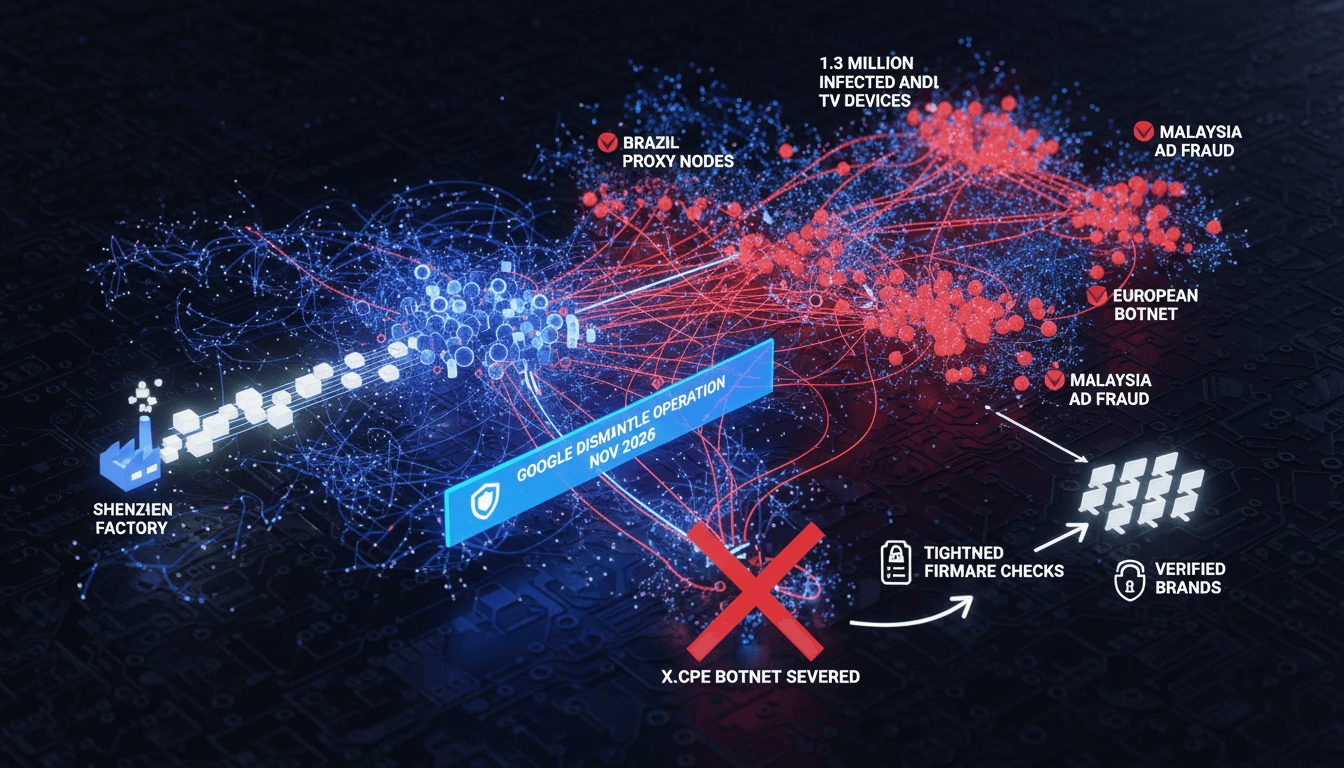
- Coordinated global takedown: On November 2–3, 2026, the Google Threat Intelligence Group joined Japan’s National Police Agency, Synthient, and Trend Micro to dismantle the command-and-control infrastructure of the x.cpe botnet.
- Hardware-level compromise: Shenzhen-based manufacturer Videostrong Technology intentionally embedded a firmware backdoor across certified Android TV boxes—including MECOOL and white-label units—compromising an estimated 1.3 million to 1,472,554 devices globally.
- Immediate platform ban: Google severed all ecosystem ties with Videostrong and its subsidiaries, revoking their certified Android partner status and updating ecosystem compliance checks.
The context you actually need
- Post-setup evasion mechanics: Videostrong bypassed standard Android compliance audits by utilizing an obfuscated stub application (`com.oemservice`) that remained dormant during laboratory vetting, pulling modular malware payloads only after consumer deployment.
- Ad fraud and residential proxies: The primary economic driver was affiliate revenue; the rogue firmware converted home bandwidth into residential proxy exit nodes and automated ad-click engines while systematically disabling Google Play Protect.
- A distributed global footprint: The infection clustered heavily across emerging broadband markets—predominantly Brazil, Malaysia, Iraq, Mexico, and Taiwan—alongside tens of thousands of endpoints operating inside enterprise and residential networks in the United States, Germany, the United Kingdom, Australia, and Canada.
What's really happening
The dismantling of the x.cpe botnet highlights a structural failure in hardware certification economics: the divergence between initial testing compliance and post-sale operational incentives.
Original Equipment Manufacturers (OEMs) and Original Design Manufacturers (ODMs) operating in the white-label electronics segment face declining operating margins on hardware sales. Videostrong structured a secondary monetization stream by embedding remote-execution capabilities into consumer hardware long before distribution. By utilizing `com.oemservice`, the manufacturer ensured that devices submitted for certification appeared compliant during pre-market testing. The malicious behavior activated only after the end-user completed initial setup, connecting to command-and-control servers to install secondary modules.
This modular architecture allowed operators to sell residential proxy bandwidth and run automated ad fraud. Because residential IP addresses bypass enterprise geoblocking and fraud-detection scoring, access to 1.4 million connected living-room endpoints carries sustained market value for bad actors. By turning domestic television streaming devices into routing nodes, the network allowed third-party traffic to blend seamlessly into household digital footprints.
The defensive challenge lies in post-takedown remediation. While Google and its partners disrupted central command-and-control domains and upstream proxy infrastructure, the physical hardware in circulation retains the underlying modified firmware. In many cases, these units remain operational on home networks with Google Play Protect disabled by the base image. Severing domain access neutralizes active command routing, but it does not re-enable native operating system protections or patch the base firmware vulnerabilities baked in at the factory level.
Consequently, the operational burden shifts to continuous ecosystem telemetry. Software platform licensors can no longer treat hardware certification as an administrative gate that concludes at retail delivery. If a manufacturer controls signing keys and low-level system partitions, compliance verification must function as an ongoing monitoring pipeline rather than a static pre-launch checkpoint.
Who feels it first (and how)
- Procurement and network security teams: IT managers managing remote workers face unmanaged, backdoored IoT nodes sitting on the same local subnets as enterprise-managed laptops.
- Budget streaming hardware brands: White-label distributors relying on Shenzhen ODM supply chains face higher friction, platform compliance scrutiny, and consumer skepticism.
- Ad networks and cybersecurity providers: Fraud analytics firms see clean residential proxy traffic contract as 1.4 million synthetic ad-view generators go dark.
- Non-technical consumer owners: End users across regions like Brazil, Malaysia, and Mexico are left with permanently modified firmware that cannot restore Google Play Protect without manual re-flashing.
What to watch next
- Firmware verification mandates: Watch for updated platform license agreements requiring hardware OEMs to submit cryptographically verifiable, immutable build logs for ongoing over-the-air updates.
- Consumer supply-chain consolidation: Observe whether retail channels alter stocking practices for low-cost media streamers, driving market share toward fully integrated, direct-to-consumer hardware platforms.
- Proxy market repricing: Monitor the dark-market price indices for residential proxy bandwidth as the loss of nearly 1.5 million endpoints constrains supply across commercial proxy-reselling services.
Videostrong deliberately engineered a multi-stage backdoor into over 1.3 million devices to operate proxy routing and ad fraud networks, prompting a full Google ecosystem ban.
Consumer trust will drift further away from unbranded white-label hardware toward tier-one technology ecosystems with closed, tightly audited supply chains.
Whether millions of physically backdoored boxes still connected to home and enterprise networks can be sanitized without full hardware replacement.
Frequently Asked Questions
- Why it matters?
- The compromise of certified consumer hardware demonstrates that perimeter software screenings fail when original equipment manufacturers design downstream evasion directly into base firmware for secondary monetization.
- What happened (in 30 seconds)?
- Coordinated global takedown: On November 2–3, 2026, the Google Threat Intelligence Group joined Japan’s National Police Agency, Synthient, and Trend Micro to dismantle the command-and-control infrastructure of the x.cpe botnet. Hardware-level compromise: Shenzhen-based manufacturer Videostrong Technology intentionally embedded a firmware backdoor across certified Android TV boxes—including MECOOL and white-label units—compromising an estimated 1.3 million to 1,472,554 devices globally. Immediate
- What's really happening?
- The dismantling of the x.cpe botnet highlights a structural failure in hardware certification economics: the divergence between initial testing compliance and post-sale operational incentives. Original Equipment Manufacturers (OEMs) and Original Design Manufacturers (ODMs) operating in the white-label electronics segment face declining operating margins on hardware sales. Videostrong structured a secondary monetization stream by embedding remote-execution capabilities into consumer hardware lo
- Who feels it first (and how)?
- Procurement and network security teams: IT managers managing remote workers face unmanaged, backdoored IoT nodes sitting on the same local subnets as enterprise-managed laptops. Budget streaming hardware brands: White-label distributors relying on Shenzhen ODM supply chains face higher friction, platform compliance scrutiny, and consumer skepticism. Ad networks and cybersecurity providers: Fraud analytics firms see clean residential proxy traffic contract as 1.4 million synthetic ad-view generat
- What to watch next?
- Firmware verification mandates: Watch for updated platform license agreements requiring hardware OEMs to submit cryptographically verifiable, immutable build logs for ongoing over-the-air updates. Consumer supply-chain consolidation: Observe whether retail channels alter stocking practices for low-cost media streamers, driving market share toward fully integrated, direct-to-consumer hardware platforms. Proxy market repricing: Monitor the dark-market price indices for residential proxy bandwidth
In-depth reporting on tech, policy, and science including AI.
"Respected analysis for technically savvy readers, including AI topics."
— A47 Editor
Google dismantles botnet secretly running on 1.3 million Android TV boxes
Google has dismantled a botnet secretly running on about 1.3 million Android TV boxes, after reporting that Shenzhen-based Android manufacturing partner Videostrong Technology Co. built a backdoor into the devices, turning them into a botnet. Google ...
In-depth coverage of hardware, software, science, and policy.
"Ars Technica provides expert technology news, hardware reviews, and analysis for a technically savvy audience."
— A47 Editor
Google dismantles botnet secretly running on 1.3 million Android TV boxes
Google has dismantled a botnet secretly running on about 1.3 million Android TV boxes, after reporting that Shenzhen-based Android manufacturing partner Videostrong Technology Co. built a backdoor into the devices, turning them into a botnet. Google ...
Curated tech headlines including AI stories.
"Influential aggregator surfacing the day’s top tech/AI links."
— A47 Editor
Google severs ties with and bans Android TV box maker Videostrong after discovering it intentionally preloaded a malware backdoor to control the XCPE botnet (Ben Schoon/9to5Google)
Google has cut ties with and banned Android TV box maker Videostrong after discovering it intentionally preloaded a malware backdoor onto certified devices to control the XCPE botnet. The base report, published by 9to5Google and surfaced via Techmeme...
Consumer tech news, reviews, and buying guides for gadgets and electronics.
"TechRadar is known for comprehensive buying advice, hardware reviews, and consumer tech news targeted at mainstream audiences."
— A47 Editor
Google leads takedown of massive XCPE malware botnet made of more than 1.3 million Android TV streaming boxes — and claims the items were intentionally set up for criminal access
Google has led an operation to take down the XCPE botnet, which comprised more than 1.3 million Android TV streaming boxes. Google claims the devices were intentionally set up for criminal access, with a Chinese company allegedly infecting them with ...
Consumer tech and culture with frequent AI coverage.
"Influential tech outlet covering AI products and policy."
— A47 Editor
One of Google’s Android partners turned 1.3 million set-top boxes into a botnet
Google says one of its Android manufacturing partners, Shenzhen-based Videostrong Technology Co. in China, secretly built a backdoor into about 1.3 million set-top boxes, turning them into a botnet. Google says it has dismantled the backdoor and cut ...
Tech news, reviews, and analysis of consumer electronics, science, art, and culture.
"The Verge is a technology-focused media outlet known for in-depth reporting, product reviews, and coverage of the intersection between technology and culture."
— A47 Editor
One of Google’s Android partners turned 1.3 million set-top boxes into a botnet
Google says one of its Android manufacturing partners, Shenzhen-based Videostrong Technology Co. in China, secretly built a backdoor into about 1.3 million set-top boxes, turning them into a botnet. Google says it has dismantled the backdoor and cut ...