
Apple Accelerates Agentic Siri Roadmap to Close Gap With OpenAI and Meta
Why it matters
The enterprise battle for software dominance is shifting from standalone chatbot interfaces to native OS-level agents that control digital workflows across every app you touch.
What happened (in 30 seconds)
- Cupertino accelerated development: CEO John Ternus and software executive Craig Federighi are fast-tracking an agentic evolution of Siri to preserve iOS ecosystem relevance against competing proactive platforms.
- Phased deployment underway: iOS 27.3 beta builds introduced first-party App Intents controls for Safari and Photos, setting the stage for third-party integrations such as food orders and reservations by spring 2027.
- Autonomous targets set: Internal roadmaps now aim for full agentic operations as early as 2027, transforming Siri from a responsive assistant into an autonomous engine capable of sustained goal tracking without repeated prompts.
The context you actually need
- The reactive backlog: While iOS 27 delivered baseline personal AI capabilities in 2026, the framework remained limited to single-turn requests rather than executing complex multi-action tasks.
- Rival operational benchmarks: Meta’s Muse has already established an active foothold with 3 million weekly active users, while OpenAI’s Dots raised user performance expectations for autonomous goal execution.
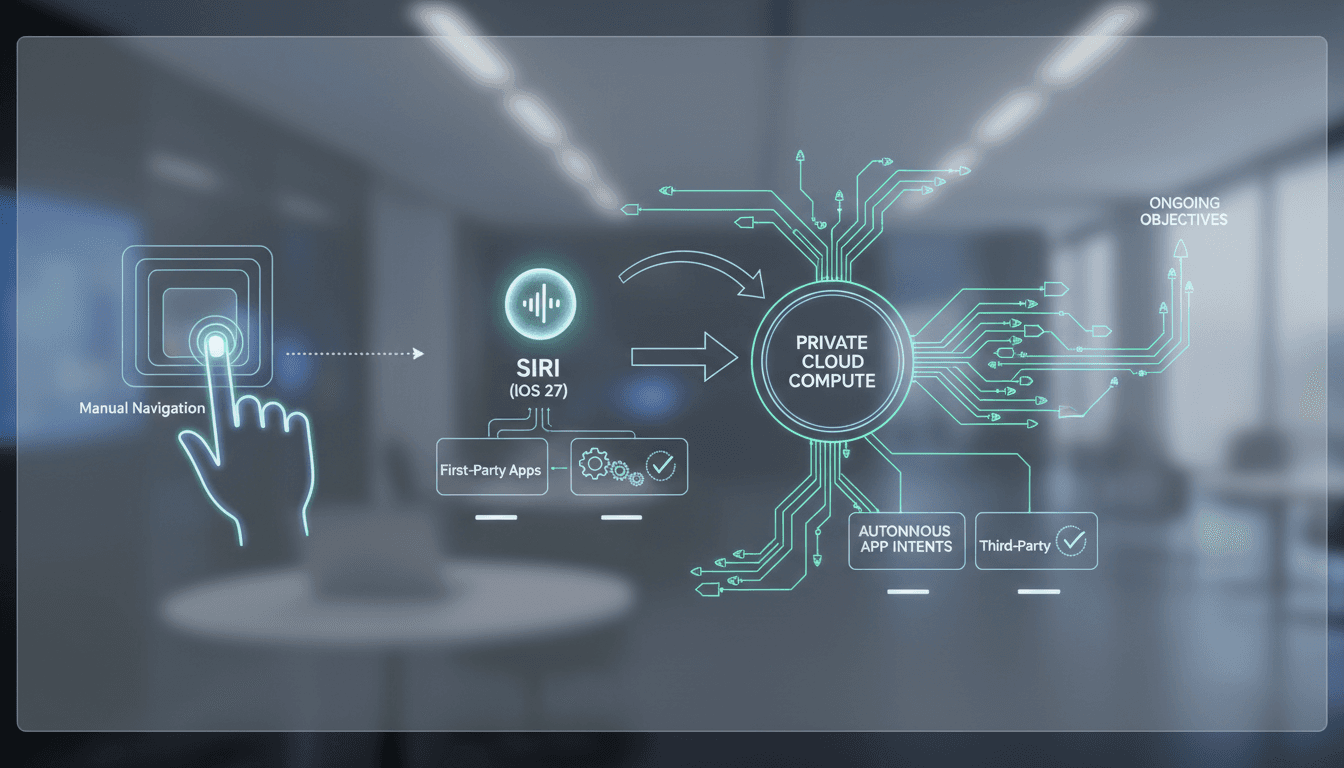
- Infrastructure foundation: Rather than deploying external virtual machines, Apple’s architecture relies on native App Intents schemas coupled with Private Cloud Compute to maintain client-side privacy standards.
What's really happening
The acceleration of Siri’s agentic capabilities reveals an urgent defensive realignment within Cupertino's hardware-software apparatus. For years, operating system lock-in depended on application real estate: the app grid, notifications, and time-in-app metrics. The rise of proactive artificial intelligence alters that calculation entirely. When competitor software layers can chain actions, parse unstructured inputs, and autonomously resolve user objectives, the underlying mobile operating system risks becoming a mere utility pipeline.
The technical pivot relies entirely on the developer framework known as App Intents. In traditional mobile environments, an action requires human navigation across multiple apps: opening a delivery platform, filtering options, inputting payment verification, and confirming an order. An agentic assistant short-circuits this funnel. By wiring deep hooks through App Intents into third-party codebases, Siri will execute these multi-step sequences sequentially. For instance, rather than prompting the user at each junction, the system retains the primary objective—such as booking an OpenTable reservation or reordering via Grubhub—and executes dependent actions autonomously.
This shift presents a critical developer incentive structure. Software makers who fail to expose their operational actions through App Intents risk losing discovery altogether. If high-value consumer decisions are orchestrated through voice or background execution, applications without deep system integrations will become functionally invisible. Apple’s leverage rests on hardware penetration, but its vulnerability lies in velocity. Meta’s Muse has already captured 3 million weekly active users by providing functional utility beyond basic conversational answers, proving that consumers gravitate toward systems that take action over systems that simply answer queries.
Underpinning this push is Apple’s insistence on native execution and Private Cloud Compute. By routing complex reasoning through dedicated privacy-preserving infrastructure rather than unvetted third-party virtual machine sandboxes, Apple is attempting to solve the chief liability of agentic AI: unauthorized execution and data exposure. However, building native guardrails into legacy app architectures introduces technical drag. By targeting initial app actions in iOS 27.3, third-party rollouts in spring 2027, and full autonomous agentic execution later that year, executive leadership is attempting to close the capability gap before external agents permanently disintermediate the iPhone's core interaction layer.
Who feels it first (and how)
- Mobile app product teams: Developers must urgently build and maintain structured App Intents schemas to ensure their core services remain accessible within autonomous Siri workflows.
- High-throughput mobile professionals: Power users handling recurring digital logistics—scheduling, tab organization, asset sorting—will reduce manual app interactions via chained system commands.
- Dubai and global lifestyle service consumers: Residents in high smartphone-density hubs will see native hands-free execution across consumer platforms for dining, delivery, and booking workflows as third-party endpoints roll out.
- Enterprise security leads: IT infrastructure managers will evaluate Private Cloud Compute telemetry to determine whether background agent operations comply with internal data containment protocols.
What to watch next
- Third-party schema adoption rates: Watch developer participation during the spring 2027 third-party rollout, as the volume of integrated platforms will determine whether native agents outcompete external apps.
- Beta telemetry on multi-step completion: Track user retention metrics on iOS 27.3 workflow automations, particularly error rates during autonomous photo editing and browser session management.
- Rival ecosystem counter-moves: Monitor weekly active user benchmarks for Meta’s Muse beyond its 3 million figure, which signals whether dedicated AI assistants can draw high-value interactions away from native mobile operating systems.
Apple management has accelerated the Siri development roadmap under John Ternus and Craig Federighi, with initial first-party features launching in iOS 27.3 betas.
Third-party transactional actions, including food ordering and table reservations, will begin deployment across supported consumer applications by spring 2027.
Whether Apple’s architectural choice to rely on Private Cloud Compute and App Intents can match the iteration speed and goal-handling flexibility of competitive virtual machine approaches.
Frequently Asked Questions
- Why it matters?
- The enterprise battle for software dominance is shifting from standalone chatbot interfaces to native OS-level agents that control digital workflows across every app you touch.
- What happened (in 30 seconds)?
- Cupertino accelerated development: CEO John Ternus and software executive Craig Federighi are fast-tracking an agentic evolution of Siri to preserve iOS ecosystem relevance against competing proactive platforms. Phased deployment underway: iOS 27.3 beta builds introduced first-party App Intents controls for Safari and Photos, setting the stage for third-party integrations such as food orders and reservations by spring 2027. Autonomous targets set: Internal roadmaps now aim for full agentic opera
- What's really happening?
- The acceleration of Siri’s agentic capabilities reveals an urgent defensive realignment within Cupertino's hardware-software apparatus. For years, operating system lock-in depended on application real estate: the app grid, notifications, and time-in-app metrics. The rise of proactive artificial intelligence alters that calculation entirely. When competitor software layers can chain actions, parse unstructured inputs, and autonomously resolve user objectives, the underlying mobile operating syste
- Who feels it first (and how)?
- Mobile app product teams: Developers must urgently build and maintain structured App Intents schemas to ensure their core services remain accessible within autonomous Siri workflows. High-throughput mobile professionals: Power users handling recurring digital logistics—scheduling, tab organization, asset sorting—will reduce manual app interactions via chained system commands. Dubai and global lifestyle service consumers: Residents in high smartphone-density hubs will see native hands-free execut
- What to watch next?
- Third-party schema adoption rates: Watch developer participation during the spring 2027 third-party rollout, as the volume of integrated platforms will determine whether native agents outcompete external apps. Beta telemetry on multi-step completion: Track user retention metrics on iOS 27.3 workflow automations, particularly error rates during autonomous photo editing and browser session management. Rival ecosystem counter-moves: Monitor weekly active user benchmarks for Meta’s Muse beyond its 3
Consumer tech and culture with frequent AI coverage.
"Influential tech outlet covering AI products and policy."
— A47 Editor
Apple is racing to make Siri more agentic
Bloomberg's Mark Gurman reports that Apple CEO John Ternus is pressing AI chief Craig Federighi to accelerate the Siri roadmap and deliver a powerful AI agent able to compete with OpenAI's Dots and Meta's Muse, while Federighi has already delivered a...
Tech news, reviews, and analysis of consumer electronics, science, art, and culture.
"The Verge is a technology-focused media outlet known for in-depth reporting, product reviews, and coverage of the intersection between technology and culture."
— A47 Editor
Apple is racing to make Siri more agentic
Bloomberg's Mark Gurman reports that Apple CEO John Ternus is pressing AI chief Craig Federighi to accelerate the Siri roadmap and deliver a powerful AI agent able to compete with OpenAI's Dots and Meta's Muse, while Federighi has already delivered a...
Curated tech headlines including AI stories.
"Influential aggregator surfacing the day’s top tech/AI links."
— A47 Editor
Sources: John Ternus wants more urgency in Apple's AI efforts, pushing Craig Federighi to move beyond Siri AI tweaks to agentic and other advanced capabilities (Mark Gurman/Bloomberg)
Sources cited by Bloomberg's Mark Gurman report that Apple executive John Ternus is pushing for more urgency in the company's AI efforts, urging engineering chief Craig Federighi to move beyond incremental Siri AI tweaks toward agentic and other adva...
Technology business and AI-related headlines.
"Data-driven tech newsroom with global scope."
— A47 Editor
Apple Explores Turning Siri AI Into ChatGPT Dots-Like Agent; iOS 28 Shake-Up
Apple is exploring a redesign that would turn its Siri AI assistant into a true AI agent resembling OpenAI's Dots-style agents, according to Bloomberg Technology, with the changes reportedly tied to a broader iOS overhaul.
Technology business news, market impacts, and innovation trends.
"Bloomberg is a premier financial and tech news provider, respected for its in-depth reporting and analytical rigor."
— A47 Editor
Apple Explores Turning Siri AI Into ChatGPT Dots-Like Agent; iOS 28 Shake-Up
Apple is exploring a redesign that would turn its Siri AI assistant into a true AI agent resembling OpenAI's Dots-style agents, according to Bloomberg Technology, with the changes reportedly tied to a broader iOS overhaul.