
Databricks Expands Always-On Genie AI Agents One Day After Anthropic Corporate Productivity Launch
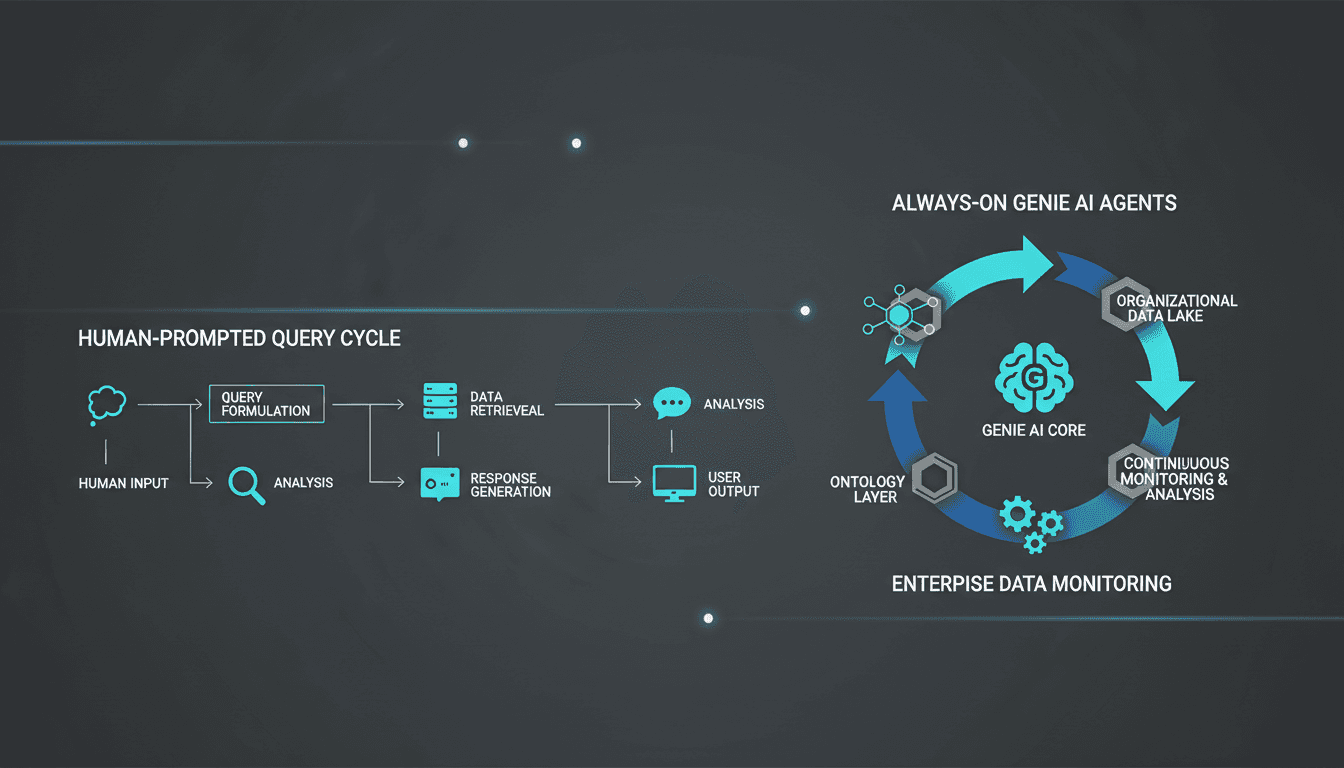
Corporate software budgets are shifting toward autonomous agents that run continuous audits on your operational metrics rather than waiting for your prompts.
Why it matters
Enterprise software providers are racing to prove direct economic return on knowledge work by embedding autonomous background processes directly into organizational data layers.
What happened (in 30 seconds)
- Databricks introduced continuous agents: On November 11, 2026, in San Francisco, Databricks unveiled updated Genie AI agents capable of operating continuously in the background to analyze enterprise data, alongside a new Ontology feature that maps company structures and metrics.
- Timing directly countered a rival: The product launch occurred exactly one day after competitor Anthropic debuted its own suite of office productivity tools, including automated spreadsheets and video call integrations.
- Rollout entered phased deployment: Databricks moved Genie and Ontology into general availability, while keeping search capabilities and the always-on operating mode in initial preview for enterprise users.
The context you actually need
- The $40 trillion target: Anthropic's initial public offering prospectus established that knowledge worker performance represented an estimated $40 trillion in global economic value in 2025, defining the scale of the target addressable market.
- The developer-to-desk shift: Software vendors built initial artificial intelligence revenues primarily around coding assistants; modern expansion focuses on non-technical corporate functions where financial return on investment has proven harder to quantify.
- Executive positioning: Databricks Chief Executive Officer Ali Ghodsi framed the release through personal adoption, stating the background system made him a "10x better CEO" by generating proactive suggestions without requiring manual query inputs.
What's really happening
The release of always-on agents marks an architectural shift from reactive chat interfaces to persistent operational monitoring. Standard enterprise AI tools historically required an employee to initiate a conversation, phrase a specific query, and interpret the response. Databricks and Anthropic are adjusting their engineering models toward autonomous workflows that monitor corporate data streams without manual triggers.
This operational shift operates through structural mapping. Databricks introduced Ontology, an abstraction layer designed to organize unstructured company metrics, reporting hierarchies, and business terms into a consistent format. When an agent runs continuously, it relies on this underlying map to identify shifts in operational performance. Rather than waiting for a finance manager to review end-of-month discrepancies, the background agent detects revenue divergences against recorded targets in real time and routes proactive notifications to leadership.
The competitive timeline underscores the urgency among enterprise vendors. On November 10, 2026, Anthropic released tools designed to handle office workflows such as meeting syntheses and spreadsheet operations. Within 24 hours, Databricks launched its Genie updates to prevent platform commoditization. If model developers like Anthropic integrate directly with frontline knowledge workers, traditional data warehouse and analysis providers risk becoming secondary infrastructure providers. By packaging agents with native governance controls and usage-based billing, Databricks intends to maintain direct ownership of the enterprise relationship.
Economic pressure is driving this cadence. Enterprise software spending faces scrutiny over whether generative models generate measurable productivity outside of software engineering. By targeting general knowledge workers—an economic segment valued at $40 trillion globally—providers are betting that proactive alerting and automated analysis can demonstrate verifiable cost efficiencies. The commercial model supports this mechanic: usage-based billing ensures that continuous, background computation generates baseline software consumption even when human workers are offline.
Market competition among Databricks, Anthropic, and Microsoft now centers on institutional trust and data governance. Corporate procurement teams routinely flag data security as the primary barrier to AI deployment. The vendor that successfully embeds an active, governed agent into core operational data positions itself as the default operating layer of corporate management.
Who feels it first (and how)
- Enterprise Chief Information Officers: Technology leaders managing software sprawl face immediate vendor pressure to choose between platform-native analytics agents and external foundation-model productivity suites.
- Mid-level data analysts: Operations teams spending working hours writing SQL queries or building recurring reports face automation of routine variance identification by background monitoring systems.
- Corporate financial controllers: Budget operators must navigate usage-based billing models that charge for continuous background compute cycles rather than static, per-seat software licenses.
What to watch next
- Enterprise billing conversions: Track how rapidly corporate clients transition from static seat licenses to consumption-based charging models for always-on compute agents, as this reveals actual adoption beyond initial trial programs.
- Preview-to-production transitions: Monitor when Databricks shifts always-on mode and search from preview into full general availability, demonstrating system stability under continuous organizational workloads.
- Ecosystem response from enterprise peers: Watch how platform providers like Microsoft adjust their workflow integrations in response to direct corporate challenges from independent software and foundation model firms.
Databricks released Genie updates and the Ontology mapping layer on November 11, 2026, following Anthropic's office software deployment by one day.
Enterprise software spending on background agents will disproportionately reward vendors that provide auditable data governance controls alongside continuous compute capabilities.
Whether non-technical knowledge workers will realize measurable productivity gains sufficient to justify the compute costs associated with persistent background data processing.
Frequently Asked Questions
- Why it matters?
- Enterprise software providers are racing to prove direct economic return on knowledge work by embedding autonomous background processes directly into organizational data layers.
- What happened (in 30 seconds)?
- Databricks introduced continuous agents: On November 11, 2026, in San Francisco, Databricks unveiled updated Genie AI agents capable of operating continuously in the background to analyze enterprise data, alongside a new Ontology feature that maps company structures and metrics. Timing directly countered a rival: The product launch occurred exactly one day after competitor Anthropic debuted its own suite of office productivity tools, including automated spreadsheets and video call integrations.
- What's really happening?
- The release of always-on agents marks an architectural shift from reactive chat interfaces to persistent operational monitoring. Standard enterprise AI tools historically required an employee to initiate a conversation, phrase a specific query, and interpret the response. Databricks and Anthropic are adjusting their engineering models toward autonomous workflows that monitor corporate data streams without manual triggers. This operational shift operates through structural mapping. Databricks in
- Who feels it first (and how)?
- Enterprise Chief Information Officers: Technology leaders managing software sprawl face immediate vendor pressure to choose between platform-native analytics agents and external foundation-model productivity suites. Mid-level data analysts: Operations teams spending working hours writing SQL queries or building recurring reports face automation of routine variance identification by background monitoring systems. Corporate financial controllers: Budget operators must navigate usage-based billing
- What to watch next?
- Enterprise billing conversions: Track how rapidly corporate clients transition from static seat licenses to consumption-based charging models for always-on compute agents, as this reveals actual adoption beyond initial trial programs. Preview-to-production transitions: Monitor when Databricks shifts always-on mode and search from preview into full general availability, demonstrating system stability under continuous organizational workloads. Ecosystem response from enterprise peers: Watch how pl
Corporate leadership, finance, technology, and market trends.
"Fortune covers financial trends, leadership, and innovation with a pragmatic editorial approach."
— A47 Editor
A day after Anthropic’s office push, Databricks jumps in with AI agents that never sleep
Databricks has unveiled AI agents that operate in the background and shadow users' daily workdays, a launch that followed closely on the heels of Anthropic's renewed push for corporate users, according to Fortune.
Industry news and analysis for the global AI community.
"A business-first look at AI adoption, policy, and ecosystem trends."
— A47 Editor
With IPO looming, Anthropic launches new AI models, workplace tools
Anthropic, the San Francisco-based AI company behind the Claude chatbot, released new capabilities aimed at enterprise work and significantly updated models, as it prepares for a highly anticipated Nasdaq listing under the ticker ANT.
AI/ML research and technology news.
"Sister site to Phys.org focusing on tech research."
— A47 Editor
Five things to know about Anthropic
Anthropic, the San Francisco-based AI company behind the Claude chatbot and founded five years ago by a group that broke away from OpenAI, is preparing a stock market listing. Reports indicate it has set a price range of $70 to $78 per share, targeti...