
Google DeepMind Launches AlphaGenome 2 for Cell-Type-Specific Genomic Variant Prediction
Why it matters
By doubling the recall rate of causal disease variants down to specific cell states, the model converts previously uninterpretable non-coding DNA into computable targets for precision medicine pipelines.
What happened (in 30 seconds)
- DeepMind released AlphaGenome 2 on November 11, 2026, introducing a conditional sequence-to-function AI model capable of parsing inputs up to 1 megabase alongside specific cellular states.
- Trained on over 100 million single-cell profiles across 68 human tissues, the architecture expands beyond bulk tissue readouts to predict DNA methylation and regulatory molecular shifts.
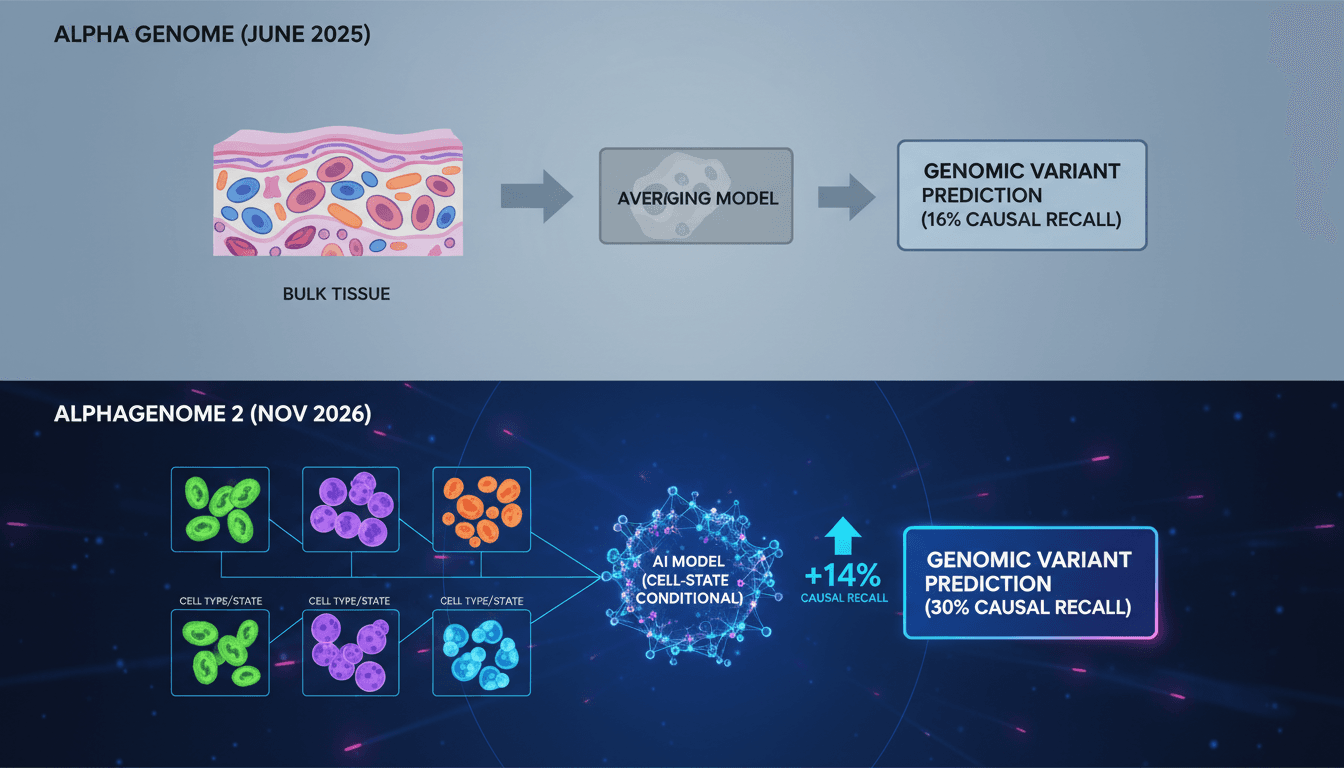
- Benchmark performance doubled previous baselines, hitting 30% recall of causal variants versus 16% for its predecessor on the TenK10K single-cell eQTL benchmark.
The context you actually need
- Earlier genomic foundation models relied on bulk tissue data, which obscured the distinct regulatory operations occurring inside specialized cell subtypes during disease progression.
- The original AlphaGenome, launched in June 2025, established sequence-to-function baselines but lacked the granularity required to map how non-coding mutations alter discrete cell states.
- Non-coding regions represent the vast majority of human DNA, making in silico simulation of these segments essential for identifying target mechanisms without running physical assays for every mutation.
What's really happening
The operational friction in genomic drug discovery has long centered on context. Human disease is driven primarily by mutations in non-coding DNA—the regulatory switches that dictate when, where, and how much a gene is expressed. Yet for decades, predictive modeling treated organs as uniform biological blends. When an algorithm evaluated liver or brain tissue, it averaged signals across dozens of distinct cell types, effectively flattening rare cellular behaviors into background noise.
AlphaGenome 2 shifts this dynamic by coupling 1-megabase sequence windows directly with single-cell state data. Rather than evaluating a mutation in isolation, the architecture operates conditionally: it takes a DNA sequence and a target cell identity, then models how that specific cellular environment reads the sequence. To achieve this, the system ingested over 100 million single-cell profiles across 68 tissues. This scale allows it to predict downstream functional consequences—including DNA methylation and directional regulatory effects—without requiring researchers to run laboratory perturbation screens across every isolated cell type.
The quantitative shift shows up in performance benchmarks. On the TenK10K immune cell expression quantitative trait loci (eQTL) benchmark, AlphaGenome 2 achieved a 30% recall rate for causal variants, up from 16% in its predecessor. Its ability to identify the correct direction of an effect—whether a variant increases or decreases expression—rose from 23% to 43%.
Critically, the architecture demonstrates generalization to unseen cell states without retraining. In practical terms, this lowers the compute and wet-lab barrier for teams investigating conditions driven by dynamic cell transitions, such as immune responses or oncogenesis. Instead of gathering specialized single-cell training corpora to fine-tune a model for every experimental variant, research teams can feed conditional parameters into the existing architecture via an API.
Google DeepMind is deploying this through a dual-track distribution strategy. Non-commercial researchers receive direct API access, which establishes AlphaGenome 2 as a default analytical layer across academic consortia and foundational biology labs. Meanwhile, commercial access remains gated in private preview. This structure allows the platform to capture real-world benchmark validations and edge-case testing from the scientific community while preserving pricing leverage and partnership flexibility for enterprise biotechnology and pharmaceutical licensing.
Who feels it first (and how)
- Translational genomics leads: Teams prioritizing target validation can cut exploratory in vitro mutagenesis runs by screening non-coding candidate variants through in silico predictions first.
- Biotech venture investors: Portfolios built around proprietary single-cell wet-lab screening platforms face competition from standard API workflows that predict variant outcomes computationally.
- Single-cell atlas consortia: Data generators see their historical single-cell profiles gain structural utility as operational inputs for predictive modeling rather than remaining static reference maps.
What to watch next
- Commercial tier pricing and access terms, which will signal how Google DeepMind intends to monetize enterprise pharmaceutical pipelines versus academic research.
- Independent laboratory validations on rare cell states, measuring whether the model's reported zero-shot generalization holds outside controlled benchmark datasets like TenK10K.
- Integration with therapeutic design suites, tracking whether API outputs translate directly into actionable molecular targets in early-stage preclinical pipelines.
AlphaGenome 2 handles up to 1 Mb DNA sequences, models DNA methylation, and is accessible via API for non-commercial researchers as of November 11, 2026.
Pharmaceutical research groups will seek private preview access to de-risk candidate selection in therapeutic programs centered on non-coding regulatory mechanisms.
The exact accuracy rates when applying the system to human tissues that were underrepresented in the 100 million single-cell training corpus.
Frequently Asked Questions
- Why it matters?
- By doubling the recall rate of causal disease variants down to specific cell states, the model converts previously uninterpretable non-coding DNA into computable targets for precision medicine pipelines.
- What happened (in 30 seconds)?
- DeepMind released AlphaGenome 2 on November 11, 2026, introducing a conditional sequence-to-function AI model capable of parsing inputs up to 1 megabase alongside specific cellular states. Trained on over 100 million single-cell profiles across 68 human tissues, the architecture expands beyond bulk tissue readouts to predict DNA methylation and regulatory molecular shifts. Benchmark performance doubled previous baselines, hitting 30% recall of causal variants versus 16% for its predecessor on th
- What's really happening?
- The operational friction in genomic drug discovery has long centered on context. Human disease is driven primarily by mutations in non-coding DNA—the regulatory switches that dictate when, where, and how much a gene is expressed. Yet for decades, predictive modeling treated organs as uniform biological blends. When an algorithm evaluated liver or brain tissue, it averaged signals across dozens of distinct cell types, effectively flattening rare cellular behaviors into background noise. AlphaGe
- Who feels it first (and how)?
- Translational genomics leads: Teams prioritizing target validation can cut exploratory in vitro mutagenesis runs by screening non-coding candidate variants through in silico predictions first. Biotech venture investors: Portfolios built around proprietary single-cell wet-lab screening platforms face competition from standard API workflows that predict variant outcomes computationally. Single-cell atlas consortia: Data generators see their historical single-cell profiles gain structural utility a
- What to watch next?
- Commercial tier pricing and access terms, which will signal how Google DeepMind intends to monetize enterprise pharmaceutical pipelines versus academic research. Independent laboratory validations on rare cell states, measuring whether the model's reported zero-shot generalization holds outside controlled benchmark datasets like TenK10K. Integration with therapeutic design suites, tracking whether API outputs translate directly into actionable molecular targets in early-stage preclinical pipelin
Curated insights and thought leadership in enterprise technology.
"Ciente.io delivers curated insights, thought leadership, and trends in B2B tech and innovation."
— A47 Editor
DeepMind’s AlphaGenome 2 Decodes Dark DNA
Google DeepMind has unveiled AlphaGenome 2, an AI model that addresses the long-neglected 98% of human DNA that does not code for proteins, a portion of the genome that geneticists largely set aside for decades in favor of the roughly 2% that produce...
Curated tech headlines including AI stories.
"Influential aggregator surfacing the day’s top tech/AI links."
— A47 Editor
Google DeepMind launches AlphaGenome 2, trained on 100M+ cell profiles across 68 tissues to predict genetic mutation effects, for non-commercial research (Robert Hart/The Verge)
Google DeepMind has launched AlphaGenome 2, a DNA model trained on more than 100 million cell profiles across 68 tissues, designed to predict how genetic mutations affect different cells. The model is being released for non-commercial research, accor...
Consumer tech and culture with frequent AI coverage.
"Influential tech outlet covering AI products and policy."
— A47 Editor
Google’s AlphaGenome 2 zooms in on the cellular roots of disease
Google DeepMind has unveiled AlphaGenome 2, a new AI model designed to show how changes in DNA affect different cells, offering scientists a more detailed view of a notoriously difficult problem that could help explain the causes of disease and point...
Tech news, reviews, and analysis of consumer electronics, science, art, and culture.
"The Verge is a technology-focused media outlet known for in-depth reporting, product reviews, and coverage of the intersection between technology and culture."
— A47 Editor
Google’s AlphaGenome 2 zooms in on the cellular roots of disease
Google DeepMind has unveiled AlphaGenome 2, a new AI model designed to show how changes in DNA affect different cells, offering scientists a more detailed view of a notoriously difficult problem that could help explain the causes of disease and point...