
Microsoft Traces Global Microsoft 365 Outage to Latent July Gateway Defect Under Load and Capacity Reduction
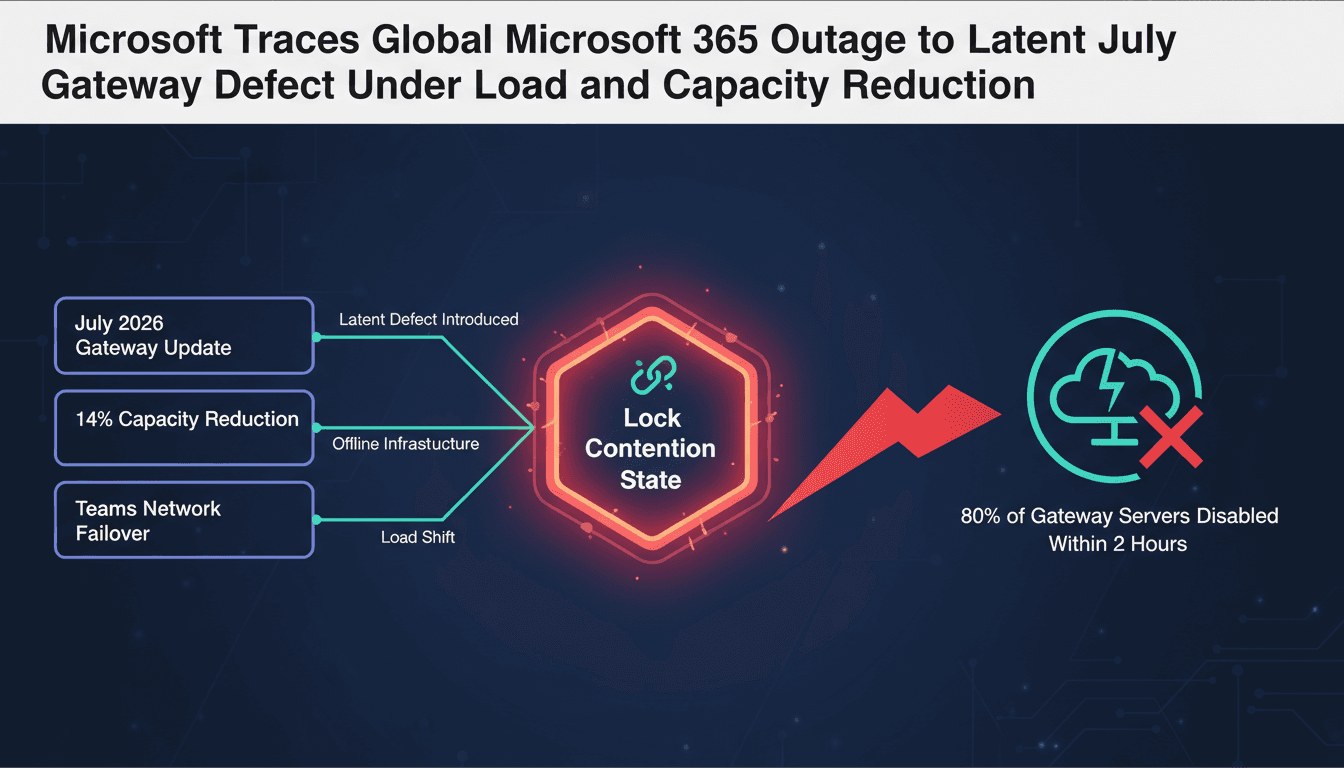
A four-month-old code defect dormant on high-core server infrastructure can bring down your enterprise communication channels for an entire business day without a single cyberattack.
Why it matters
When unified productivity suites centralize global operations onto shared gateway hardware, a software flaw combined with routine load balancing can incapacitate essential enterprise communications across 75 countries simultaneously.
What happened (in 30 seconds)
- A multi-month software defect surfaced: On November 12, 2026, Microsoft 365 experienced a 24-hour disruption across Outlook, Exchange Online, Teams, and Office suite applications due to a latent bug introduced in a July 2026 update.
- Three independent variables collided: A software lock contention issue combined with a 15-hour-old Teams traffic failover and a separate 14% drop in gateway server capacity to paralyze infrastructure during peak U.S. traffic hours.
- Automated routing compounded the collapse: The system's automated traffic redirection rapidly transferred load onto surviving nodes, rendering over 80% of affected networking gateway servers unresponsive within two hours.
The context you actually need
- Pre-deployment testing failed to reflect hardware reality: The July 2026 update passed standard testing protocols because the staging environments did not mirror high-load production traffic across newer server hardware with higher processor core counts.
- Shared gateways created hidden dependencies: Exchange Online and Microsoft Teams shared primary networking gateways, meaning a scheduled operational failover in one application directly consumed the buffer capacity of the other.
- Critical services operate without isolation: Enterprise infrastructure relied upon by healthcare networks, law enforcement agencies, and schools experienced widespread operational freezes with no evidence of external cybersecurity interference.
What's really happening
The November 2026 Microsoft 365 breakdown illustrates the mechanical hazards of hyper-optimized enterprise software architecture. The primary driver of the outage was not a malicious intrusion, but a textbook systemic cascade driven by three interlocking operational conditions.
First, the root flaw was a lock contention defect embedded within networking gateway servers during a July 2026 routine deployment. In computing, lock contention occurs when multiple parallel processes request access to a shared resource simultaneously, forcing processing threads to wait. This specific defect remained invisible for over three months because it required an exact threshold of high-density traffic running specifically on newer, high-core processors to trigger. Because staging and standard load-testing environments did not replicate production-scale concurrency across these specific hardware configurations, the code cleared deployment pipelines without incident.
Second, the structural margin of safety was eliminated hours before the failure occurred. Approximately 15 hours prior to peak disruption, Microsoft Teams executed a network failover, shifting its traffic onto the primary networking gateway shared with Exchange Online. This shift altered typical traffic composition and increased baseline volume. Simultaneously, an unrelated operational issue from the prior day had knocked out 14% of the gateway fleet’s operational capacity. The infrastructure entered peak U.S. business hours running with diminished capacity, heightened baseline throughput, and shared resource paths.
Third, programmatic resilience features accelerated the collapse. When the surge pushed initial gateway servers into the lock contention state, automated load balancers detected the unresponsive nodes and routed incoming traffic to neighboring servers. Rather than insulating the network, this influx triggered the same latent hardware bug on the destination machines. The resulting feedback loop knocked out over 80% of affected networking gateway servers within 120 minutes.
For the modern enterprise, the operational trade-off is clear: shared cloud architecture offers cost efficiencies and real-time integration, but it couples disparate business functions to identical points of failure. When standard pre-production testing fails to replicate modern multi-core production loads, latent bugs turn routine automated failovers into enterprise-wide paralysis.
Who feels it first (and how)
- Enterprise Operations and IT Leaders: Organizations reliant on single-vendor communication suites lose both internal workflows and customer-facing channels, forcing reliance on decentralized, out-of-band continuity plans.
- Healthcare Providers and Hospital Networks: Clinical facilities lose access to coordinated scheduling, secure messaging, and digital health communications, forcing manual paperwork fallbacks during peak patient intake.
- Education and Law Enforcement Administrations: Public school systems and emergency response coordination experience communications dropouts across 75 countries, stalling critical coordination tools lacking local redundancy.
What to watch next
- Hardware-specific staging protocols: Watch whether cloud providers revise staging guidelines to mandate multi-core, high-density production mirrors for all gateway updates to prevent thread lock contention bugs.
- The formal post-incident review: Monitor the final post-incident report from Microsoft for detailed timelines on how gateway sharing protocols between Teams and Exchange will be decoupled.
- Multi-cloud and hybrid communications investment: Track enterprise budget reallocations toward secondary, out-of-band communication systems to prevent total communication blackout during primary vendor downtime.
The outage began on November 12, 2026, lasted approximately 24 hours, impacted millions across more than 70 countries, and stemmed from a July software bug interacting with a 14% server capacity deficit and a Teams traffic failover.
Enterprise procurement reviews will demand distinct architectural isolation between enterprise email and internal chat infrastructure to ensure a failover in one does not incapacitate the other.
Whether major enterprise clients will extract contractual commitments or altered Service Level Agreements (SLAs) regarding production-parity testing on new gateway hardware configurations.
Frequently Asked Questions
- Why it matters?
- When unified productivity suites centralize global operations onto shared gateway hardware, a software flaw combined with routine load balancing can incapacitate essential enterprise communications across 75 countries simultaneously.
- What happened (in 30 seconds)?
- A multi-month software defect surfaced: On November 12, 2026, Microsoft 365 experienced a 24-hour disruption across Outlook, Exchange Online, Teams, and Office suite applications due to a latent bug introduced in a July 2026 update. Three independent variables collided: A software lock contention issue combined with a 15-hour-old Teams traffic failover and a separate 14% drop in gateway server capacity to paralyze infrastructure during peak U.S. traffic hours. Automated routing compounded the co
- What's really happening?
- The November 2026 Microsoft 365 breakdown illustrates the mechanical hazards of hyper-optimized enterprise software architecture. The primary driver of the outage was not a malicious intrusion, but a textbook systemic cascade driven by three interlocking operational conditions. First, the root flaw was a lock contention defect embedded within networking gateway servers during a July 2026 routine deployment. In computing, lock contention occurs when multiple parallel processes request access to
- Who feels it first (and how)?
- Enterprise Operations and IT Leaders: Organizations reliant on single-vendor communication suites lose both internal workflows and customer-facing channels, forcing reliance on decentralized, out-of-band continuity plans. Healthcare Providers and Hospital Networks: Clinical facilities lose access to coordinated scheduling, secure messaging, and digital health communications, forcing manual paperwork fallbacks during peak patient intake. Education and Law Enforcement Administrations: Public schoo
- What to watch next?
- Hardware-specific staging protocols: Watch whether cloud providers revise staging guidelines to mandate multi-core, high-density production mirrors for all gateway updates to prevent thread lock contention bugs. The formal post-incident review: Monitor the final post-incident report from Microsoft for detailed timelines on how gateway sharing protocols between Teams and Exchange will be decoupled. Multi-cloud and hybrid communications investment: Track enterprise budget reallocations toward seco
Top international stories selected by The Guardian editors.
"The Guardian is known for its progressive editorial stance and in-depth analysis."
— A47 Editor
Microsoft identifies months-old bug as a root cause of global outage
Microsoft has identified the root causes of a global outage that disrupted Outlook, Exchange and other office software, in a 24-hour blackout. Its initial report points to three factors: a months-old bug, malfunctioning internal connections and serve...
UK and international business news, economics, and corporate coverage.
"The Guardian’s business section covers finance and markets with a progressive editorial tone."
— A47 Editor
Microsoft identifies months-old bug as a root cause of global outage
Microsoft has identified the root causes of a global outage that disrupted Outlook, Exchange and other office software, in a 24-hour blackout. Its initial report points to three factors: a months-old bug, malfunctioning internal connections and serve...
Market-moving headlines impacting equities, bonds, and related risk assets.
"Real-time catalysts and volatility drivers across indices and sectors."
— A47 Editor
Microsoft says latent July bug triggered global Microsoft 365 outage
Microsoft has said that a latent bug introduced in July triggered a global outage affecting Microsoft 365 services, according to a report published by Investing.com on November 16, 2026. The company attributed the disruption to a defect that had rema...
Conservative-leaning political and national coverage.
"The Washington Times is a conservative-leaning newspaper known for its political coverage and advocacy of right-of-center viewpoints."
— A47 Editor
Microsoft blames outage on software defect introduced in July
Microsoft has blamed a costly outage of its Microsoft 365 services, including Outlook, Teams, SharePoint, Copilot and Defender, on complications linked to a software defect introduced in July, according to The Washington Times. The disruption followe...
Technology business and AI-related headlines.
"Data-driven tech newsroom with global scope."
— A47 Editor
Microsoft Bug Undetected Since July Triggered Worldwide Outage
A Microsoft Corp. bug that had been lurking undetected in the company's data centers since July triggered a worldwide outage that crippled its productivity software, including Outlook email and chat services, Bloomberg Technology reported.
Technology business news, market impacts, and innovation trends.
"Bloomberg is a premier financial and tech news provider, respected for its in-depth reporting and analytical rigor."
— A47 Editor
Microsoft Bug Undetected Since July Triggered Worldwide Outage
A Microsoft Corp. bug that had been lurking undetected in the company's data centers since July triggered a worldwide outage that crippled its productivity software, including Outlook email and chat services, Bloomberg Technology reported.
Curated tech headlines including AI stories.
"Influential aggregator surfacing the day’s top tech/AI links."
— A47 Editor
Preliminary report: Microsoft attributes a major 365 and Exchange outage to a software defect introduced in a July 2026 update for network gateway servers (Richard Speed/The Register)
Microsoft has attributed a major Microsoft 365 and Exchange outage to a software defect introduced in a July 2026 update for network gateway servers, according to a preliminary report covered by The Register. The disruption followed a widespread outa...
Community posts including AI/ML tutorials and news.
"Open platform where developers share AI learnings."
— A47 Editor
Your AI Agent Depends on More Than Its Model: The Microsoft 365 Outage Is a Warning
A Microsoft 365 outage that began on Thursday, November 12, 2026, disrupted Outlook, Teams, SharePoint and Microsoft Copilot, with OpenAI and Anthropic also reporting problems connecting to Microsoft 365 tools. Microsoft said the disruption stemmed f...
Breaking news, politics, business, and entertainment from the U.S. and around the world.
"The New York Post is a tabloid-format newspaper known for its sensationalist headlines and conservative-leaning editorial tone."
— A47 Editor
Microsoft restores service to Outlook and Teams after historic outage crippled businesses, governments
Microsoft restored service to Outlook and Teams after a historic outage disrupted businesses and governments, according to the New York Post. The company said server issues were behind the incident, and reporting across outlets described widespread d...
English-language digital publication covering business, politics, technology, and current affairs.
"The Arabian Post mixes original and syndicated-style coverage with a broad regional and global business-news orientation."
— A47 Editor
Microsoft apologises as Outlook services recover after outage
Microsoft apologised on Friday for a worldwide outage that disrupted Outlook email and other Microsoft 365 services, attributing the breakdown to a technical fault linked to network upgrades rather than a cyberattack. The company said it had addresse...