
Multiple Unrelated U.S. Technical Outages Disrupt Air Travel Banking and Government Networks in November 2026
Why it matters
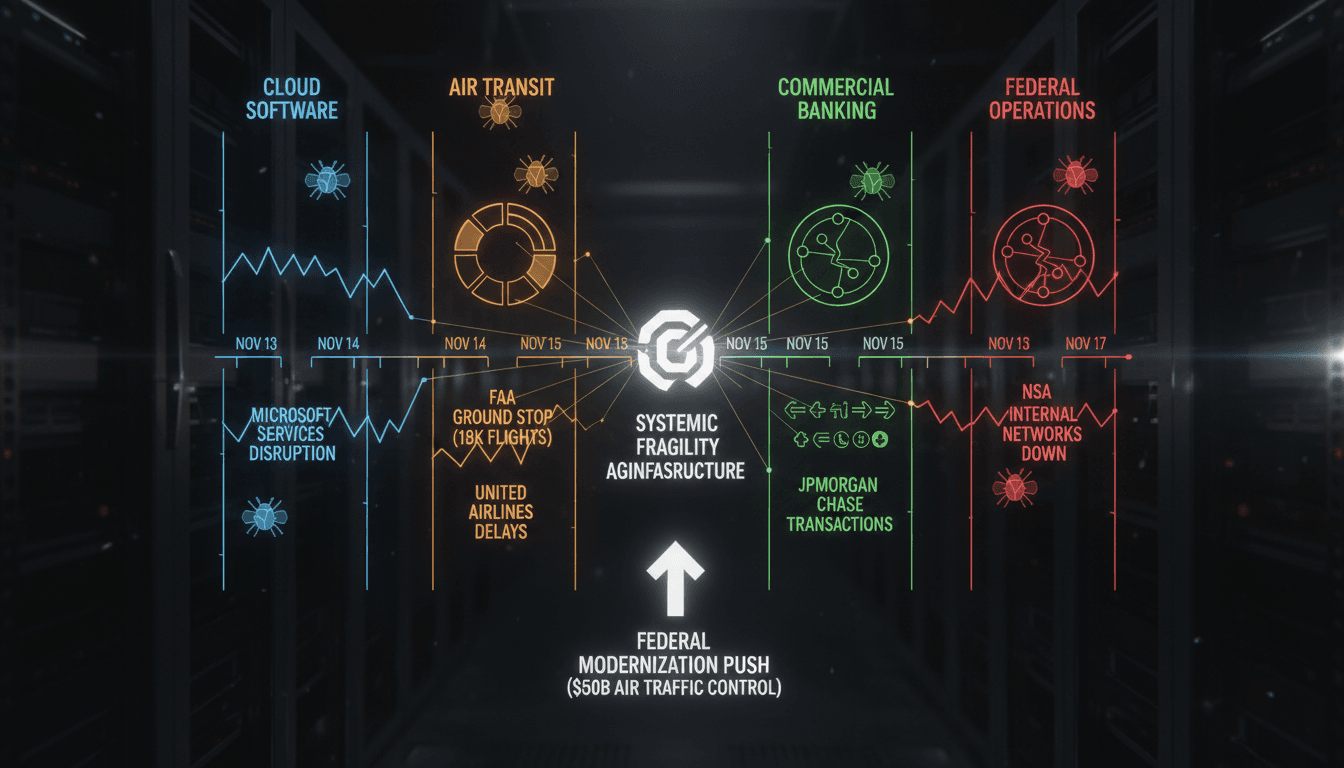
Simultaneous failures across core software, transit, and banking illustrate how compounding maintenance deficits and rapid software deployment cycles create widespread operational bottlenecks without any hostile cyber interference.
What happened (in 30 seconds)
- Multi-sector disruptions hit U.S. services: Between November 13 and November 17, 2026, separate technical failures interrupted operations across Microsoft enterprise tools, commercial aviation, consumer banking networks, and federal internal systems.
- Flight operations suffered nationwide stops: A Florida router overload on November 13 triggered an FAA ground stop lasting approximately 4.5 hours, leading to roughly 18,000 flight cancellations and cascading schedule delays across carriers like United Airlines.
- Transaction delays affected financial flow: A software bug at JPMorgan Chase on November 16 disrupted account processing, affecting peer-to-peer services like Zelle, alongside separate maintenance-related network degradation on the NSA's internal NSANet.
The context you actually need
- Unrelated concurrent technical triggers: Federal investigators, corporate executives, and intelligence leaders confirmed the events were independent incidents caused by software bugs, network overloads, and scheduled maintenance rather than coordinated malicious attacks.
- Amplified system fragility: The disruptions unfolded against a backdrop of documented aging air traffic control hardware and heightened reliance on complex digital ecosystems where rapid code patches introduce systemic instability.
- Capital calls for modernization: In response to the transportation gridlock, U.S. Transportation Secretary Sean Duffy called on Congress to fund a $50 billion dedicated telecommunications replacement for aging air traffic control infrastructure.
What's really happening
The cluster of downtime across mid-November 2026 highlights the hidden economics of technical debt inside mission-critical infrastructure. For decades, both private enterprises and federal agencies prioritized feature deployment, rapid continuous integration, and real-time cloud migration over the capital-intensive modernization of core base layers. When modern digital interfaces—such as cloud communication platforms or automated banking layers—are placed on top of legacy operational backbones, the resulting architecture becomes fragile.
The operational breakdown reveals how systemic risk concentrates when independent platforms encounter maintenance friction at the same time. On November 12 and 13, enterprise collaboration was disrupted as Microsoft experienced issues affecting Outlook and Teams. Simultaneously, the physical transportation layer buckled when an edge router overload in Florida forced the FAA to order an operational ground stop lasting approximately 4.5 hours. Because domestic and international flight routing operates on tight scheduling margins, that single hardware failure removed operational slack from the ecosystem, resulting in approximately 18,000 flight cancellations.
The financial and intelligence sectors faced parallel friction points within 72 hours. JPMorgan Chase’s November 16 software bug demonstrated how quickly transactional liquidity freezes for institutional and retail accounts when settlement pathways like Zelle fail to reconcile. When United Airlines experienced an independent software failure that same day, and the NSA faced internal network degradation during routine maintenance on November 17, the pattern became clear: modernization processes themselves now carry operational execution risk.
The incentives driving this dynamic are structural. Organizations operate under commercial and political pressure to deploy software patches rapidly, increasingly driven by automated integration cycles. However, as legacy systems interact with fast-moving code changes, the blast radius of standard bugs expands. While high-level political reactions, such as President Trump's statements, downplayed the clustering of failures as normal operational occurrences, the operational cost of these bottlenecks has triggered formal demands for infrastructure renewal, led by Transportation Secretary Sean Duffy’s proposal for a $50 billion telecommunications network overhaul. For global operators, the takeaway is clear: enterprise vulnerability is driven just as frequently by delayed hardware capital expenditure and software maintenance friction as it is by external security breaches.
Who feels it first (and how)
- Aviation logistics and corporate travelers: Suffer immediate schedule loss from ground stops and rolling cancellations, exposing cross-border itineraries to regional routing bottlenecks.
- Financial operations and treasury managers: Face liquidity and reconciliation delays when automated settlement networks and major commercial banking payment rails encounter batch-processing bugs.
- Enterprise workforce leads: Experience real-time productivity losses during unexpected communication and workflow platform downtime across international teams.
- Public sector technology administrators: Must absorb the capital allocation shifts and oversight demands as governments prioritize foundational telecommunications replacements.
What to watch next
- Congressional response to the $50 billion telecom ask: Track whether U.S. lawmakers advance dedicated funding bills for FAA telecommunications modernization, signaling a pivot toward hard infrastructure overhauls.
- Vendor update deployment protocols: Monitor whether major enterprise cloud and financial software providers alter patch cadences, moving toward staged rollouts to reduce simultaneous ecosystem bugs.
- Corporate redundancy auditing: Watch whether global firms increase enterprise multi-cloud adoption and multi-rail payment fallbacks to protect against single-point software failures.
The outages across Microsoft, the FAA, JPMorgan Chase, United Airlines, and the NSA were driven by technical bugs, hardware bottlenecks, and maintenance cycles rather than foreign cyberattacks; the FAA disruption caused approximately 18,000 flight cancellations.
Enterprise infrastructure operators and federal agencies will face increased compliance and operational pressure to audit legacy software dependencies and establish stricter testing frameworks before rolling out maintenance updates.
Whether the U.S. Congress will approve the proposed $50 billion telecommunications budget for air traffic control, or if political resistance will leave legacy transport systems operating on existing frameworks.
Frequently Asked Questions
- Why it matters?
- Simultaneous failures across core software, transit, and banking illustrate how compounding maintenance deficits and rapid software deployment cycles create widespread operational bottlenecks without any hostile cyber interference.
- What happened (in 30 seconds)?
- Multi-sector disruptions hit U.S. services: Between November 13 and November 17, 2026, separate technical failures interrupted operations across Microsoft enterprise tools, commercial aviation, consumer banking networks, and federal internal systems. Flight operations suffered nationwide stops: A Florida router overload on November 13 triggered an FAA ground stop lasting approximately 4.5 hours, leading to roughly 18,000 flight cancellations and cascading schedule delays across carriers like Uni
- What's really happening?
- The cluster of downtime across mid-November 2026 highlights the hidden economics of technical debt inside mission-critical infrastructure. For decades, both private enterprises and federal agencies prioritized feature deployment, rapid continuous integration, and real-time cloud migration over the capital-intensive modernization of core base layers. When modern digital interfaces—such as cloud communication platforms or automated banking layers—are placed on top of legacy operational backbones,
- Who feels it first (and how)?
- Aviation logistics and corporate travelers: Suffer immediate schedule loss from ground stops and rolling cancellations, exposing cross-border itineraries to regional routing bottlenecks. Financial operations and treasury managers: Face liquidity and reconciliation delays when automated settlement networks and major commercial banking payment rails encounter batch-processing bugs. Enterprise workforce leads: Experience real-time productivity losses during unexpected communication and workflow pla
- What to watch next?
- Congressional response to the $50 billion telecom ask: Track whether U.S. lawmakers advance dedicated funding bills for FAA telecommunications modernization, signaling a pivot toward hard infrastructure overhauls. Vendor update deployment protocols: Monitor whether major enterprise cloud and financial software providers alter patch cadences, moving toward staged rollouts to reduce simultaneous ecosystem bugs. Corporate redundancy auditing: Watch whether global firms increase enterprise multi-clo
National headlines across the United States including breaking stories and societal issues.
"NBC News is a mainstream media outlet known for comprehensive national and international news coverage with a centrist to slightly left-leaning editorial tone."
— A47 Editor
Nationwide System Outages Raise Questions on US Tech Security
On Friday, the FAA issued a rare nationwide ground stop that halted departing flights at all U.S. airports, citing a temporary telecommunications outage, and roughly 18,000 flights were cancelled as about 1 million travelers were stranded. Investigat...
English-language reporting on Saudi politics, policy, and society.
"Saudi Gazette reflects mainstream Saudi institutional perspectives."
— A47 Editor
Thousands of US flights cancelled or delayed as disruptions persist through Monday
Thousands of US flights were cancelled or delayed on Sunday as the aviation network struggled to recover from a technical failure that triggered a rare nationwide ground stop, with more than 5,000 flights delayed and 2,000 cancelled; Transportation S...
Global markets, investing, and macroeconomics from a premier financial newsroom.
"Bloomberg is respected for in-depth financial reporting and data-driven analysis."
— A47 Editor
Router Failure Exposes Risks in FAA Network
A router failure during work on the FAA's aging telecommunications network triggered a rare nationwide ground stop, halting departing flights and delaying landings at U.S. airports, citing "extraordinary circumstances" and safety concerns before the ...