
Nvidia Halts Licensed Hopper AI Chip Shipments to China Despite Prior US Approval
Why it matters
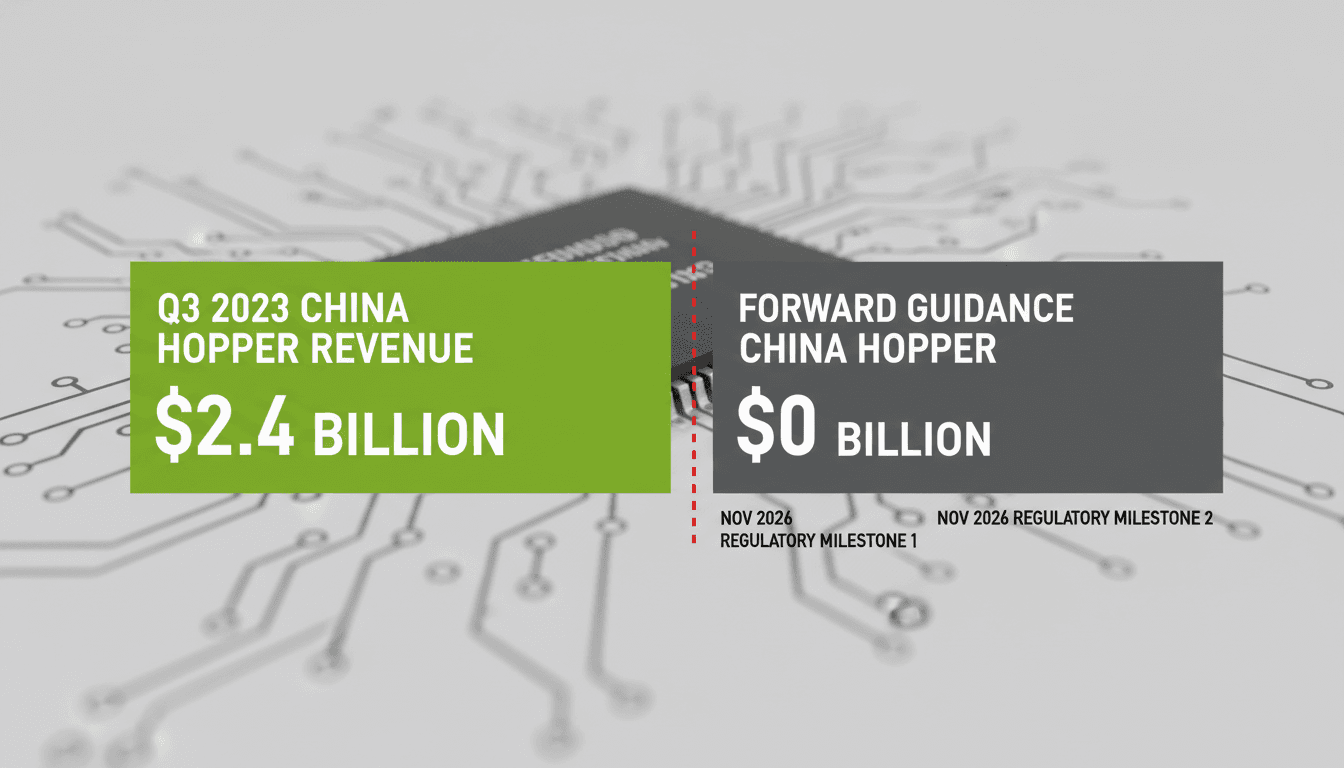
Voluntarily abandoning a licensed $2.4 billion quarterly product line signals that regulatory and legal exposure now outweighs direct enterprise sales for dominant semiconductor manufacturers.
What happened (in 30 seconds)
- Shipments halted immediately: Nvidia confirmed on November 17, 2026, that it has stopped shipping licensed Hopper-series data center chips to China and will exclude those sales from future guidance.
- Leadership transition completed: Interim CEO Colette Kress announced the strategic shift during the Q3 earnings call following the resignation of former CEO Jensen Huang amid export control inquiries.
- Internal governance overhauled: The board established a dedicated export control committee to oversee international compliance following new US Commerce Department restrictions on remote chip access.
The context you actually need
- The regulatory trajectory began years ago: The United States started tightening semiconductor export rules in 2022 to maintain technological superiority, later narrowing allowances for modified architectures like the H200.
- Remote computing became the new perimeter: On November 16, 2026, the US Department of Commerce introduced rules requiring explicit licenses for overseas third-country data centers serving Chinese entities.
- Prior exemptions generated billions: Despite tightening trade parameters, Nvidia generated $2.4 billion in Q3 2026 alone from Hopper-series deliveries that had secured prior US export approvals.
What's really happening
The decision to cut off China-bound Hopper processors marks a fundamental pivot from regulatory adaptation to risk elimination. For several quarters, the operational baseline for semiconductor vendors relied on designing specific, modified silicon variants to remain within the letter of evolving trade controls. That architecture allowed Nvidia to service mainland enterprise customers while navigating export rules through direct licensing and domestic routing frameworks.
The incentives governing this market have now inverted. The US Department of Commerce's November 16, 2026, rule closed off third-country remote access mechanisms, signaling that indirect compute pathways face the same legal exposure as physical hardware transfers. Operating within adjacent or grey-zone arrangements carries escalating internal costs. Following investigations into hardware diversion and the subsequent leadership vacuum left by former CEO Jensen Huang, Nvidia’s incoming leadership under Interim CEO Colette Kress has chosen to sacrifice an active $2.4 billion quarterly revenue pipeline to shield its core corporate standing.
By excluding Chinese enterprise deliveries from forward guidance entirely, the enterprise eliminates earnings volatility stemming from sudden licensing revocations. The creation of a board-level export control committee formalizes this posture: governance is shifting from aggressive commercial optimization to strict compliance insulation. Rather than expending resources modifying chips to comply with rapidly moving regulatory targets, the company is prioritizing stability in primary markets where capital expenditures for AI infrastructure remain robust.
This shift affects the structural availability of secondary compute tiers. Because licensed Hopper chips represented the highest-grade approved processors available to Chinese developers, their withdrawal leaves enterprise builders inside that ecosystem without access to Tier-1 infrastructure. For global technology leaders, this divergence fragments enterprise software development: applications built on cutting-edge architectures will operate on an entirely separate hardware foundation from systems developed inside mainland China. Hardware optimization is no longer just a technical choice; it is an artifact of regulatory geography.
Who feels it first (and how)
- Enterprise technology buyers: Infrastructure procurement leads outside mainland China will likely see reduced competition for Hopper-class compute capacity as allocations redirect toward Western hyperscalers.
- Chinese cloud providers and AI developers: Engineering teams lose access to legal imports of Hopper architecture, forcing compute constraints onto domestic alternatives or legacy infrastructure.
- Semiconductor industry investors: Portfolios weighted in advanced hardware must absorb the loss of $2.4 billion in quarterly revenue without direct compensation from replacement markets in the near term.
- Compliance and legal officers: Corporate leadership managing dual-market supply chains must reassess cross-border remote server access under the Commerce Department’s revised parameters.
What to watch next
- Board committee enforcement metrics: The cadence and public disclosure of decisions made by Nvidia's newly formed export oversight board will indicate how aggressively the firm audits third-party buyers.
- Redirection of Hopper inventory: Data on how quickly the enterprise redirects the $2.4 billion worth of quarterly production volume toward North American and European cloud providers will measure underlying demand elasticity.
- Enforcement actions on third-country data hubs: Regulatory actions taken by the US Bureau of Industry and Security against overseas data centers will reveal whether the remote-access ban effectively closes off compute leasing.
Nvidia halted shipments of licensed Hopper chips to China on or before November 17, 2026, after generating $2.4 billion from the line in Q3, and formed a board-level export control committee.
Capital expenditure by Western cloud providers will absorb a portion of the newly unallocated Hopper inventory over subsequent quarters.
Whether Chinese enterprise firms can replace this compute throughput via domestic fabrication or if overall AI deployment inside that market will slow significantly.
Frequently Asked Questions
- Why it matters?
- Voluntarily abandoning a licensed $2.4 billion quarterly product line signals that regulatory and legal exposure now outweighs direct enterprise sales for dominant semiconductor manufacturers.
- What happened (in 30 seconds)?
- Shipments halted immediately: Nvidia confirmed on November 17, 2026, that it has stopped shipping licensed Hopper-series data center chips to China and will exclude those sales from future guidance. Leadership transition completed: Interim CEO Colette Kress announced the strategic shift during the Q3 earnings call following the resignation of former CEO Jensen Huang amid export control inquiries. Internal governance overhauled: The board established a dedicated export control committee to overse
- What's really happening?
- The decision to cut off China-bound Hopper processors marks a fundamental pivot from regulatory adaptation to risk elimination. For several quarters, the operational baseline for semiconductor vendors relied on designing specific, modified silicon variants to remain within the letter of evolving trade controls. That architecture allowed Nvidia to service mainland enterprise customers while navigating export rules through direct licensing and domestic routing frameworks. The incentives governin
- Who feels it first (and how)?
- Enterprise technology buyers: Infrastructure procurement leads outside mainland China will likely see reduced competition for Hopper-class compute capacity as allocations redirect toward Western hyperscalers. Chinese cloud providers and AI developers: Engineering teams lose access to legal imports of Hopper architecture, forcing compute constraints onto domestic alternatives or legacy infrastructure. Semiconductor industry investors: Portfolios weighted in advanced hardware must absorb the loss
- What to watch next?
- Board committee enforcement metrics: The cadence and public disclosure of decisions made by Nvidia's newly formed export oversight board will indicate how aggressively the firm audits third-party buyers. Redirection of Hopper inventory: Data on how quickly the enterprise redirects the $2.4 billion worth of quarterly production volume toward North American and European cloud providers will measure underlying demand elasticity. Enforcement actions on third-country data hubs: Regulatory actions tak
Technology business news, market impacts, and innovation trends.
"Bloomberg is a premier financial and tech news provider, respected for its in-depth reporting and analytical rigor."
— A47 Editor
Nvidia Stops Selling AI Chips to China Despite US Approval
Nvidia Corp. has stopped shipping its Hopper data center chips to China, even though the US government approved a version of the model for sale to the country last year, according to Bloomberg Technology reporting. The halt comes amid a sharp escalat...
Technology business and AI-related headlines.
"Data-driven tech newsroom with global scope."
— A47 Editor
Nvidia Stops Selling AI Chips to China Despite US Approval
Nvidia Corp. has stopped shipping its Hopper data center chips to China, even though the US government approved a version of the model for sale to the country last year, according to Bloomberg Technology reporting. The halt comes amid a sharp escalat...
Curated insights and thought leadership in enterprise technology.
"Ciente.io delivers curated insights, thought leadership, and trends in B2B tech and innovation."
— A47 Editor
The US Tightens Export Controls on Advanced Nvidia Chips after the Huang State of Affairs
The US government is tightening export controls on advanced Nvidia AI chips as the fallout from the ouster of Nvidia co-founder and CEO Jensen Huang continues. Huang resigned after the company's board opened an investigation into his relationship wit...
Market-moving headlines impacting equities, bonds, and related risk assets.
"Real-time catalysts and volatility drivers across indices and sectors."
— A47 Editor
Nvidia to halt chip sales to data centers renting over half to China - report
Nvidia is reported to be halting chip sales to data centers that rent more than half of their capacity to Chinese customers, according to a report carried by Investing.com. The move comes amid a wider sell-off in AI and chip stocks after co-founder a...
Science discoveries, research, and analysis.
"NPR is a nonprofit media organization offering thoughtful, in-depth journalism and storytelling, often with a liberal or progressive slant."
— A47 Editor
U.S. tightens controls on remote access to AI technology amid Nvidia fallout
The U.S. has tightened controls on remote access to advanced AI technology, closing a loophole that had allowed Chinese companies to keep using advanced AI chips from afar despite restrictions on their physical sale to China. The move, reported by NP...
Policy, elections, and government reporting.
"NPR is an American public media organization known for thoughtful reporting and a slightly left-leaning editorial tone."
— A47 Editor
U.S. tightens controls on remote access to AI technology amid Nvidia fallout
The U.S. has tightened controls on remote access to advanced AI technology, closing a loophole that had allowed Chinese companies to keep using advanced AI chips from afar despite restrictions on their physical sale to China. The move, reported by NP...
Tech industry news, innovation, gadgets, and startups from a UK broadcaster.
"Sky News is often seen as a center-right outlet in the UK, known for its rolling coverage and breaking stories."
— A47 Editor
US to further curb China's access to Nvidia chips
The US government is set to further restrict China's access to the most powerful AI chips, such as those supplied by Nvidia, according to a report from Sky News citing Reuters. The move aims to curb Beijing's ability to obtain advanced American chip ...
News from the United States including domestic politics, society, and culture.
"Sky News is often seen as a center-right outlet in the UK, known for its rolling news coverage and emphasis on breaking stories and political affairs."
— A47 Editor
US to further curb China's access to Nvidia chips
The US government is set to further restrict China's access to the most powerful AI chips, such as those supplied by Nvidia, according to a report from Sky News citing Reuters. The move aims to curb Beijing's ability to obtain advanced American chip ...
International news, politics, and culture.
"Sky News is a UK-based 24-hour channel known for fast-breaking news and political coverage."
— A47 Editor
US to further curb China's access to Nvidia chips
The US government is set to further restrict China's access to the most powerful AI chips, such as those supplied by Nvidia, according to a report from Sky News citing Reuters. The move aims to curb Beijing's ability to obtain advanced American chip ...