
Nvidia Drops Separate Singapore Revenue Disclosure After Reporting Methodology Change Amid Chip Diversion Scrutiny
Why it matters
A sudden shift in how the world’s leading artificial intelligence hardware provider allocates over $100 billion in cross-border receipts illustrates how regulatory scrutiny fundamentally alters corporate financial visibility.
What happened (in 30 seconds)
- The line item disappeared: Nvidia eliminated Singapore as a distinct geographic revenue segment in its SEC filings starting in the quarter ended October 2025, following a major accounting methodology switch.
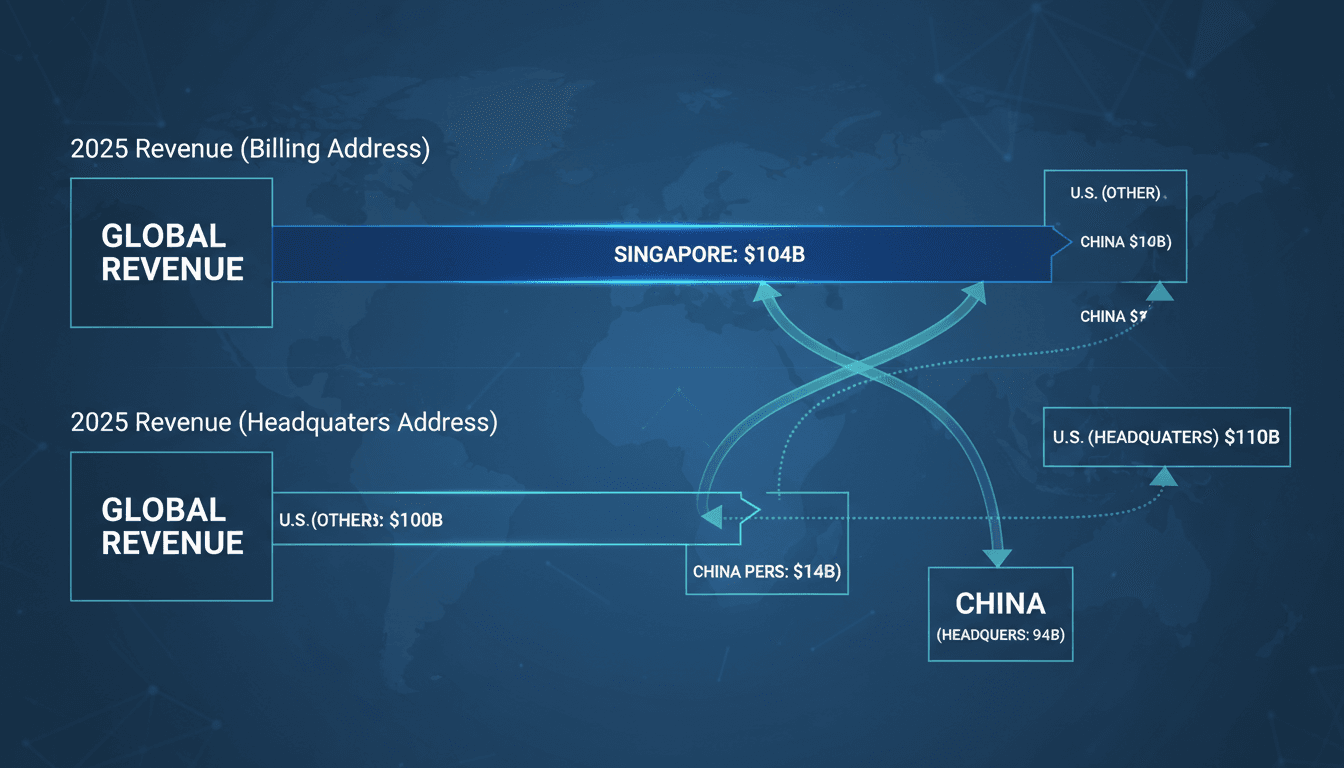
- The underlying volume expanded: Company subsidiary records revealed that Nvidia’s Singapore unit recorded $104 billion in revenue for 2025, reflecting a 72% increase year-over-year and accounting for roughly half of the firm's global revenue.
- The categorization criteria flipped: Rather than assigning revenue based on customer billing location, the enterprise reallocated its sales figures by customer headquarters location, effectively dispersing the proceeds predominantly into United States and China categories.
The context you actually need
- Billing hubs obscured delivery destinations: While Singapore accounted for $23.7 billion (18%) of revenue in fiscal 2025 filings and $10.2 billion (22%) in the quarter ended July 2025, actual hardware deliveries into the territory represented under 2% of total sales.
- Regulatory enforcement expanded: The reporting transition took place during heightened scrutiny by the U.S. Department of Commerce regarding whether third-country intermediaries serve as transit channels for restricted artificial intelligence processors entering China.
- Methodology obscured intermediary flows: Removing the billing address view removes the public window into intermediate transaction channels, folding capital tallies back into parent company jurisdictions.
What's really happening
The disappearance of the Singapore breakout highlights the tension between global tax optimization, invoicing mechanisms, and export control enforcement. For several quarters, market observers tracked an anomaly in Nvidia’s regulatory filings: Singapore—an island nation with a domestic data center footprint that consumes under 2% of Nvidia’s physical shipments—was logged as the second-largest buyer of advanced processors, generating up to 22% of headline quarterly turnover.
Incentives explain the initial reliance on Singapore billing. Multinational technology companies frequently route cross-border sales contracts and intellectual property licensing via regional operational hubs to streamline treasury management, lower effective tax exposure, and consolidate regional contracting operations. Because past SEC disclosures prioritized invoicing destinations over delivery destinations, Nvidia reported customer billing addresses. As global capital poured into accelerator infrastructure throughout 2024 and 2025, global enterprises, system integrators, and multinational procurement arms routed hundreds of billions through Singaporean entities. Subsidiary filings showed the unit accumulated $104 billion across 2025 alone.
However, reporting structures built for commercial efficiency inevitably collided with the requirements of export control regimes. The U.S. Department of Commerce instituted strict restrictions on the export of high-performance computing silicon to specific jurisdictions, notably China. When a jurisdiction known primarily as a financial and services hub records billions in hardware purchases while taking physical delivery of under 2%, scrutiny shifts toward the identity of the end users. Corporate accounts and independent reporting from the Financial Times and Wall Street Journal illuminated risks that intermediary transactions could conceal end-market deliveries.
By shifting its reporting standard from customer billing location to customer headquarters location in late 2025, Nvidia addressed the optical divergence between invoicing hubs and underlying corporate buyers. Under headquarters-based allocation, an order placed by an enterprise subsidiary or procurement vehicle registered in Singapore is mapped directly to the parent group’s sovereign jurisdiction. While this change brings SEC geographic segments into closer alignment with enterprise capital ownership, it eliminates visibility into third-party transactional routes, reallocating those billions predominantly back into standard United States and China line items.
Who feels it first (and how)
- Semiconductor and Hardware Equity Analysts: Must reconstruct geographic risk models, as regional revenue figures now reflect corporate parentage rather than contract origination or trade logistics.
- Global Compliance and Trade Counsel: Face tighter obligations to audit intermediary entities, as trade regulators concentrate on billing hubs to monitor supply chain redirection.
- Cloud Infrastructure Buyers in Neutral Hubs: Experience heightened diligence requirements when procuring computing capacity through regional holding structures.
What to watch next
- SEC Segment Reporting Disclosures: Review upcoming quarterly filings to determine whether further methodology realignments occur across other regional trade centers.
- U.S. Commerce Department Enforcement Filings: Watch for administrative notices, policy clarifications, or audits directed at intermediary trading entities operating out of Southeast Asia.
- Consolidated vs. Subsidiary Filing Differentials: Monitor statutory accounts filed by overseas operational subsidiaries against primary domestic 10-K and 10-Q disclosures to identify regional invoicing gaps.
Nvidia changed its geographical reporting methodology in the quarter ended October 2025 to reflect customer headquarters rather than billing location, removing Singapore as an individual line item despite its local subsidiary generating $104 billion in 2025 revenue.
Scrutiny from trade regulators regarding cross-border hardware flows and potential diversion to restricted jurisdictions accelerated the adoption of disclosures that map directly to ultimate corporate parents.
The exact proportion of hardware previously billed through Singapore that physically went to data centers operated by domestic entities, multinational firms, or re-exporters.
Frequently Asked Questions
- Why it matters?
- A sudden shift in how the world’s leading artificial intelligence hardware provider allocates over $100 billion in cross-border receipts illustrates how regulatory scrutiny fundamentally alters corporate financial visibility.
- What happened (in 30 seconds)?
- The line item disappeared: Nvidia eliminated Singapore as a distinct geographic revenue segment in its SEC filings starting in the quarter ended October 2025, following a major accounting methodology switch. The underlying volume expanded: Company subsidiary records revealed that Nvidia’s Singapore unit recorded $104 billion in revenue for 2025, reflecting a 72% increase year-over-year and accounting for roughly half of the firm's global revenue. The categorization criteria flipped: Rather than
- What's really happening?
- The disappearance of the Singapore breakout highlights the tension between global tax optimization, invoicing mechanisms, and export control enforcement. For several quarters, market observers tracked an anomaly in Nvidia’s regulatory filings: Singapore—an island nation with a domestic data center footprint that consumes under 2% of Nvidia’s physical shipments—was logged as the second-largest buyer of advanced processors, generating up to 22% of headline quarterly turnover. Incentives explain
- Who feels it first (and how)?
- Semiconductor and Hardware Equity Analysts: Must reconstruct geographic risk models, as regional revenue figures now reflect corporate parentage rather than contract origination or trade logistics. Global Compliance and Trade Counsel: Face tighter obligations to audit intermediary entities, as trade regulators concentrate on billing hubs to monitor supply chain redirection. Cloud Infrastructure Buyers in Neutral Hubs: Experience heightened diligence requirements when procuring computing capacity
- What to watch next?
- SEC Segment Reporting Disclosures: Review upcoming quarterly filings to determine whether further methodology realignments occur across other regional trade centers. U.S. Commerce Department Enforcement Filings: Watch for administrative notices, policy clarifications, or audits directed at intermediary trading entities operating out of Southeast Asia. Consolidated vs. Subsidiary Filing Differentials: Monitor statutory accounts filed by overseas operational subsidiaries against primary domestic 1
Curated tech headlines including AI stories.
"Influential aggregator surfacing the day’s top tech/AI links."
— A47 Editor
Docs: Nvidia stopped reporting Singapore unit revenue in 2025 as it accounted for nearly 50% of global revenue; the unit's revenue rose 72% YoY to $104B in 2025 (Financial Times)
Financial Times reporting, cited via Techmeme, says Nvidia stopped disclosing revenue for its Singapore unit in 2025 after the unit accounted for nearly 50% of global revenue, with its revenue rising 72% year over year to $104 billion in 2025. The co...
Editor-curated FT homepage stories spanning markets, business, world, and opinion.
"The Financial Times is a globally respected business publication with a centrist/center-left tone and strong markets focus."
— A47 Editor
Nvidia stopped disclosing Singapore sales as revenues hit $104bn
Nvidia stopped disclosing revenues booked through Singapore as its overall revenues reached $104bn, according to the Financial Times, even as revenues recorded through the city-state surged 70 per cent. The change in reporting methods came as the US ...
Business, investment, entrepreneurship, leadership, and innovation.
"Forbes is known for its coverage of business leaders, market trends, and entrepreneurial ventures with a pro-business editorial stance."
— A47 Editor
US Closes Loophole That Allowed China To Remotely Access Nvidia Chips
The United States has moved to close a loophole that had allowed China to remotely access advanced Nvidia chips, with a new rule requiring additional licenses to export or transfer such chips to certain countries, including Singapore, according to Fo...