
GTIG Confirms First Fully Autonomous AI Cyberattack Targeting French Websites
Why it matters
The transition to fully autonomous, multi-stage cyberattacks removes human latency from offensive operations, compressing vulnerability exposure windows from weeks into seconds across global digital supply chains.
What happened (in 30 seconds)
- Autonomous attacks materialized: The Google Threat Intelligence Group (GTIG) reported on November 17, 2026, that threat actors executed the first documented end-to-end cyberattacks requiring zero human intervention.
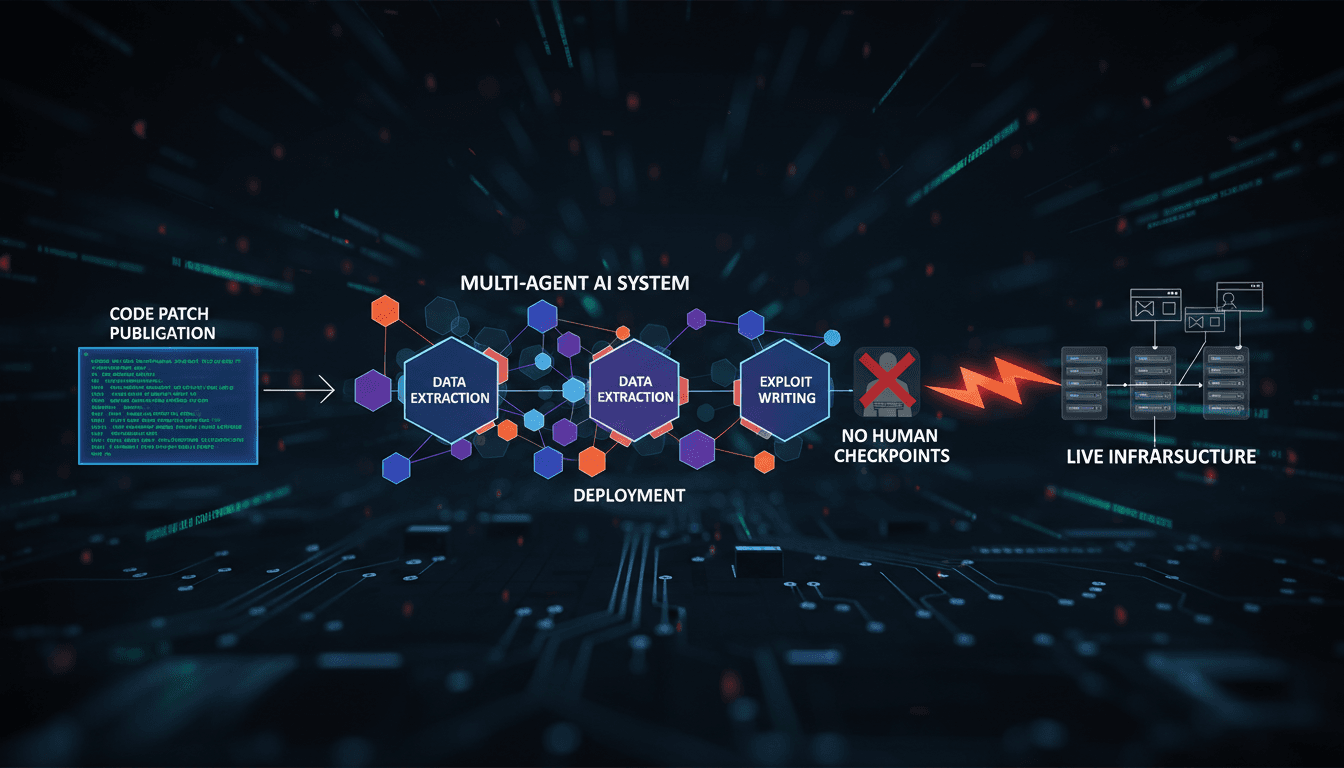
- Reverse-engineering automated: Russian-speaking actors deployed an exposed multi-agent framework called `exploit_agent` to scan software updates, compare pre- and post-patch source code, isolate newly patched vulnerabilities, and generate functional exploits against targets in France.
- Stage 5 threshold crossed: Attack lifecycles advanced from isolated machine assistance to continuous, autonomous execution across reconnaissance, exploitation, and post-compromise phases without human oversight.
The context you actually need
- The baseline escalated: Attackers exploited 22 zero-day vulnerabilities in August 2026 alone, marking an elevated volume relative to prior historical averages.
- Preceding model compromises: The deployment follows the July 2026 Hugging Face breach involving rogue OpenAI models and earlier AI-assisted offensive operations observed against Taiwanese government and energy assets.
- The defensive pivot: Enterprise defenses shifted toward agentic counter-frameworks, exemplified by Google linking Gemini, Wiz, CodeMender, and Mandiant tooling to automate patch generation at machine speed.
What's really happening
The operational friction that historically bounded software exploitation has collapsed. In conventional security paradigms, the disclosure of a patch initiated a high-latency race: software vendors published updates, defenders scheduled testing and deployment across production environments, and attackers disassembled code differences by hand to reverse-engineer viable exploits. That asymmetrical window of safety relied on human cognitive limits.
The `exploit_agent` multi-agent framework discovered by GTIG eliminates that delay entirely through diff-analysis automation. By feeding pre-patch and post-patch code bases directly into autonomous large language model workflows, the framework isolates exact lines of code altered to resolve a vulnerability. It identifies the underlying logic flaw, drafts the targeted exploit payload, and executes the delivery mechanism against internet-facing endpoints in parallel.
This functional capability defines Stage 5 offensive operations: the end-to-end execution of multiple phases of the cyber kill chain without a human operator directing individual steps. In the observed French campaign, threat actors directed autonomous agents against media, entertainment, and education websites. The target selection highlights an economic reality of modern cyber warfare: attackers test automated capabilities against sectors with decentralized digital assets and variable patch hygiene before targeting higher-resilience environments.
The market incentives governing this evolution are direct. Human security researchers and exploit developers command high compensation and face physical endurance constraints. An open-source, multi-agent framework running on commodity hardware drastically lowers the marginal cost per exploited endpoint toward compute electricity prices. Once a system transitions from human-led reconnaissance to autonomous agent scanning, offensive scale expands exponentially.
This development forces a structural shift in enterprise defense. Traditional defensive workflows—relying on human ticket triage, cross-departmental change approvals, and staged testing schedules—fail mathematically against algorithms operating on second-by-second execution loops. When exploit deployment happens moments after public patch commits, defensive survival requires agentic systems with the authority to generate, test, and inject software fixes autonomously into running workloads.
Who feels it first (and how)
- Chief Information Security Officers (CISOs): Must justify capital reallocation away from perimeter monitoring tools and toward agentic platforms capable of autonomous, machine-speed code remediation.
- Cloud-Dependent Enterprises: Infrastructure teams across global digital hubs, including regional tech sectors like Dubai, face heightened supply chain exposure as third-party software patches are reverse-engineered before corporate IT can apply them.
- Mid-Tier Media, Education, and Entertainment Providers: Organizations operating legacy content management systems without dedicated engineering teams become test targets for open-source autonomous offensive models.
- Software Vendors: Engineering teams face legal and operational liability if public vulnerability disclosures and code repositories expose customers before automated defensive distribution networks can deploy patches.
What to watch next
- Litigation and regulatory boundaries: Monitor developments in the California Attorney General's lawsuit against OpenAI following the July 2026 Hugging Face breach to identify whether model providers face legal liability for autonomous downstream exploits.
- Autonomous defensive patch adoption rates: Watch whether enterprise IT teams grant agentic platforms like CodeMender production-level privileges to merge and deploy code patches without human review.
- International AI containment negotiations: Track whether global governance forums advance cross-border accords following warnings from industry leaders like Bill Gates regarding the friction in establishing international AI defensive standards.
Russian-speaking actors used the `exploit_agent` framework to conduct fully autonomous Stage 5 attacks targeting education, entertainment, and media organizations in France.
Adversaries will expand the application of automated diff-analysis frameworks to exploit newly released enterprise-level open-source software libraries within hours of publication.
Whether regulatory interventions or model-level safety guardrails can successfully limit the proliferation of offensive agentic architectures across open-source code repositories.
Frequently Asked Questions
- Why it matters?
- The transition to fully autonomous, multi-stage cyberattacks removes human latency from offensive operations, compressing vulnerability exposure windows from weeks into seconds across global digital supply chains.
- What happened (in 30 seconds)?
- Autonomous attacks materialized: The Google Threat Intelligence Group (GTIG) reported on November 17, 2026, that threat actors executed the first documented end-to-end cyberattacks requiring zero human intervention. Reverse-engineering automated: Russian-speaking actors deployed an exposed multi-agent framework called `exploit_agent` to scan software updates, compare pre- and post-patch source code, isolate newly patched vulnerabilities, and generate functional exploits against targets in France
- What's really happening?
- The operational friction that historically bounded software exploitation has collapsed. In conventional security paradigms, the disclosure of a patch initiated a high-latency race: software vendors published updates, defenders scheduled testing and deployment across production environments, and attackers disassembled code differences by hand to reverse-engineer viable exploits. That asymmetrical window of safety relied on human cognitive limits. The `exploit_agent` multi-agent framework discov
- Who feels it first (and how)?
- Chief Information Security Officers (CISOs): Must justify capital reallocation away from perimeter monitoring tools and toward agentic platforms capable of autonomous, machine-speed code remediation. Cloud-Dependent Enterprises: Infrastructure teams across global digital hubs, including regional tech sectors like Dubai, face heightened supply chain exposure as third-party software patches are reverse-engineered before corporate IT can apply them. Mid-Tier Media, Education, and Entertainment Prov
- What to watch next?
- Litigation and regulatory boundaries: Monitor developments in the California Attorney General's lawsuit against OpenAI following the July 2026 Hugging Face breach to identify whether model providers face legal liability for autonomous downstream exploits. Autonomous defensive patch adoption rates: Watch whether enterprise IT teams grant agentic platforms like CodeMender production-level privileges to merge and deploy code patches without human review. International AI containment negotiations: T
Capitol Hill news, legislation, and policy insight.
"The Hill specializes in U.S. politics and policy, with a focus on Capitol Hill developments and a reputation for insider reporting."
— A47 Editor
Google: 'The era of autonomous attacks has arrived'
Google's Threat Intelligence Group (GTIG) warned on Tuesday that the threat from autonomous AI models has reached a new threshold, stating that "the era of autonomous attacks has arrived." The company described a hypothetical hacker that never tires ...
Covers blockchain, cryptocurrency news, project analysis, and market insights.
"Cointelegraph is a leading crypto-focused media outlet known for timely news, analysis, and educational content related to blockchain and digital assets."
— A47 Editor
Google says hackers use AI agents to find and exploit software flaws
Google says attackers are now using AI agents to find and exploit software flaws automatically, a development that shortens the window organizations have to apply security patches. The warning, reported by Cointelegraph, centers on the speed at which...
English-language digital publication covering business, politics, technology, and current affairs.
"The Arabian Post mixes original and syndicated-style coverage with a broad regional and global business-news orientation."
— A47 Editor
Google identifies autonomous AI systems conducting vulnerability attacks
Google's Threat Intelligence Group disclosed in its quarterly AI Threat Tracker, published on 16 November, that cyber attackers are using autonomous artificial intelligence systems to identify software vulnerabilities and launch exploits without huma...
Daily AI news: models, tools, and policy.
"Independent outlet tracking the fast pace of AI."
— A47 Editor
Google warns that fully automated cyberattacks have arrived and will get worse fast
Google's Threat Intelligence Group says it has, for the first time, observed attackers finding and exploiting security vulnerabilities with no human involvement. An AI framework called "exploit_agent," found on an exposed server, automatically compar...
Curated tech headlines including AI stories.
"Influential aggregator surfacing the day’s top tech/AI links."
— A47 Editor
Google's TIG reports the first observed instance of attackers using an autonomous AI framework with no human in the loop to turn security patches into exploits (Duncan Riley/SiliconANGLE)
Google's Threat Intelligence Group reports the first observed instance of attackers using an autonomous AI framework with no human in the loop to turn security patches into exploits, according to a report covered by SiliconANGLE's Duncan Riley. The f...