
US Commerce Department Expands AI Chip Export Licence Requirements to Five Countries to Block Diversion to China
Why it matters
The expansion of export licensing transforms regional cloud data centers into actively monitored border checkpoints, testing whether targeted trade controls can contain computing power without splintering global tech infrastructure.
What happened (in 30 seconds)
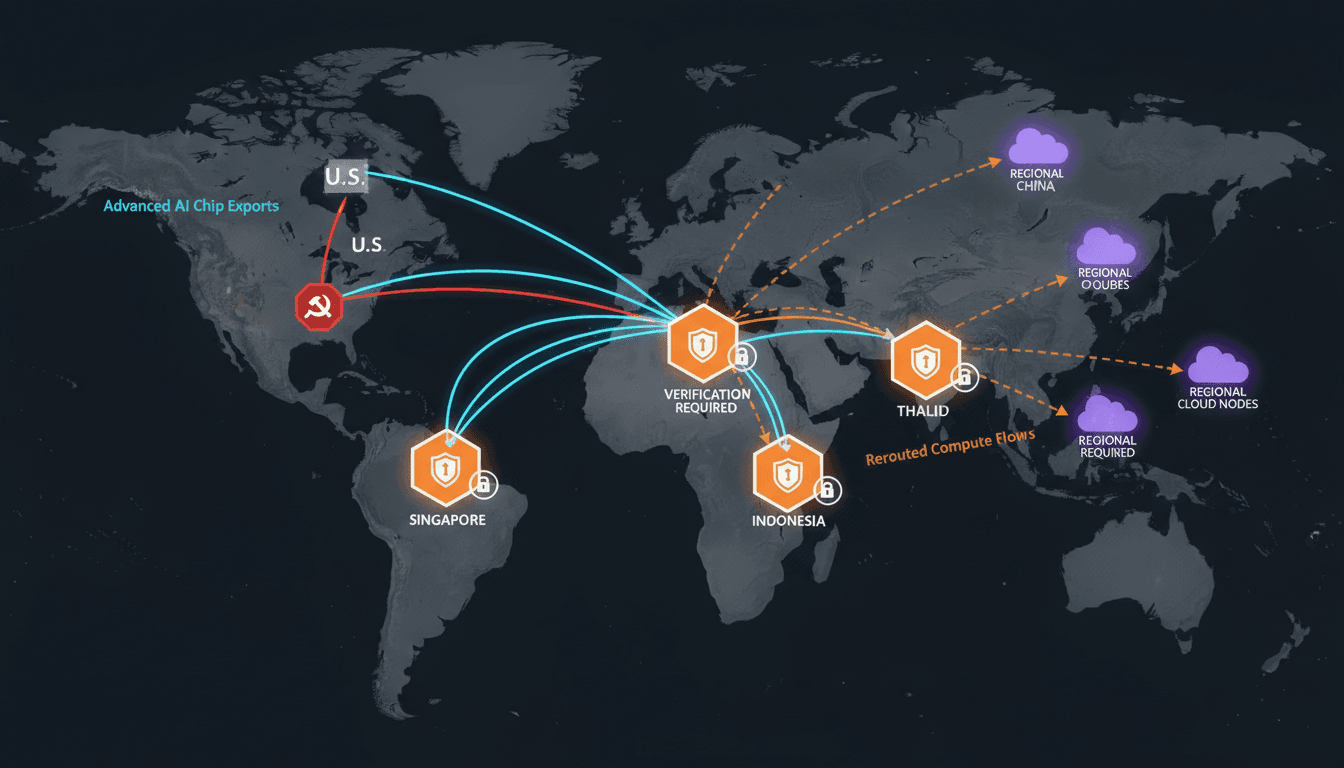
- The Bureau of Industry and Security expanded licensing controls: On November 16, 2026, the U.S. Commerce Department released a 132-page interim final rule requiring export licenses for advanced AI chips shipped to Malaysia, Thailand, Indonesia, Singapore, and Brazil.
- Data center operations face strict new compliance obligations: The rule mandates that overseas data facilities serving Chinese-headquartered entities register and obtain licenses, rescinding the previous administration's AI Diffusion Rule with immediate effect.
- Public markets registered an immediate drop: Equity valuations slipped across the semiconductor and compute sector, with AMD and CoreWeave dropping by approximately 5% and Nvidia sliding 4% following the publication.
The context you actually need
- Remote access had become an established bypass mechanism: Following the initial 2022 restrictions aimed at Beijing's advanced computing capabilities, Chinese enterprises routed their workloads through third-party cloud infrastructure hosted across Southeast Asia.
- Scrutiny intensified around private-sector links: Internal friction between Commerce Secretary Howard Lutnick, Treasury Secretary Scott Bessent, and the National Security Council escalated following revelations regarding former Nvidia CEO Jensen Huang's ties to Megaspeed International, a Singapore-based provider.
- The regulatory clock has started running: While the interim final rule took effect immediately upon release, the agency established a 60-day public comment window alongside a 90-day grace period for affected data facilities to secure necessary licenses.
What's really happening
The Commerce Department's 132-page interim final rule marks a structural transition in how technology restrictions operate. For years, semiconductor export controls focused on the physical movement of silicon across sovereign borders. If an advanced graphics processing unit did not enter a restricted jurisdiction, the transaction cleared. However, modern compute models operate decoupled from physical proximity. By renting remote server capacity in neutral geographic corridors, international developers accessed cutting-edge capabilities without possessing the physical hardware.
This regulatory pivot directly targets that operational architecture. By placing Malaysia, Thailand, Indonesia, Singapore, and Brazil under formal licensing regimes, the Bureau of Industry and Security is eliminating the geographic gray zones that previously served as regional compute clearinghouses. These five nations represent essential nodes in the global digital supply chain. Singapore operates as a primary regional colocation hub, while Malaysia and Thailand host rapidly expanding server farm infrastructure designed to meet global processing demands. Brazil provides an expanding landing zone for South American compute capacity.
The economic incentives underlying this rule reflect institutional friction within the administration. Treasury Secretary Scott Bessent openly linked the publication to inter-agency pressure driven by his office and the National Security Council, pushing past previous Commerce Department hesitation amid persistent scrutiny over historical enforcement gaps. The regulatory adjustment arrived concurrently with high-level diplomatic travel across Asia, signaling an intent to align administrative trade mechanisms with broader strategic posture.
For enterprise operators, the rule rewires the unit economics of international cloud provision. Facility operators now face legal exposure under U.S. export regulations if they provide advanced compute services to firms headquartered in restricted jurisdictions. Establishing physical operations outside traditional target markets no longer shields cloud providers from U.S. regulatory oversight if the underlying silicon originates from American designers.
This requirement introduces substantial verification burdens. Data center providers must audit workload origin, corporate ownership structures, and end-user access points. The resulting compliance costs alter capital expenditure calculations for building out regional data infrastructure. Consequently, the measure forces hosting facilities to decide whether to service Western hardware ecosystems under tight regulatory oversight or isolate their business models to accommodate unsanctioned clients.
Who feels it first (and how)
- Regional Cloud and Colocation Providers in Southeast Asia: Operators in Singapore, Malaysia, Indonesia, and Thailand must rapidly deploy compliance systems within 90 days to verify whether enterprise clients possess ultimate parent entities based in China.
- Advanced Chip Designers and Hardware Vendors: Companies like Nvidia and AMD face immediate regulatory friction in regional distribution, directly reflected in the initial 4% to 5% equity drop following the announcement.
- Infrastructure-as-a-Service (IaaS) Specialized Firms: Platforms such as CoreWeave face operational adjustments, balancing their buildout pipelines against new licensing requirements across newly controlled territories.
- Brazilian Data Center Developers: Expanding infrastructure operators in Latin America now fall inside the same compliance perimeter as Southeast Asian transport corridors, requiring unexpected regulatory clearances for hardware imports.
What to watch next
- The 90-day licensing operational deadline: Watch whether the Bureau of Industry and Security issues bulk approvals or experiences administrative backlogs as regional data centers submit compliance filings before mid-February 2027.
- Public comments over the 60-day feedback period: Monitor filings from international cloud operators and foreign trade ministries to see how private enterprise attempts to narrow the definition of foreign-headquartered access restrictions.
- Diplomatic and corporate counter-positioning: Track statements from cloud providers such as Megaspeed International and host-nation trade bodies navigating bilateral agreements with the United States.
The interim final rule takes effect immediately, rescinds the Biden-era AI Diffusion Rule, adds five specific countries to license review tracks, and gives data centers 90 days to comply.
The administrative workload will slow down hardware deployments to Southeast Asian facilities as the Bureau of Industry and Security processes unprecedented licensing volumes.
Whether the Commerce Department has sufficient monitoring capabilities to verify software-level remote access from offshore corporate entities without extensive on-site administrative audits.
Frequently Asked Questions
- Why it matters?
- The expansion of export licensing transforms regional cloud data centers into actively monitored border checkpoints, testing whether targeted trade controls can contain computing power without splintering global tech infrastructure.
- What happened (in 30 seconds)?
- The Bureau of Industry and Security expanded licensing controls: On November 16, 2026, the U.S. Commerce Department released a 132-page interim final rule requiring export licenses for advanced AI chips shipped to Malaysia, Thailand, Indonesia, Singapore, and Brazil. Data center operations face strict new compliance obligations: The rule mandates that overseas data facilities serving Chinese-headquartered entities register and obtain licenses, rescinding the previous administration's AI Diffusio
- What's really happening?
- The Commerce Department's 132-page interim final rule marks a structural transition in how technology restrictions operate. For years, semiconductor export controls focused on the physical movement of silicon across sovereign borders. If an advanced graphics processing unit did not enter a restricted jurisdiction, the transaction cleared. However, modern compute models operate decoupled from physical proximity. By renting remote server capacity in neutral geographic corridors, international deve
- Who feels it first (and how)?
- Regional Cloud and Colocation Providers in Southeast Asia: Operators in Singapore, Malaysia, Indonesia, and Thailand must rapidly deploy compliance systems within 90 days to verify whether enterprise clients possess ultimate parent entities based in China. Advanced Chip Designers and Hardware Vendors: Companies like Nvidia and AMD face immediate regulatory friction in regional distribution, directly reflected in the initial 4% to 5% equity drop following the announcement. Infrastructure-as-a-Ser
- What to watch next?
- The 90-day licensing operational deadline: Watch whether the Bureau of Industry and Security issues bulk approvals or experiences administrative backlogs as regional data centers submit compliance filings before mid-February 2027. Public comments over the 60-day feedback period: Monitor filings from international cloud operators and foreign trade ministries to see how private enterprise attempts to narrow the definition of foreign-headquartered access restrictions. Diplomatic and corporate count
Tech business coverage, major deals, product launches, and Silicon Valley trends.
"WSJ’s tech section offers authoritative reporting on the intersection of technology and business, including exclusive industry analysis."
— A47 Editor
The Morning Risk Report: Commerce Department Moves to Crack Down on Chip Exports
The U.S. Commerce Department is moving to crack down on advanced chip exports, according to the WSJ Tech Morning Risk Report, amid a growing espionage-linked scandal involving Nvidia and former CEO Jensen Huang, whose departure has not quieted scruti...
Insights and news on social issues, policy, and political movements across the United States.
"The Wall Street Journal is known for its deep political coverage, especially at the intersection of policy, regulation, and social dynamics."
— A47 Editor
The Commerce Department issued a long-awaited rule to crack down on shipments of chips from Nvidia and other U.S. companies to China
The U.S. Commerce Department has issued a long-awaited rule to crack down on shipments of advanced chips from Nvidia and other American companies to China, according to The Wall Street Journal. The measure reflects sustained pressure on the agency, i...
Corporate leadership, finance, technology, and market trends.
"Fortune covers financial trends, leadership, and innovation with a pragmatic editorial approach."
— A47 Editor
The Nvidia scandal fuels tougher China chip rules as Commerce targets Singapore and Malaysia
The U.S. Commerce Department is moving to expand export controls to five new countries and close a loophole that allowed China to access advanced Nvidia chips in overseas data centers, including in Singapore and Malaysia, as reported by Fortune. The ...
Right-of-center views on political news.
"The Washington Times is a conservative-leaning newspaper known for its political coverage and advocacy of right-of-center viewpoints."
— A47 Editor
Commerce Dept. cracks down on China's use of third-country computing power after Nvidia scandal
The U.S. Commerce Department has issued a rule restricting China's use of data centers in third-party countries, closing a loophole that allowed Beijing to tap into computing power from Nvidia's advanced chips even though physical sales were restrict...