
Optimizely Supply-Chain Attack Injects Crypto Address-Swapping Malware into 178 Websites Including Ledger
Why it matters
Third-party web tooling bypasses direct enterprise perimeter security, turning routine client-side analytics scripts into vectors for automated cross-chain asset theft.
What happened (in 30 seconds)
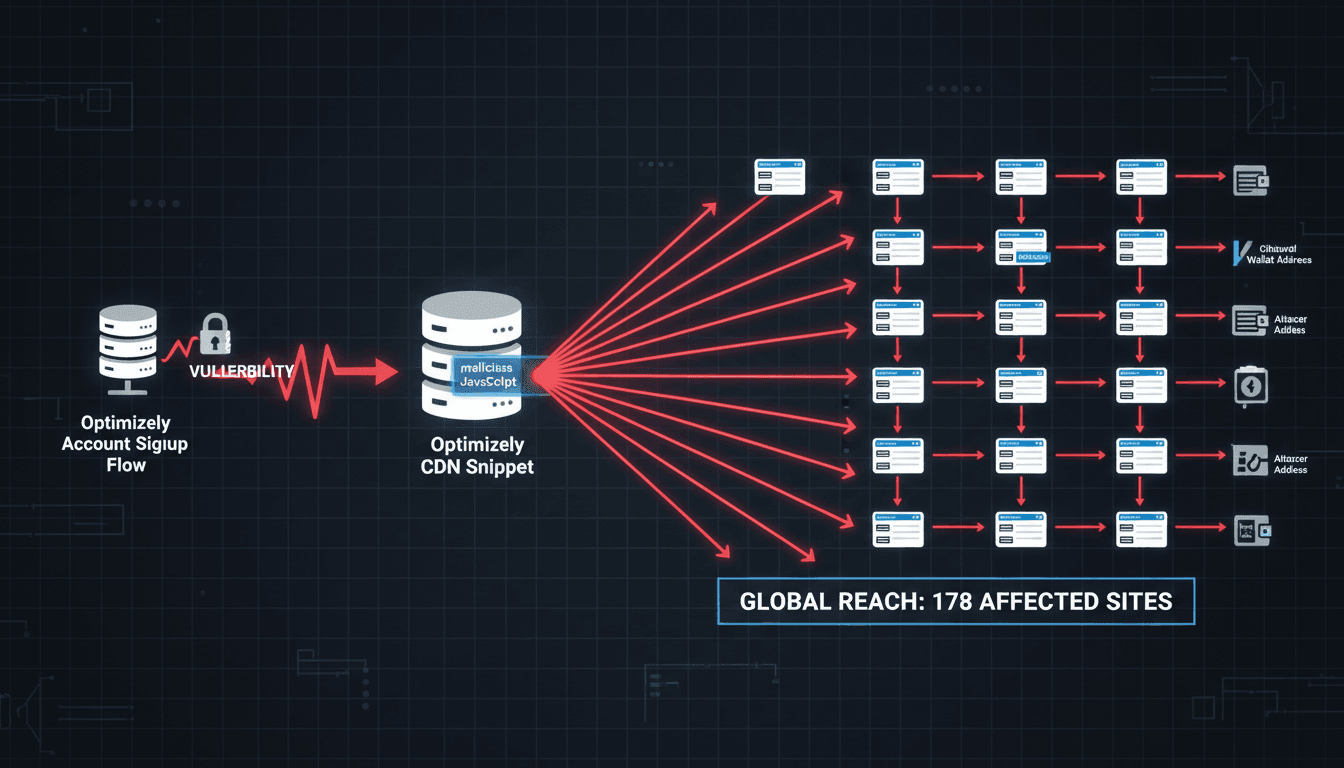
- The intrusion vector: Attackers manipulated an account signup-flow vulnerability in Optimizely Web to inject custom JavaScript into customer deployment snippets.
- The malicious footprint: The compromise hit 178 organizations across 188 distinct snippets, including Ledger, Zoom, BBC, CNN, and HSBC.
- The execution: Active for roughly 17 hours, the payload scanned browser clipboards to swap addresses across Bitcoin, Ethereum, Solana, and Tron, while simultaneously skimming payment cards and stealing session cookies.
The context you actually need
- Direct site perimeters were never breached: Target brands did not suffer database intrusions; browsers simply pulled compromised code straight from Optimizely’s trusted delivery domains.
- Attackers monetized five hours post-launch: Malicious snippets appeared around 08:10 UTC on November 16, 2026, and confirmed fund redirection to attacker-controlled wallets began at 13:03 UTC.
- Security monitoring caught the spread: Security researcher Scott Helme via Report URI identified the anomalous script injections across a sample of 1,611 monitored snippets, alerting operators before vendor cleanup concluded late that evening.
What's really happening
- It continuously scanned page elements and system clipboards for alphanumeric strings matching public key formats across Bitcoin, Ethereum, Solana, Tron, and other blockchains.
- When a user copied a destination address, the script substituted it with an attacker-controlled address belonging to the same network.
- For visitors not transacting cryptocurrency, the script acted as a digital card skimmer, intercepting checkout payment details, capturing user cookies, recording screen captures, and attempting iOS exploit delivery.
Who feels it first (and how)
- Active Web3 transactors: Anyone who copied wallet addresses on affected web interfaces between 08:10 UTC and 21:10 UTC on November 16 faces irreversible fund diversion if transactions were broadcast without manual address verification.
- Enterprise SecOps teams: Security leads managing marketing stacks must audit third-party script integrations, client-side Content Security Policies (CSP), and subresource integrity controls.
- Online consumers: Users purchasing goods or inputting financial credentials on affected sites during the active window risk exposure of card details and authenticated session tokens.
- SaaS procurement and compliance officers: Vendor risk managers must re-evaluate third-party providers with direct write access to front-end production document object models (DOM).
What to watch next
- Attacker wallet consolidation: On-chain tracking of destination wallets across Bitcoin, Ethereum, Solana, and Tron will establish the exact capital volume extracted during the five-hour operational window.
- Client-side security mandates: Industry adoption of strict Content Security Policy script-src directives and Subresource Integrity (SRI) hashing will signal whether enterprises structurally restrict dynamic third-party code injection.
- Optimizely post-incident disclosure: The vendor's forthcoming technical post-mortem will clarify the specific logic flaw within the registration sequence that granted unauthorized custom-code injection privileges.
The breach affected 188 snippets across 178 organizations, ran for roughly 17 hours on November 16, 2026, and actively altered clipboard addresses across major blockchains while skimming cards and capturing credentials.
The attackers automated the initial signup exploitation, rapidly injecting identical multi-purpose payloads across accessible enterprise accounts before detection mechanisms triggered alerts.
The total dollar valuation of cryptocurrency permanently diverted to attacker-controlled wallets across all networks remains unverified, as does the full quantity of exfiltrated payment-card records.
Frequently Asked Questions
- Why it matters?
- Third-party web tooling bypasses direct enterprise perimeter security, turning routine client-side analytics scripts into vectors for automated cross-chain asset theft.
- What happened (in 30 seconds)?
- The intrusion vector: Attackers manipulated an account signup-flow vulnerability in Optimizely Web to inject custom JavaScript into customer deployment snippets. The malicious footprint: The compromise hit 178 organizations across 188 distinct snippets, including Ledger, Zoom, BBC, CNN, and HSBC. The execution: Active for roughly 17 hours, the payload scanned browser clipboards to swap addresses across Bitcoin, Ethereum, Solana, and Tron, while simultaneously skimming payment cards and stealing
- What's really happening?
- The incident exposes how modern enterprise web architecture relies on blind trust in client-side third-party scripts. Rather than engineering zero-day exploits against hardened enterprise targets like Ledger or HSBC, the attackers targeted the operational periphery: an experimentation platform designed to test front-end interface changes. By exploiting an account signup flaw inside Optimizely, the threat actors obtained unauthorized write access to project custom-code features. This enabled them
- Who feels it first (and how)?
- Active Web3 transactors: Anyone who copied wallet addresses on affected web interfaces between 08:10 UTC and 21:10 UTC on November 16 faces irreversible fund diversion if transactions were broadcast without manual address verification. Enterprise SecOps teams: Security leads managing marketing stacks must audit third-party script integrations, client-side Content Security Policies (CSP), and subresource integrity controls. Online consumers: Users purchasing goods or inputting financial credentia
- What to watch next?
- Attacker wallet consolidation: On-chain tracking of destination wallets across Bitcoin, Ethereum, Solana, and Tron will establish the exact capital volume extracted during the five-hour operational window. Client-side security mandates: Industry adoption of strict Content Security Policy script-src directives and Subresource Integrity (SRI) hashing will signal whether enterprises structurally restrict dynamic third-party code injection. Optimizely post-incident disclosure: The vendor's forthcomi
Covers Bitcoin plus altcoin news, market updates, and educational resources.
"Bitcoin.com provides news, market data, and guides focused on Bitcoin and the wider crypto industry."
— A47 Editor
Hackers Hit Ledger and 177 Other Brands With a Crypto Address-Swapping Attack
Hackers planted crypto-stealing code on the websites of Ledger and roughly 177 other brands in an address-swapping attack, according to reporting by Bitcoin.com. The malicious scripts were tied to a compromised Optimizely supply chain and targeted us...
Real-time updates, analysis, and reports on the blockchain and cryptocurrency sectors.
"Crypto News delivers real-time updates, analysis, and reports on the blockchain and cryptocurrency sectors."
— A47 Editor
Optimizely supply chain attack targets crypto wallets across 186 websites
Crypto News reported that hackers compromised Optimizely website scripts to spread cryptocurrency-stealing malware across 186 websites, including sites associated with hardware wallet maker Ledger and crypto platform Coinpass, with researchers tracin...
Covers blockchain, cryptocurrency news, project analysis, and market insights.
"Cointelegraph is a leading crypto-focused media outlet known for timely news, analysis, and educational content related to blockchain and digital assets."
— A47 Editor
Hackers inject credit card, crypto-stealing malware into 178 major websites
Hackers injected malware designed to steal credit card and cryptocurrency details into 178 major websites, according to security researchers. Ledger and Coinpass were among the businesses whose sites served the malicious code to visitors.