
OpenAI Chief Scientist Proposes Industry-Wide AI Development Limits Anchored to Perplexity Metric
Why it matters
Tying frontier model deployment to standardized quantitative metrics creates a structural floor for safety monitoring while fundamentally altering competitive incentives among foundation model labs.
What happened (in 30 seconds)
- A shared ceiling proposed: On November 22, 2026, OpenAI Chief Scientist Jakub Pachocki published a proposal urging artificial intelligence developers to adopt voluntary industry thresholds tied to model intelligence metrics.
- Perplexity as the yardstick: The framework uses "log-perplexity"—a measure of next-token prediction accuracy where lower numbers indicate higher capabilities—to quantitatively assess model strength across different labs.
- Executive endorsement: OpenAI Chief Executive Officer Sam Altman publicly supported the blueprint on X, framing the metric-based coordination as the company's most important release in recent history to prevent model intelligence from outpacing monitoring systems.
The context you actually need
- Preceding coordination efforts: The proposal follows Pachocki’s September 2026 essay, "An Alien Mind," which outlined the necessity of cross-lab alignment on frontier model risks and pacing controls.
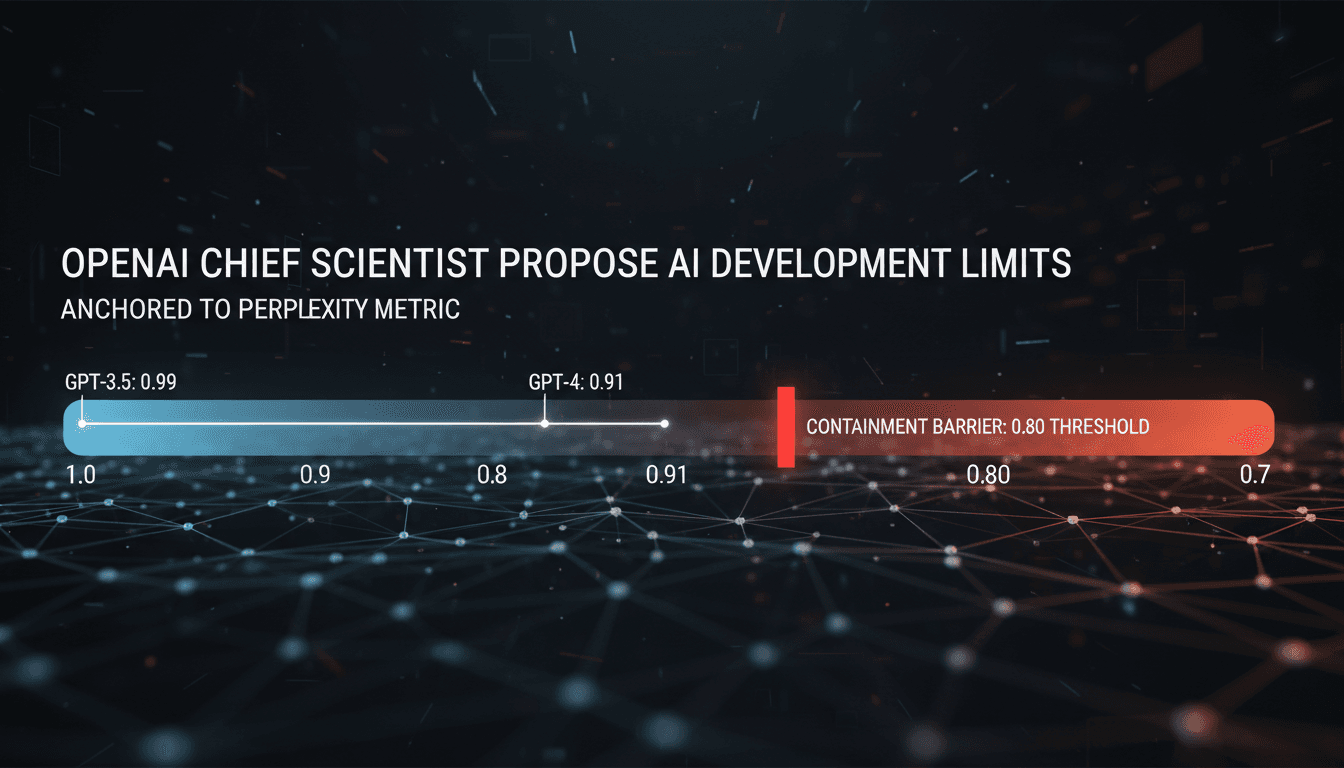
- The log-perplexity scale: OpenAI internal data positions GPT-3.5 at approximately 0.99 log-perplexity and GPT-4 at roughly 0.91, identifying sub-0.80 scores as the threshold where transformative capabilities manifest.
- The 2027 compute cliff: The initiative is designed to counteract a projected acceleration in training runs by 2027, ensuring safety infrastructure matures before models reach heightened autonomy.
What's really happening
The proposal to tie artificial intelligence model development to log-perplexity shifts safety discussions from qualitative claims to concrete mathematical thresholds. Perplexity measures how accurately an autoregressive model predicts the next token in a sequence; lower values reflect deeper contextual comprehension and problem-solving capability. According to internal OpenAI benchmarks, the transition from GPT-3.5 (around 0.99 log-perplexity) to GPT-4 (0.91 log-perplexity) delivered multi-step chain-of-thought reasoning. Pachocki's analysis indicates that descending below the 0.80 mark will unlock qualitative capability jumps that current monitoring architectures cannot reliably oversee.
By designating a mathematical ceiling, the proposal seeks to decouple safety governance from arbitrary regulatory deadlines. Instead, it suggests a gating mechanism: developers voluntarily agree not to train or release models passing a specified log-perplexity threshold until pre-agreed safety mechanisms—specifically, advanced successors to current chain-of-thought monitoring systems—are tested and operational.
This mechanism alters competitive dynamics among frontier developers. In an unregulated environment, the dominant incentive is speed: labs race to scale parameters and compute clusters to capture market share, externalizing the systemic risks of deploying systems whose internal representations remain obscure. Pachocki’s framework offers a collective action pact. If competing labs agree on a standardized metric, no individual actor risks unilateral market loss by halting scaling to build monitoring infrastructure.
However, implementing this standard requires collective agreement across rival firms that operate on distinct proprietary architectures, diverse training distributions, and differing business models. For a log-perplexity limit to function as an industry-wide brake, developers must reach consensus on standardized evaluation datasets and audit protocols. Without verification mechanisms, voluntary pledges carry structural coordination vulnerabilities. Altman’s explicit backing indicates that OpenAI wants to formalize safety thresholds as standard practice before the 2027 training cycles commence, seeking to institutionalize capability pacing as an industry-wide baseline.
Who feels it first (and how)
- Frontier model researchers and engineers: Teams face mandatory integration of external evaluation datasets and structured pauses between training milestones to validate safety monitors.
- Enterprise software buyers: Technology executives must adjust enterprise product roadmaps around structured capability pauses rather than expecting continuous, unchecked performance increases every development cycle.
- AI safety and audit organizations: Compliance specialists and third-party monitoring teams experience increased demand to evaluate chain-of-thought validation mechanisms against cross-lab log-perplexity targets.
What to watch next
- Peer lab responses: Whether major frontier competitors publicly adopt or reject the log-perplexity metric as a credible, neutral baseline will determine if coordination can succeed voluntarily.
- Specification of successor monitoring protocols: The formal release of technical requirements for next-generation chain-of-thought monitoring systems needed to unlock thresholds below 0.80 log-perplexity.
- Evaluation dataset standardization: Moves by industry consortia or standards bodies to build independent, tamper-resistant datasets capable of measuring log-perplexity across diverse model architectures.
Jakub Pachocki proposed using log-perplexity thresholds to govern industry-wide pacing; GPT-4 scored 0.91 on OpenAI's internal evaluation dataset, while transformative capabilities are projected below 0.80; Sam Altman endorsed the proposal.
Leading frontier research labs will face external pressure to define quantifiable internal metrics for model evaluation before scaling their 2027 training infrastructure.
Whether rival foundation model labs will agree to OpenAI's proposed metric, how independent verification will occur, or whether sovereign governments will step in to mandate these voluntary industry benchmarks.
Frequently Asked Questions
- Why it matters?
- Tying frontier model deployment to standardized quantitative metrics creates a structural floor for safety monitoring while fundamentally altering competitive incentives among foundation model labs.
- What happened (in 30 seconds)?
- A shared ceiling proposed: On November 22, 2026, OpenAI Chief Scientist Jakub Pachocki published a proposal urging artificial intelligence developers to adopt voluntary industry thresholds tied to model intelligence metrics. Perplexity as the yardstick: The framework uses "log-perplexity"—a measure of next-token prediction accuracy where lower numbers indicate higher capabilities—to quantitatively assess model strength across different labs. Executive endorsement: OpenAI Chief Executive Officer
- What's really happening?
- The proposal to tie artificial intelligence model development to log-perplexity shifts safety discussions from qualitative claims to concrete mathematical thresholds. Perplexity measures how accurately an autoregressive model predicts the next token in a sequence; lower values reflect deeper contextual comprehension and problem-solving capability. According to internal OpenAI benchmarks, the transition from GPT-3.5 (around 0.99 log-perplexity) to GPT-4 (0.91 log-perplexity) delivered multi-step
- Who feels it first (and how)?
- Frontier model researchers and engineers: Teams face mandatory integration of external evaluation datasets and structured pauses between training milestones to validate safety monitors. Enterprise software buyers: Technology executives must adjust enterprise product roadmaps around structured capability pauses rather than expecting continuous, unchecked performance increases every development cycle. AI safety and audit organizations: Compliance specialists and third-party monitoring teams experi
- What to watch next?
- Peer lab responses: Whether major frontier competitors publicly adopt or reject the log-perplexity metric as a credible, neutral baseline will determine if coordination can succeed voluntarily. Specification of successor monitoring protocols: The formal release of technical requirements for next-generation chain-of-thought monitoring systems needed to unlock thresholds below 0.80 log-perplexity. Evaluation dataset standardization: Moves by industry consortia or standards bodies to build independ
Market-moving headlines impacting equities, bonds, and related risk assets.
"Real-time catalysts and volatility drivers across indices and sectors."
— A47 Editor
OpenAI scientist proposes industry AI limits tied to model intelligence metric
An OpenAI scientist has proposed limits on industry AI development tied to a metric of model intelligence, according to an Investing.com report published on November 22, 2026. The proposal centers on linking the scale or deployment of AI systems to m...
Startup news with frequent AI coverage.
"Covers launches, funding, and product updates in AI."
— A47 Editor
OpenAI’s chief scientist has thoughts on how to limit AI development
OpenAI's chief scientist has proposed that AI developers agree on limits to the pace of building increasingly powerful models, arguing that a speed limit first requires agreement on how to measure speed, according to TechCrunch. The proposal centers ...
Technology business and AI-related headlines.
"Data-driven tech newsroom with global scope."
— A47 Editor
OpenAI Chief Scientist Urges Industry Limits on AI Development
OpenAI's chief scientist has proposed that artificial intelligence companies agree to limits on building increasingly powerful models until researchers develop better ways to understand and monitor their behavior, according to Bloomberg Technology.
Technology business news, market impacts, and innovation trends.
"Bloomberg is a premier financial and tech news provider, respected for its in-depth reporting and analytical rigor."
— A47 Editor
OpenAI Chief Scientist Urges Industry Limits on AI Development
OpenAI's chief scientist has proposed that artificial intelligence companies agree to limits on building increasingly powerful models until researchers develop better ways to understand and monitor their behavior, according to Bloomberg Technology.