
US Intelligence Tracked Nvidia Executive Alice Huang's Ministry of State Security Contacts Amid CEO Affair
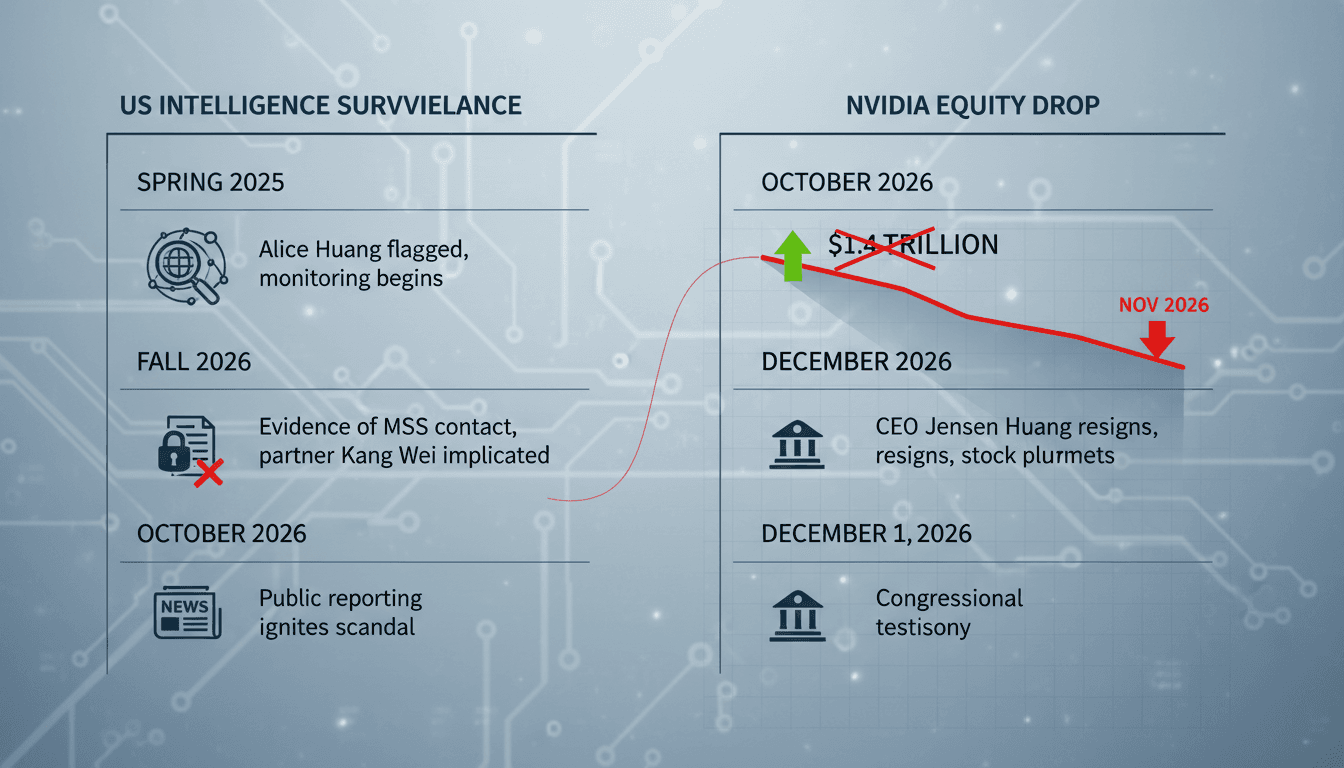
Corporate governance at critical infrastructure firms is no longer evaluated solely on financial metrics, as personal associations and cross-border commercial links now trigger direct federal security intervention and severe enterprise volatility.
Why it matters
The convergence of global export restrictions, corporate leadership intelligence monitoring, and sudden executive turnover reveals how vulnerable hardware supply monopolies are to state-level geopolitical pressure.
What happened (in 30 seconds)
- Sustained intelligence tracking: United States intelligence agencies tracked communications between Singapore-based Megaspeed executive Alice Huang and China's Ministry of State Security from spring 2025 through fall 2026.
- Executive leadership exposure: Surveillance occurred during a secret romantic affair between Alice Huang and then-Nvidia CEO Jensen Huang, alongside evidence of her business partner Kang Wei cooperating with the same state security agency.
- Immediate corporate fallout: Following public reporting and federal scrutiny over potential advanced AI semiconductor diversion through Southeast Asia, Jensen Huang resigned as CEO in November 2026, accompanied by a $1.4 trillion contraction in Nvidia's market capitalization.
The context you actually need
- Hardware export control enforcement: Nvidia's position as the primary supplier of advanced artificial intelligence processors placed the company at the center of US policy designed to restrict Chinese access to high-performance computing silicon.
- Southeast Asian transshipment scrutiny: Prior to the disclosure of the executive relationship, Alice Huang and corporate vehicle Megaspeed were already subject to investigative review regarding potential AI chip diversion networks operating across Southeast Asia.
- Interagency escalation: Intelligence gathered across 2025 and 2026 informed an internal spring 2026 US government memorandum, ultimately leading to Treasury Department directives mandating disclosures on China-related semiconductor shipments.
What's really happening
The sudden disruption of leadership at the world's core semiconductor designer demonstrates the operational mechanisms governing high-tech geopolitical friction. The structural challenge does not rest merely on enterprise espionage; it centers on the structural incentives created by unilateral trade controls and the intermediary distribution networks that emerge in response.
When state authorities restrict cross-border trade in capital goods like high-performance computing processors, the economic margin for third-party intermediaries expands. Intermediary enterprises based in neutral or multi-aligned jurisdictions—such as Singapore and broader Southeast Asian trade hubs—face commercial incentives to route technology across borders. For firms operating in these zones, accessing high-volume allocations of enterprise graphics processing units creates substantial arbitrage potential.
US intelligence tracking Alice Huang, Kang Wei, and their interactions with the Ministry of State Security across an 18-month timeline indicates that Western counterintelligence prioritized mapping informal network nodes rather than executing immediate regulatory enforcement. By allowing surveillance to continue from spring 2025 into autumn 2026, investigative bodies monitored the operational relationship between state intelligence officers, intermediary sales entities, and executive decision-makers.
The personal association between Alice Huang and Jensen Huang fundamentally altered the regulatory risk calculus for Nvidia. When executive leadership intersects directly with targets of foreign intelligence tracking, corporate compliance protocols cease to function as a defensive barrier. The discovery prompted the Treasury Department to require granular disclosures of regional hardware sales, while triggering parallel inquiries by Singaporean authorities into Megaspeed’s operations.
The institutional reaction illustrates that market capitalization provides minimal insulation against national security mandates. Nvidia lost $1.4 trillion in equity value as markets factored in governance risks, leadership voids, and prospective regulatory enforcement actions. The board of directors rejected political suggestions regarding Jensen Huang’s reinstatement, opting instead to prioritize an independent national security review. This structural shift establishes that compliance for semiconductor firms has transitioned from commercial trade paperwork into strict counterintelligence accountability.
Who feels it first (and how)
- Semiconductor and Hardware Executives: Leadership teams face intrusive background scrutiny, personal-relationship disclosures, and severe liability concerning intermediate distribution partners.
- Global Institutional Shareholders: Equity portfolios absorbing valuation swings—such as Nvidia's $1.4 trillion market value decline—face legal exposure via active class-action lawsuits over concealed executive risk.
- Southeast Asian Supply Chain Intermediaries: Distribution networks and technology distributors in hubs like Singapore confront operational disruption, audit demands, and localized regulatory investigations.
- Enterprise AI Infrastructure Buyers: Cloud hyperscalers and frontier model developers encounter extended procurement delays and heightened regulatory transparency requirements for hardware allocations.
What to watch next
- Congressional testimony disclosures: Jensen Huang’s scheduled closed-door appearance before US congressional committees on December 1, 2026, will establish the scope of executive awareness regarding export diversion routes.
- Treasury sales verification: The required corporate disclosures detailing Nvidia's China-related semiconductor transactions will clarify whether hardware was diverted systematically through Southeast Asian entities.
- Singaporean regulatory actions: Official investigations by Singapore authorities into Megaspeed will determine the legal status of intermediate trade conduits operating in regional logistics corridors.
US intelligence monitored Alice Huang's communications with China's Ministry of State Security for over a year; Jensen Huang resigned as Nvidia CEO in November 2026; Nvidia shed $1.4 trillion in equity valuation; Singapore opened formal probes into Megaspeed.
Corporate boards will mandate mandatory counterintelligence vetting and third-party relationship reporting for C-suite personnel handling dual-use, controlled technologies.
Whether proprietary hardware intellectual property or restricted semiconductor units were successfully transferred to Chinese state entities through the Megaspeed network prior to federal intervention.
Frequently Asked Questions
- Why it matters?
- The convergence of global export restrictions, corporate leadership intelligence monitoring, and sudden executive turnover reveals how vulnerable hardware supply monopolies are to state-level geopolitical pressure.
- What happened (in 30 seconds)?
- Sustained intelligence tracking: United States intelligence agencies tracked communications between Singapore-based Megaspeed executive Alice Huang and China's Ministry of State Security from spring 2025 through fall 2026. Executive leadership exposure: Surveillance occurred during a secret romantic affair between Alice Huang and then-Nvidia CEO Jensen Huang, alongside evidence of her business partner Kang Wei cooperating with the same state security agency. Immediate corporate fallout: Followin
- What's really happening?
- The sudden disruption of leadership at the world's core semiconductor designer demonstrates the operational mechanisms governing high-tech geopolitical friction. The structural challenge does not rest merely on enterprise espionage; it centers on the structural incentives created by unilateral trade controls and the intermediary distribution networks that emerge in response. When state authorities restrict cross-border trade in capital goods like high-performance computing processors, the econo
- Who feels it first (and how)?
- Semiconductor and Hardware Executives: Leadership teams face intrusive background scrutiny, personal-relationship disclosures, and severe liability concerning intermediate distribution partners. Global Institutional Shareholders: Equity portfolios absorbing valuation swings—such as Nvidia's $1.4 trillion market value decline—face legal exposure via active class-action lawsuits over concealed executive risk. Southeast Asian Supply Chain Intermediaries: Distribution networks and technology distrib
- What to watch next?
- Congressional testimony disclosures: Jensen Huang’s scheduled closed-door appearance before US congressional committees on December 1, 2026, will establish the scope of executive awareness regarding export diversion routes. Treasury sales verification: The required corporate disclosures detailing Nvidia's China-related semiconductor transactions will clarify whether hardware was diverted systematically through Southeast Asian entities. Singaporean regulatory actions: Official investigations by S
Daily AI news: models, tools, and policy.
"Independent outlet tracking the fast pace of AI."
— A47 Editor
US spies tracked Nvidia scandal figure's ties to Chinese intelligence for over a year
US intelligence agencies tracked contacts between Alice Huang and China's Ministry of State Security for over a year, according to the New York Times, a surveillance effort that ran in parallel with her reported secret affair with then-Nvidia CEO Jen...
Arabic tech news covering startups, apps, AI, and gadgets.
"AITnews is a well-known Arabic technology outlet covering regional tech developments."
— A47 Editor
تقرير: اتصالات أليس هوانغ بالاستخبارات الصينية تزامنت مع علاقتها برئيس إنفيديا السابق
A New York Times report identifies a period of alleged communications between Alice Hwang and an officer in Chinese intelligence, which coincided with her relationship with Jensen Huang, the former CEO of Nvidia. The report notes that the US investig...
Market-moving headlines impacting equities, bonds, and related risk assets.
"Real-time catalysts and volatility drivers across indices and sectors."
— A47 Editor
Alice Huang in touch with Chinese spy agency during affair with Nvidia CEO, NYT says
The New York Times reported that Alice Huang, a Chinese executive who was in a romantic relationship with Nvidia co-founder and former CEO Jensen Huang, was in touch with a Chinese spy agency during the affair, according to the report carried by Inve...
Curated tech headlines including AI stories.
"Influential aggregator surfacing the day’s top tech/AI links."
— A47 Editor
Sources: Alice Huang was in touch with an officer of China's spy agency MSS from spring 2025 until this fall; her business partner Kang Wei also worked with MSS (New York Times)
U.S. intelligence is reported to show that Alice Huang, the figure at the center of the Nvidia AI chip scandal, was in contact with an officer of China's Ministry of State Security (MSS) from spring 2025 until this fall, according to sources cited by...
Curated tech headlines including AI stories.
"Influential aggregator surfacing the day’s top tech/AI links."
— A47 Editor
Investigation: Alice Huang had ties to gaming firms, alleged Prince Group figures and hundreds of shell companies in a network moving Nvidia chips to China (Financial Times)
The Financial Times investigation reports that Alice Huang, a Chinese executive in a romantic relationship with former Nvidia CEO Jensen Huang, had ties to gaming firms, alleged Prince Group figures and hundreds of shell companies in a network that m...
Editor-curated FT homepage stories spanning markets, business, world, and opinion.
"The Financial Times is a globally respected business publication with a centrist/center-left tone and strong markets focus."
— A47 Editor
Nvidia affair puts Chinese spies in spotlight
The Financial Times reports that Western officials and analysts say China's Ministry of State Security is formidable in scale and technological capability, in a story tied to an alleged espionage affair surrounding Nvidia, and that Alice Huang, accus...