
US Adds Singapore-Based Megaspeed and Six Affiliates to Entity List Over Alleged AI Chip Diversion to China
If your firm deploys cross-border cloud infrastructure, procures high-end graphics processing units, or partners with third-party data centers in Southeast Asia, your compliance exposure just climbed significantly.
Why it matters
The formal trade blacklisting of a top-tier regional artificial intelligence infrastructure provider signals that downstream export controls are shifting from domestic border checks to aggressive, cross-border intermediary policing.
What happened (in 30 seconds)
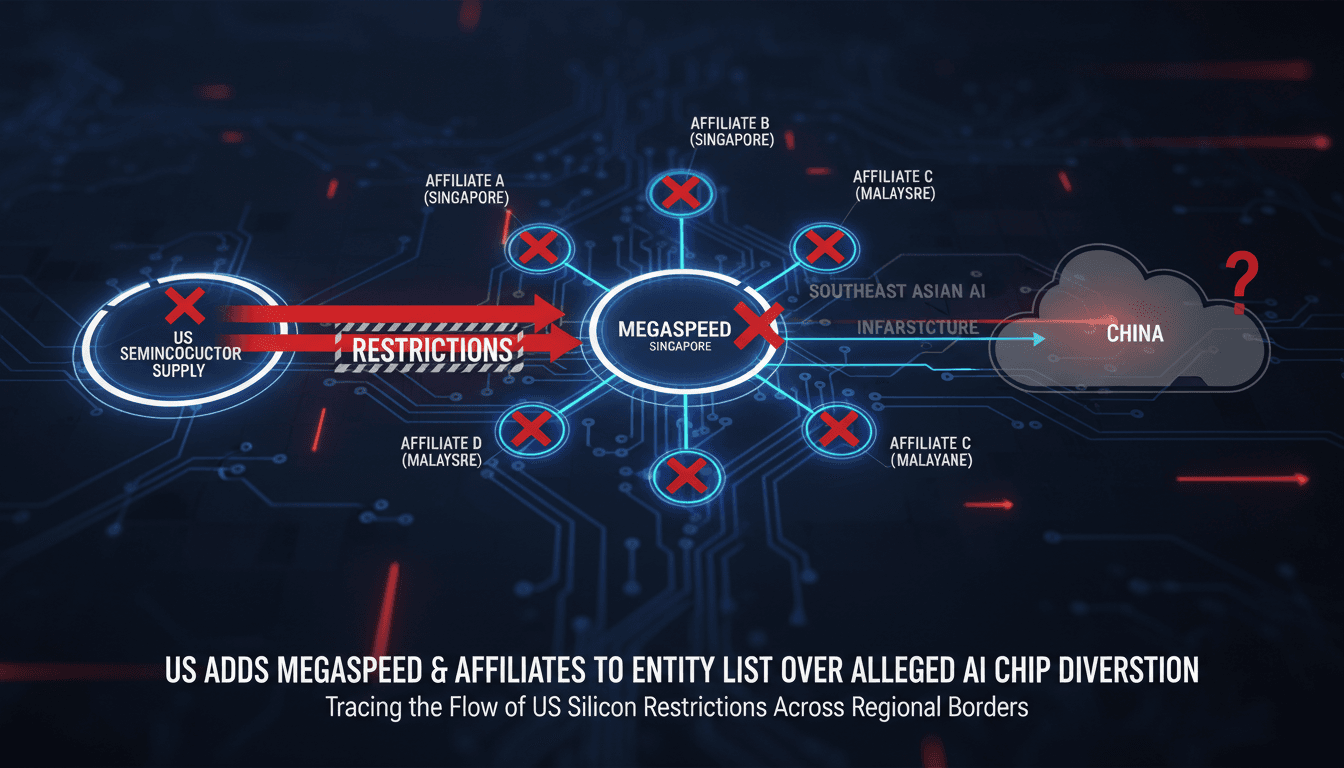
- The US Department of Commerce placed Megaspeed on the Entity List: On November 23, 2026, the Bureau of Industry and Security applied export restrictions to Singapore-headquartered Megaspeed International alongside six regional operating affiliates.
- The penalty cuts off American hardware access: US suppliers cannot ship advanced semiconductors, compute infrastructure, or related components to Megaspeed or its subsidiaries in Malaysia and Thailand without a specialized federal license.
- The move culminates multi-year espionage and diversion inquiries: Federal investigators launched probes in 2024 over suspected semiconductor diversions into China, an inquiry intensified by former executive Alice Huang's connections to Nvidia chief executive Jensen Huang.
The context you actually need
- Export restrictions have tightened continuously since 2022: Washington has systematically restricted high-performance compute chips to limit sovereign artificial intelligence development and military computing overseas.
- Southeast Asia became an operational hub for AI compute: Regional infrastructure firms scaled rapidly across Singapore, Malaysia, and Thailand to serve surging enterprise demand, simultaneously creating complex routing networks for dual-use technology.
- Internal corporate compliance moved faster than regulatory listing: Nvidia transferred Megaspeed to an internal no-sell list in June 2025 following federal sales record requests, months before formal public blacklisting occurred.
What's really happening
The addition of Megaspeed and its six affiliates to the US Entity List is not an isolated administrative penalty; it demonstrates the operational perimeter of technological containment.
Since late 2022, regulatory architects have focused on closing secondary routing corridors. As compute restrictions on mainland destinations expanded, demand did not evaporate—it migrated. Third-party cloud hosts, high-performance compute resellers, and data center operators in Southeast Asia expanded capital expenditure to absorb enterprise compute workloads. Megaspeed operated as a prominent customer for high-end enterprise silicon, building facilities across Singapore, Malaysia, and Thailand.
When regulatory barriers separate capital from high-margin compute assets, arbitrage incentives follow. Intermediaries operating outside primary restriction zones can market access to compute clusters or reroute hardware through regional hubs. The multi-jurisdictional enforcement path seen here—spanning Commerce Department inquiries, Department of Justice criminal proceedings, and joint on-site inspections with Singaporean authorities—illustrates how export enforcement now operates. It relies on coordinated multi-agency tracking rather than simple customs interdiction.
The institutional mechanics reveal three concrete vulnerabilities for global operators:
First, private vendor compliance increasingly leads public policy. Nvidia instituted an internal supply cut to Megaspeed in June 2025, precisely when federal investigators requested transaction audits and conducted field interviews. For enterprise operators, the period between an internal vendor freeze and an official government listing represents an unhedged operational risk. Firms that shared data center capacity or compute contracts with Megaspeed faced counterparty paralysis long before the November 2026 regulatory action.
Second, the regulatory perimeter now captures corporate clusters rather than singular holding firms. The Bureau of Industry and Security added seven legal entities across three distinct legal jurisdictions simultaneously. By designating entities across Singapore, Malaysia, and Thailand at once, regulators neutralize regional asset transfers and operational restructuring designed to bypass jurisdictional bans.
Third, national security enforcement intersects directly with public corporate governance. The timeline of this enforcement action coincided with executive volatility and subsequent leadership stabilization at Nvidia. The speed with which federal authorities convert corporate audits into criminal and trade actions means that executive-level relationships and cross-border distribution partnerships can instantaneously disrupt hardware pipelines.
For international technology operators, the operational baseline has shifted. Contracting compute power through an offshore intermediary now carries identical compliance requirements to direct hardware procurement.
Who feels it first (and how)
- Chief Technology Officers and Cloud Architects: Teams running workloads across regional providers in Southeast Asia face sudden supply chain audits and potential hardware provisioning delays.
- Hardware Distribution Intermediaries: Resellers and system integrators operating across ASEAN corridors must re-certify end-user documentation or risk secondary compliance enforcement.
- Enterprise Semiconductor Investors: Asset managers holding positions in public chip designers face heightened headline risk around distribution compliance and sudden customer exclusions.
What to watch next
- Department of Justice indictment specifics: Progress on the parallel criminal inquiry will reveal documented transit routes, intermediary payment rails, and specific hardware volumes diverted.
- Southeast Asian regulatory coordination: Watch whether statutory authorities in Singapore, Malaysia, and Thailand introduce synchronized domestic export screening on AI infrastructure providers.
- Secondary audit reviews across major chipmakers: Institutional compliance teams will scrutinize historical regional sales logs to identify other multi-jurisdictional cloud providers exhibiting asymmetric hardware demand.
Megaspeed International and six operating affiliates across Singapore, Malaysia, and Thailand are blacklisted, cutting off unlicensed access to US-origin semiconductor technology.
Enterprise cloud customers with active workloads deployed on Megaspeed infrastructure will accelerate data migration to certified international hyperscalers to mitigate secondary trade risk.
The operational volume and precise hardware architectures diverted to unauthorized end-users before Nvidia enacted its internal June 2025 sales block.
Frequently Asked Questions
- Why it matters?
- The formal trade blacklisting of a top-tier regional artificial intelligence infrastructure provider signals that downstream export controls are shifting from domestic border checks to aggressive, cross-border intermediary policing.
- What happened (in 30 seconds)?
- The US Department of Commerce placed Megaspeed on the Entity List: On November 23, 2026, the Bureau of Industry and Security applied export restrictions to Singapore-headquartered Megaspeed International alongside six regional operating affiliates. The penalty cuts off American hardware access: US suppliers cannot ship advanced semiconductors, compute infrastructure, or related components to Megaspeed or its subsidiaries in Malaysia and Thailand without a specialized federal license. The move cu
- What's really happening?
- The addition of Megaspeed and its six affiliates to the US Entity List is not an isolated administrative penalty; it demonstrates the operational perimeter of technological containment. Since late 2022, regulatory architects have focused on closing secondary routing corridors. As compute restrictions on mainland destinations expanded, demand did not evaporate—it migrated. Third-party cloud hosts, high-performance compute resellers, and data center operators in Southeast Asia expanded capital e
- Who feels it first (and how)?
- Chief Technology Officers and Cloud Architects: Teams running workloads across regional providers in Southeast Asia face sudden supply chain audits and potential hardware provisioning delays. Hardware Distribution Intermediaries: Resellers and system integrators operating across ASEAN corridors must re-certify end-user documentation or risk secondary compliance enforcement. Enterprise Semiconductor Investors: Asset managers holding positions in public chip designers face heightened headline risk
- What to watch next?
- Department of Justice indictment specifics: Progress on the parallel criminal inquiry will reveal documented transit routes, intermediary payment rails, and specific hardware volumes diverted. Southeast Asian regulatory coordination: Watch whether statutory authorities in Singapore, Malaysia, and Thailand introduce synchronized domestic export screening on AI infrastructure providers. Secondary audit reviews across major chipmakers: Institutional compliance teams will scrutinize historical regio
Startup news with frequent AI coverage.
"Covers launches, funding, and product updates in AI."
— A47 Editor
Megaspeed, the company at the center of the Jensen Huang scandal, appears headed for a US blacklist
Megaspeed, a Singapore-based data center company previously led by Alice Huang, appears headed for a US trade blacklist that would bar U.S. companies from selling advanced AI chips to it without a federal license. The move follows a spy scandal invol...
Technology business news, market impacts, and innovation trends.
"Bloomberg is a premier financial and tech news provider, respected for its in-depth reporting and analytical rigor."
— A47 Editor
US Probing Alice Huang, Megaspeed Amid Ties to Nvidia
The US government is investigating Alice Huang and Megaspeed over alleged ties to Nvidia, with Director of National Intelligence Jay Clayton saying Sunday that Alice Huang, an alleged Chinese spy, had an affair with Nvidia's former chief executive, J...
Focused political reporting and governmental affairs.
"NBC News is a mainstream media outlet known for comprehensive national and international news coverage with a centrist to slightly left-leaning editorial tone."
— A47 Editor
Alice Huang Kept in Contact With Spy Agency During Affair: Report
NBC News reported, citing the New York Times, that Alice Huang, the woman at the center of the Nvidia scandal, kept in contact with China's top spy agency from spring 2025 until fall 2026, a period overlapping her relationship with Jensen Huang, who ...
Curated tech headlines including AI stories.
"Influential aggregator surfacing the day’s top tech/AI links."
— A47 Editor
Sources: Alice Huang associate Li Ming, whom Singapore charged with fraud in 2025, was central to smuggling restricted AI chips from Southeast Asia to China (Stu Woo/Wall Street Journal)
Singapore has charged Li Ming with fraud in 2025, and a Wall Street Journal report, citing sources, says he was central to smuggling restricted AI chips from Southeast Asia to China. The base report links Li to Alice Huang, a associate tied to Jensen...
Tech business coverage, major deals, product launches, and Silicon Valley trends.
"WSJ’s tech section offers authoritative reporting on the intersection of technology and business, including exclusive industry analysis."
— A47 Editor
The Alice Huang Associate Accused of Funneling Nvidia Chips to China
The base report says a defendant in a chip-smuggling case, Alice Huang, an associate who worked with Nvidia CEO Jensen Huang's romantic partner, is accused of funneling Nvidia chips to China. The case centers on alleged diversion of advanced processo...
Global political, business, and cultural coverage from WSJ international desks.
"The Wall Street Journal offers extensive international reporting with a reputation for financial insight and a center-right editorial stance."
— A47 Editor
The Alice Huang Associate Accused of Funneling Nvidia Chips to China
The Wall Street Journal reports that Alice Huang, a Singapore-based Chinese executive linked to Megaspeed, is accused of funneling Nvidia chips to China, and that she was involved in a romantic relationship with Nvidia CEO Jensen Huang; U.S. official...
Editor-curated FT homepage stories spanning markets, business, world, and opinion.
"The Financial Times is a globally respected business publication with a centrist/center-left tone and strong markets focus."
— A47 Editor
Alice Huang’s links to the chip underworld
The Financial Times reports on Alice Huang, a Chinese executive in a romantic relationship with former Nvidia CEO Jensen Huang, whose past connections to the lucrative trade of moving advanced chips to China are now under scrutiny. The base report ce...