
AI Infrastructure Expansion Hits Power, Cooling, Memory and Permitting Limits as Efficiency Pivot Begins
Why it matters
The global data center expansion has collided with power grid limits and real-estate moratoriums, turning compute from a pure capital expenditure race into a supply-constrained physical bottleneck.
What happened (in 30 seconds)
- Physical bottlenecks halted projects: At least 47 large data center initiatives in the United States stalled in mid-2026 due to grid interconnection queues, cooling thresholds, and municipal permitting delays.
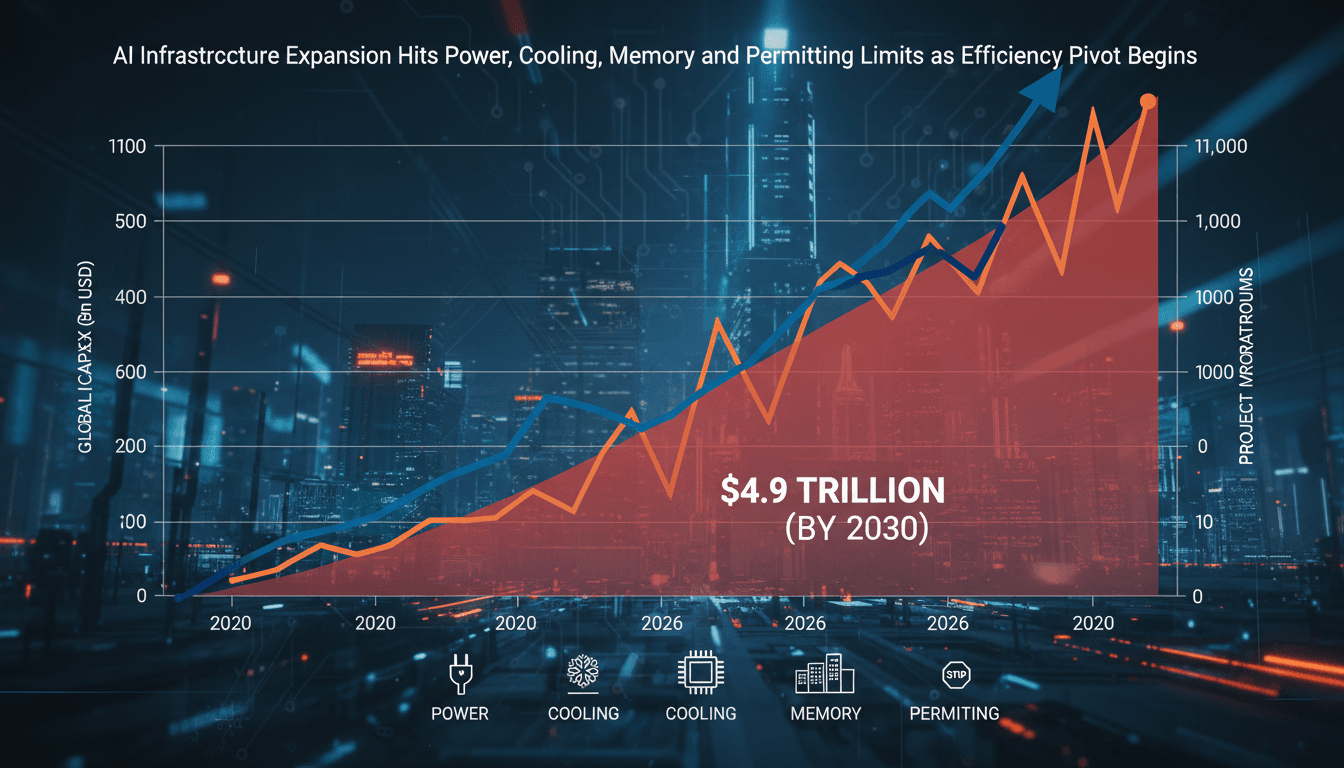
- The revenue gap widened: Gartner documented a projected cumulative shortfall of $4.9 trillion between capital deployed in AI data centers through 2030 and actual monetizable revenue.
- Hyperscalers changed engineering course: Facing idle GPU clusters alongside regional power scarcity, technology operators pivoted away from unchecked scaling toward custom ASICs, task-specific models, and on-site generation.
The context you actually need
- Exponential capital outpaced utility reality: Prior to 2026, hyperscalers like Alphabet, Amazon, Meta, Microsoft, and Oracle committed over $500 billion annually to compute builds, operating under the assumption that grid capacity and land access would expand on demand.
- Local resistance created regulatory roadblocks: Across 2026, U.S. municipalities enacted more than 1,000 moratoriums or site restrictions, while utilities began mandating that developers provide their own behind-the-meter generation.
- Capital markets adjusted pricing: Institutional lenders began repricing infrastructure debt and delaying anticipated public listings for infrastructure entities as returns diverged from initial projections.
What's really happening
The first phase of the artificial intelligence boom functioned on an assumption that computing power could scale infinitely if backed by sufficient balance sheet capacity. That premise has broken down against the physics of utility infrastructure.
Building modern high-density data centers requires more than purchasing high-margin chips from suppliers like Nvidia. It requires multi-hundred-megawatt interconnects, specialized cooling infrastructure, continuous memory components, and years of municipal approvals. Because electrical substation backlogs and high-voltage transformer lead times routinely stretch past three years, capital deployment has decoupled from physical operational readiness. Facilities are frequently completed or equipped with high-end processors before the grid can energize them, generating idle capacity that carries steep capital depreciation without generating offsetting cash flow.
This friction created a structural mismatch between investment and returns. Gartner projects a cumulative $4.9 trillion shortfall through 2030 when contrasting data center capital outlays against attributable corporate software revenues. Hyperscale operators are not pulling back on computation needs, but they are radically changing how they allocate capital.
Instead of routing workloads exclusively to monolithic, frontier-scale models running on high-wattage clusters, engineering teams are transitioning workloads toward task-specific, smaller architectures. By paring model parameters down to target specific vertical tasks, operators can run inferences on power-optimized application-specific integrated circuits (ASICs) rather than scarce, power-hungry general-purpose graphics processing units.
Simultaneously, the balance of power is shifting from software developers to utilities and energy operators. Regulators and grid authorities are declining to socialize the system costs of rapid load growth, requiring developers to bring dedicated generation or face indefinite connection queues. This structural limit has fundamentally ended the era of brute-force compute scaling, forcing operators to compete on algorithmic and electrical efficiency rather than raw capital spend.
Who feels it first (and how)
- Enterprise Chief Technology Officers: Budgets will pivot away from costly frontier API integrations toward self-hosted or specialized domain models optimized for smaller compute footprints.
- Hyperscale Cloud Providers: Alphabet, Amazon, Meta, Microsoft, and Oracle must manage margin compression caused by idle facilities and higher costs for behind-the-meter energy production.
- Municipalities and Utility Customers: Residential and industrial energy users face shifting local grid policies as operators seek to protect baseline power availability from high-density data cluster loads.
- Regional Tech Hubs (including Dubai): Markets aligning with Middle East digital economy goals will see accelerated capital inflows into local power and dedicated data infrastructure to capture spillover demand from Western markets facing site moratoriums.
What to watch next
- Behind-the-meter generation deals: Watch for hyperscalers directly acquiring dedicated natural gas, nuclear, or geothermal assets to bypass municipal grid interconnection lines.
- Custom ASIC deployment ratios: Track the rate at which proprietary hyperscaler silicon replaces standard merchant GPUs in quarterly capital asset disclosures.
- Local development moratorium volumes: Monitor whether international regulatory bodies replicate the 1,000-plus local restrictions documented across U.S. districts in 2026.
At least 47 major U.S. facilities stalled in 2026, local governments passed over 1,000 restrictive measures, and Gartner identified an anticipated $4.9 trillion revenue shortfall through 2030.
The software industry will institutionalize smaller, domain-tailored models as default commercial choices, lowering enterprise inference costs while stabilizing grid demand.
Whether decentralized private generation can be deployed rapidly enough to prevent extended delays in next-generation frontier training runs.
Frequently Asked Questions
- Why it matters?
- The global data center expansion has collided with power grid limits and real-estate moratoriums, turning compute from a pure capital expenditure race into a supply-constrained physical bottleneck.
- What happened (in 30 seconds)?
- Physical bottlenecks halted projects: At least 47 large data center initiatives in the United States stalled in mid-2026 due to grid interconnection queues, cooling thresholds, and municipal permitting delays. The revenue gap widened: Gartner documented a projected cumulative shortfall of $4.9 trillion between capital deployed in AI data centers through 2030 and actual monetizable revenue. Hyperscalers changed engineering course: Facing idle GPU clusters alongside regional power scarcity, techno
- What's really happening?
- The first phase of the artificial intelligence boom functioned on an assumption that computing power could scale infinitely if backed by sufficient balance sheet capacity. That premise has broken down against the physics of utility infrastructure. Building modern high-density data centers requires more than purchasing high-margin chips from suppliers like Nvidia. It requires multi-hundred-megawatt interconnects, specialized cooling infrastructure, continuous memory components, and years of mun
- Who feels it first (and how)?
- Enterprise Chief Technology Officers: Budgets will pivot away from costly frontier API integrations toward self-hosted or specialized domain models optimized for smaller compute footprints. Hyperscale Cloud Providers: Alphabet, Amazon, Meta, Microsoft, and Oracle must manage margin compression caused by idle facilities and higher costs for behind-the-meter energy production. Municipalities and Utility Customers: Residential and industrial energy users face shifting local grid policies as operato
- What to watch next?
- Behind-the-meter generation deals: Watch for hyperscalers directly acquiring dedicated natural gas, nuclear, or geothermal assets to bypass municipal grid interconnection lines. Custom ASIC deployment ratios: Track the rate at which proprietary hyperscaler silicon replaces standard merchant GPUs in quarterly capital asset disclosures. Local development moratorium volumes: Monitor whether international regulatory bodies replicate the 1,000-plus local restrictions documented across U.S. districts
Business, investment, entrepreneurship, leadership, and innovation.
"Forbes is known for its coverage of business leaders, market trends, and entrepreneurial ventures with a pro-business editorial stance."
— A47 Editor
AI’s $500 Billion Infrastructure Boom Is Hitting Its Limits
Big Tech's AI infrastructure spending, estimated at roughly $500 billion, is running into hard constraints including power shortages, rising memory costs and underused chips, according to a Forbes report that suggests the next competitive edge may co...
Tech business coverage, major deals, product launches, and Silicon Valley trends.
"WSJ’s tech section offers authoritative reporting on the intersection of technology and business, including exclusive industry analysis."
— A47 Editor
The AI Build-Out Is Sucking Up Resources and Crowding Out the Rest of the Economy
The AI build-out is consuming workers, equipment, energy and investment at a pace that leaves comparatively little for other industries, according to a WSJ Tech report, with a recent market selloff underscoring the risks of the buildout.
Consumer tech news, reviews, and buying guides for gadgets and electronics.
"TechRadar is known for comprehensive buying advice, hardware reviews, and consumer tech news targeted at mainstream audiences."
— A47 Editor
The AI infrastructure paradox: over-ordering and under-building
TechRadar reports on what it describes as an AI infrastructure paradox, in which companies are over-ordering computing capacity such as memory chips and data center space while the physical build-out of facilities lags behind, raising questions about...