
Nvidia Supply Chain Oversight Failures Enable Restricted AI Chip Access for Chinese Military-Linked Entities
Why it matters
The systemic breakdown in semiconductor export enforcement reveals that hardware restrictions face structural evasion when intermediary arbitrage incentives outpace multi-tier compliance monitoring.
What happened (in 30 seconds)
- Fortune published an investigation detailing how Nvidia supply chain oversight gaps permitted restricted artificial intelligence silicon to flow systematically to Chinese military-linked institutions.
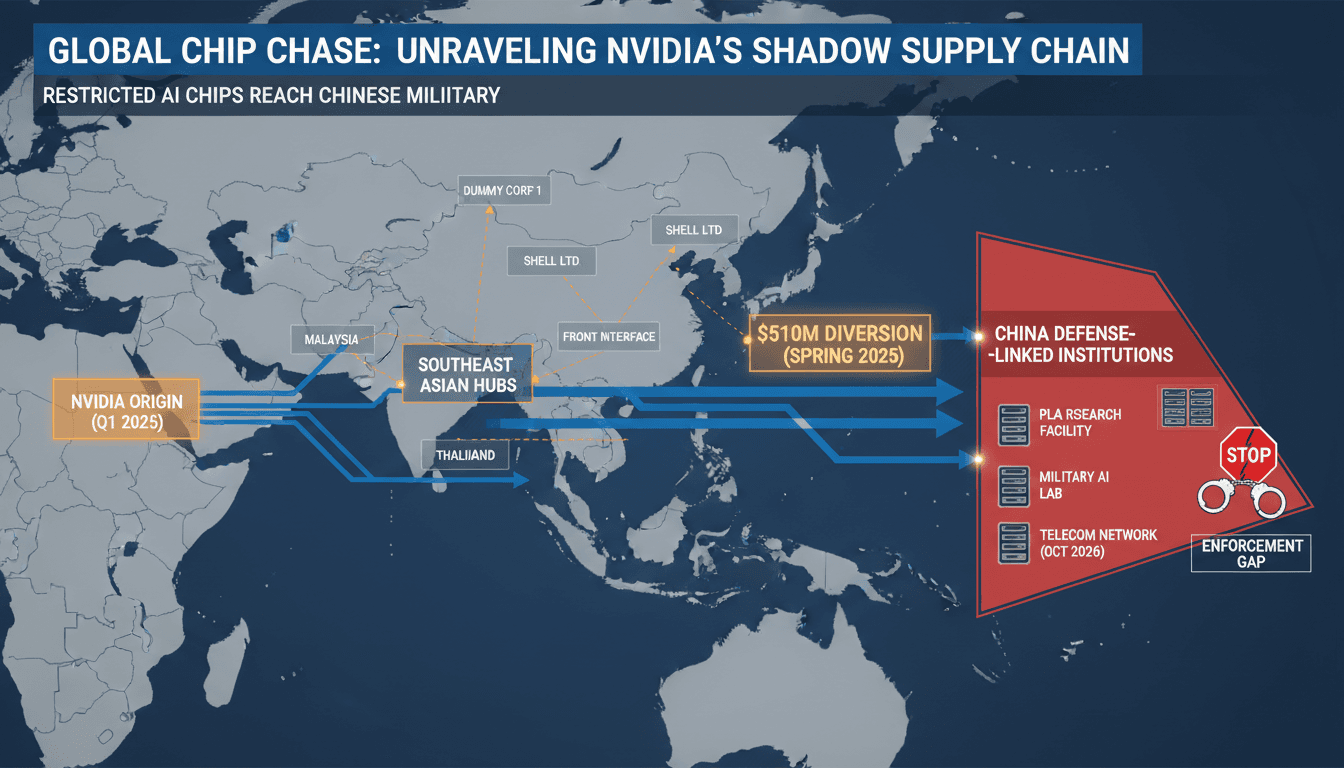
- Diversion networks operated at high volume, including an operation that rerouted $510 million worth of functional Nvidia-equipped server hardware via Southeast Asia using dummy server chassis.
- Chief Executive Jensen Huang briefly resigned on November 12, 2026, before being reinstated days later following board reviews and regulatory deliberations regarding national security positioning.
The context you actually need
- Export restrictions established in 2022 were constructed to curb the transfer of advanced computing units—specifically high-performance GPUs—to Chinese defense programs and associated research facilities.
- Procurement networks evolved intermediary routes, utilizing routing points in jurisdictions like Singapore and Malaysia alongside entities like Super Micro Computer to obfuscate true operational endpoints.
- Demand persisted across blacklisted institutions, with public tender records and network audits documenting the placement of A100, H100, H200, and Blackwell systems inside Chinese research universities and state telecom infrastructure.
What's really happening
The mechanics behind the diversion of restricted hardware to Chinese entities come down to an operational mismatch: export policy treats enterprise computing hardware as easily gatekept inventory, while the physical supply chain functions as a decentralized distribution matrix driven by arbitrage margins.
Public reporting and Department of Justice indictments show that Chinese military entities—specifically the PLA Rocket Force and Cyberspace Force—sought continuous access to advanced processing infrastructure. When direct export channels closed, capital incentives drove the creation of multi-step transshipment corridors. In a documented spring 2025 incident, an intermediary network moved $510 million in functional enterprise systems by deploying staged dummy servers during regional compliance audits. The hollow units served as visual placeholders in Southeast Asian facilities while fully populated racks containing enterprise accelerators were routed directly into mainland data centers.
This intermediary dynamic extended across product generations. Blacklisted institutions successfully procured restricted architectures throughout 2025 and 2026: Northwestern Polytechnical University acquired H200 processors in October 2025, Harbin Institute of Technology secured A100 platforms in July 2025, and parallel prosecutions recorded $160 million in smuggled H100 and H200 chips. Even the restricted Blackwell Ultra B300 hardware surfaced directly on China Telecom networks by October 2026, totaling 32 detected units.
The operational breakdown lies in the separation between fabless chip designers and downstream hardware integrators. While chipmakers engineer the silicon, third-party system builders package GPUs into proprietary server configurations. When distributors sell server racks to offshore third parties, tracking components beyond initial delivery points requires visibility that hardware designers are structurally unequipped to manage alone.
Because system-level integrators historically relied on static "know-your-customer" declarations, intermediary entities in transit hubs easily masked end-user destinations. The corporate friction that led to the brief resignation and reinstatement of Jensen Huang reflects this precise dilemma: regulatory bodies hold original equipment manufacturers accountable for final consumption, yet multi-tier distribution logistics create structural blind spots where independent brokers capture premiums by supplying compute-constrained markets.
Who feels it first (and how)
- Hardware Compliance Officers: Teams managing global data center logistics face expanded audit mandates, physical serial verification, and telemetry-backed tracking requirements.
- Enterprise Cloud Purchasers in Southeast Asia: Operators in regional distribution hubs face extended delivery timelines and elevated screening procedures for high-compute infrastructure.
- System Integrators and Server Vendors: Original design manufacturers and server packaging firms must budget for enhanced due diligence systems to avoid intermediary diversions.
- Advanced AI Research Labs: Institutions running high-performance workloads experience prolonged lead times as export licensing scrutiny broadens to include auxiliary hardware.
What to watch next
- Entity List Expansions for Regional Hubs: Watch for Commerce Department additions targeting intermediate freight forwarders and server integrators across Southeast Asian logistics routes.
- On-Chip Telemetry Mandates: Track whether regulators require silicon-level cryptographic location verification or hardware kill-switches to verify operational geography dynamically.
- Revisions to Third-Party Reseller Agreements: Monitor changes in standard vendor contracts that introduce legal liability or clawback terms for enterprise hardware distributors.
Chinese military units and blacklisted universities acquired restricted Nvidia processors—including A100, H100, H200, and Blackwell Ultra B300 hardware—through intermediary transshipment networks exceeding hundreds of millions of dollars.
U.S. regulatory authorities will tighten export licensing enforcement and penalize secondary logistics intermediaries located across Southeast Asia to plug transshipment loopholes.
Whether remote telemetry verification or automated hardware monitoring can successfully prevent downstream server diversion without disrupting normal global enterprise deliveries.
Frequently Asked Questions
- Why it matters?
- The systemic breakdown in semiconductor export enforcement reveals that hardware restrictions face structural evasion when intermediary arbitrage incentives outpace multi-tier compliance monitoring.
- What happened (in 30 seconds)?
- Fortune published an investigation detailing how Nvidia supply chain oversight gaps permitted restricted artificial intelligence silicon to flow systematically to Chinese military-linked institutions. Diversion networks operated at high volume, including an operation that rerouted $510 million worth of functional Nvidia-equipped server hardware via Southeast Asia using dummy server chassis. Chief Executive Jensen Huang briefly resigned on November 12, 2026, before being reinstated days later fol
- What's really happening?
- The mechanics behind the diversion of restricted hardware to Chinese entities come down to an operational mismatch: export policy treats enterprise computing hardware as easily gatekept inventory, while the physical supply chain functions as a decentralized distribution matrix driven by arbitrage margins. Public reporting and Department of Justice indictments show that Chinese military entities—specifically the PLA Rocket Force and Cyberspace Force—sought continuous access to advanced processi
- Who feels it first (and how)?
- Hardware Compliance Officers: Teams managing global data center logistics face expanded audit mandates, physical serial verification, and telemetry-backed tracking requirements. Enterprise Cloud Purchasers in Southeast Asia: Operators in regional distribution hubs face extended delivery timelines and elevated screening procedures for high-compute infrastructure. System Integrators and Server Vendors: Original design manufacturers and server packaging firms must budget for enhanced due diligence
- What to watch next?
- Entity List Expansions for Regional Hubs: Watch for Commerce Department additions targeting intermediate freight forwarders and server integrators across Southeast Asian logistics routes. On-Chip Telemetry Mandates: Track whether regulators require silicon-level cryptographic location verification or hardware kill-switches to verify operational geography dynamically. Revisions to Third-Party Reseller Agreements: Monitor changes in standard vendor contracts that introduce legal liability or clawb
Corporate leadership, finance, technology, and market trends.
"Fortune covers financial trends, leadership, and innovation with a pragmatic editorial approach."
— A47 Editor
Nvidia degrades U.S. national security as Chinese military snags its chips
Fortune reports that Nvidia's chips are reaching Chinese military-linked entities, degrading U.S. national security, even as scrutiny centers on Singapore-based Megaspeed, which the U.S. has added to the Commerce Department's entity list, requiring g...
Capitol Hill news, legislation, and policy insight.
"The Hill specializes in U.S. politics and policy, with a focus on Capitol Hill developments and a reputation for insider reporting."
— A47 Editor
Commerce Department adds Megaspeed to trade blacklist amid Nvidia scandal
The Commerce Department moved to add Megaspeed, the company at the center of Nvidia's national security scandal, to its trade entity blacklist on Monday, according to federal records published in the Federal Register. The action comes as scrutiny mou...
Curated tech headlines including AI stories.
"Influential aggregator surfacing the day’s top tech/AI links."
— A47 Editor
Sources: the Commerce Department added Megaspeed to its entity list on Monday, barring US companies from selling chips to the company without a license (Ashley Gold/Semafor)
On Monday, the U.S. Commerce Department added Singapore-based Megaspeed to its entity list, a trade blacklist that bars U.S. companies from selling advanced AI chips to the firm without a government license, according to sources cited by Semafor and ...