
China's Tianwen-2 spacecraft captures first image of asteroid Kamo‘oalewa
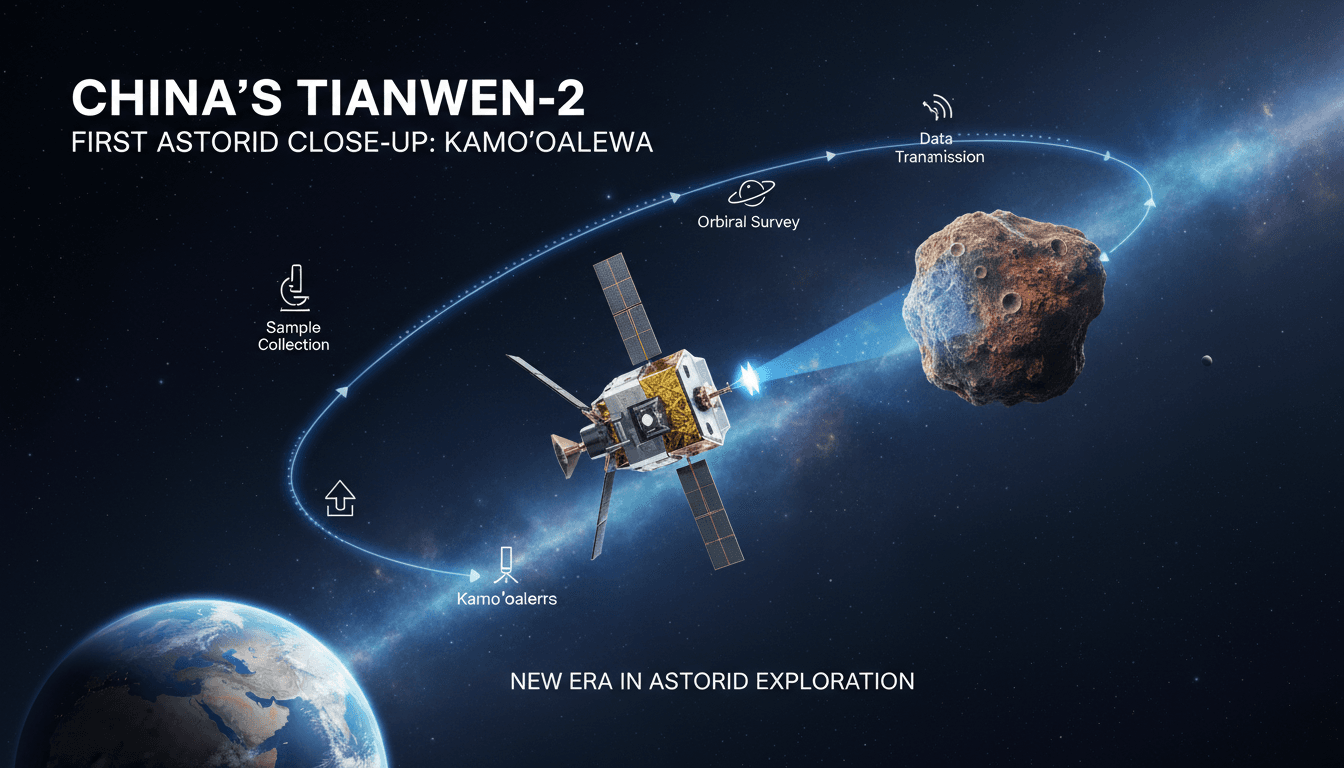
Here's what it means for you.
The successful capture of Kamo‘oalewa's first image by China's Tianwen-2 spacecraft signifies a notable advancement in space exploration technology. This achievement not only highlights China's growing capabilities in asteroid research but also sets the stage for future missions aimed at sample collection. The challenges faced in this mission could influence global strategies for asteroid exploration and sample return initiatives. As nations continue to invest in space exploration, the implications of this mission may extend beyond scientific discovery, potentially impacting international collaboration and competition in space technology.
What happened
China's Tianwen-2 spacecraft has successfully captured the first close-up image of the quasi-moon Kamo‘oalewa, also designated as asteroid 2016 HO3. This milestone marks a significant achievement in China's ongoing space exploration efforts. The image was transmitted back to Earth, showcasing the spacecraft's advanced imaging capabilities.
Despite this success, reports indicate potential difficulties in the planned sample collection from the asteroid. These challenges could affect the mission's overall objectives and future exploration strategies.
The Context
Kamo‘oalewa is classified as a quasi-moon, a type of asteroid that orbits Earth. The Tianwen-2 mission is part of China's broader ambitions in space exploration, particularly in asteroid research. The timing of this achievement is crucial as it comes amid increasing global interest in asteroid exploration and the potential for resource utilization.
The mission's success and the challenges it faces could influence how other nations approach similar endeavors. As space agencies worldwide look to expand their capabilities, the outcomes of Tianwen-2 may serve as a reference point for future missions.
Takeaway
Looking ahead, the focus will be on overcoming the challenges associated with sample collection from Kamo‘oalewa. As the Tianwen-2 mission progresses, further developments will be closely monitored, particularly regarding the implications of the asteroid's characteristics for future space missions.
The success of this mission could pave the way for enhanced strategies in asteroid exploration and sample return missions, potentially reshaping the landscape of space research.
Scientific research, space, environment, and health coverage.
"The New York Times is a globally recognized newspaper offering authoritative reporting with a center-left editorial stance."
— A47 Editor
A Chinese Spacecraft Captures First Image of Quasi-Moon
A Chinese spacecraft has successfully captured the first image of the asteroid Kamo‘oalewa, marking a significant achievement in space exploration. This event highlights advancements in China's space technology and its ongoing commitment to exploring...
Scientific discoveries, health, technology, and natural phenomena.
"Live Science reports on scientific discoveries, health, technology, and natural phenomena with a popular science tone."
— A47 Editor
Secretive Chinese probe snaps first photo of Earth's mysterious 'quasi-moon' — and it may pose a big problem
China's Tianwen-2 spacecraft has successfully captured the first close-up image of Kamo'oalewa, a near-Earth asteroid often referred to as a 'quasi-moon.' This milestone marks a significant step in its mission to collect and return samples from this ...
Space science news, astronomy updates, and spaceflight developments.
"Space.com delivers space science news, astronomy updates, and spaceflight developments with engaging coverage."
— A47 Editor
China releases 1st photo of Earth's elusive 'quasi-moon' Kamo'oalewa
China's Tianwen-2 probe has successfully transmitted its first image of the near-Earth asteroid Kamo'oalewa, also known as quasi-moon 2016HO3. This milestone marks a significant step in the mission aimed at collecting and returning samples from this ...