
MiniMax launches M3 large language model challenging AI market leaders
What happened
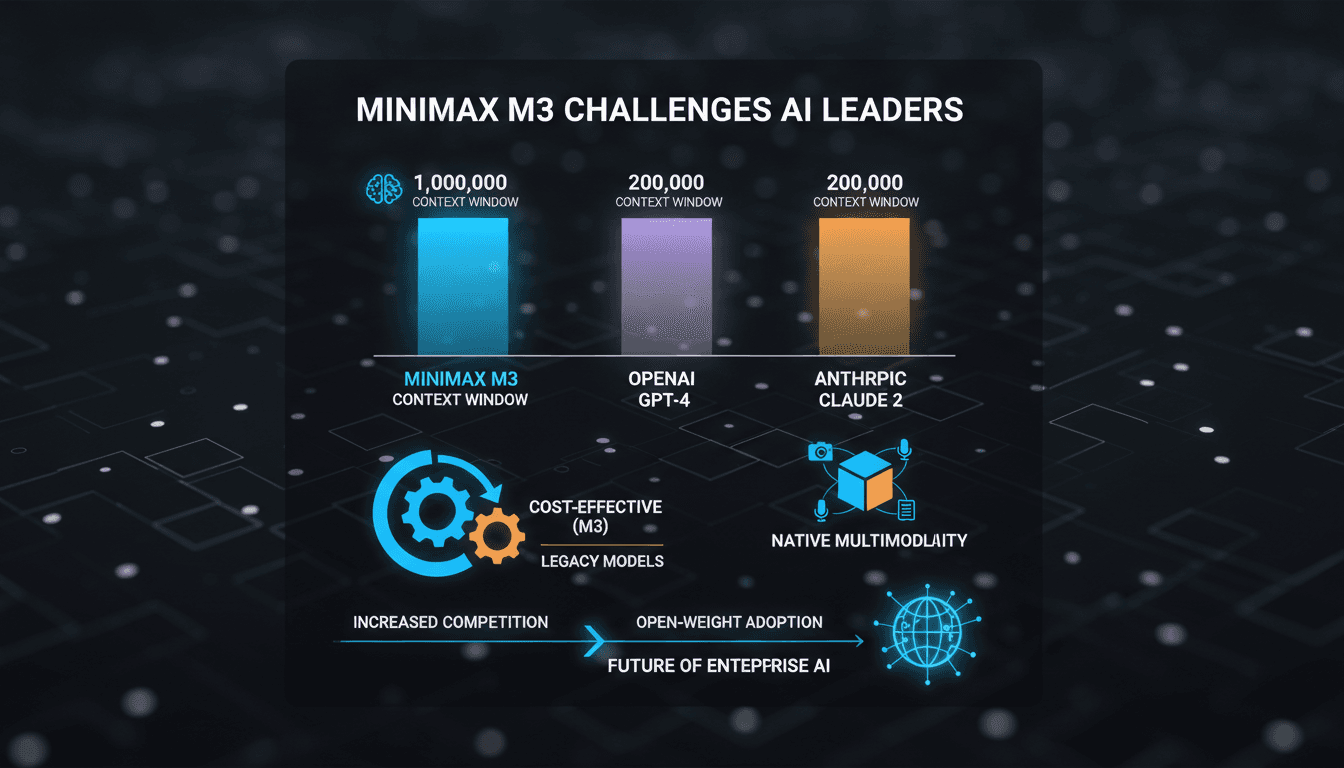
MiniMax has officially launched its M3 large language model, which boasts a one-million-token context window and native multimodality. This model is designed to outperform established competitors like OpenAI and Anthropic while being available at a significantly lower cost. M3 is priced at $0.30 per million input tokens and $1.20 per million output tokens, making it a more affordable option compared to other models in the market.
The M3 model has already demonstrated its capabilities by scoring 59.0% on SWE-Bench Pro, surpassing benchmarks set by GPT-5.5 and Gemini 3.1 Pro. MiniMax plans to release M3 under an open-source license, allowing enterprises to download and customize the model extensively. This strategic move positions MiniMax as a formidable player in the AI sector.
The Context
The introduction of M3 comes at a time when enterprises are increasingly seeking cost-effective AI solutions. MiniMax's approach to offering an open-weight model allows for greater flexibility and customization, which is crucial for organizations looking to tailor AI applications to their specific needs. The competitive pricing of M3, especially when compared to proprietary models like Opus 4.7, highlights a growing trend towards more accessible AI technologies.
As the AI landscape evolves, the demand for models that combine high performance with affordability is likely to increase. MiniMax's M3 could set a new standard for what enterprises expect from AI solutions, potentially reshaping the competitive dynamics in the industry. The launch has already garnered attention, with initial community reactions emphasizing M3's performance and cost advantages.
Takeaway
Looking ahead, the adoption of MiniMax's M3 in enterprise environments will be crucial to watch. Its success could influence competitors to reassess their pricing strategies and feature offerings, potentially leading to a more competitive market landscape. As organizations increasingly prioritize cost-effective AI solutions, the demand for open-weight models like M3 may rise, encouraging further innovation in the sector.
The implications of M3's launch extend beyond immediate performance metrics; it could catalyze a broader shift in how enterprises approach AI deployment. Monitoring the responses from established players will provide insights into the evolving dynamics of the AI market.
Focuses on transformative tech, AI, gaming, and startup innovation.
"VentureBeat is respected for its in-depth reporting on AI, startups, and disruptive technologies in Silicon Valley and beyond."
— A47 Editor
MiniMax-M3 debuts, eclipsing GPT-5.5 and Gemini 3.1 Pro on key benchmark performance for just 5-10% of the cost
MiniMax, a Chinese AI startup, has launched its M3 large language model, which outperforms established models like GPT-5.5 and Gemini 3.1 Pro on key benchmarks while being offered at a significantly lower cost, starting at $20 per month. The model fe...
Daily AI news: models, tools, and policy.
"Independent outlet tracking the fast pace of AI."
— A47 Editor
MiniMax M3: Open-weight model with a million-token context challenges proprietary leaders
Chinese AI company MiniMax has launched its new M3 model, touted as the first open-weight model that integrates top-tier coding performance with a one-million-token context window and native multimodality. This innovation positions MiniMax as a compe...
Curated tech headlines including AI stories.
"Influential aggregator surfacing the day’s top tech/AI links."
— A47 Editor
Chinese AI developer MiniMax launches M3, a new coding model that it says rivals Opus 4.7, costing $0.12 per 1M input tokens, compared with $5 for Opus 4.7 (Juro Osawa/The Information)
Chinese AI developer MiniMax has launched its latest coding model, M3, which it claims rivals the established Opus 4.7. The new model is priced significantly lower at $0.12 per million input tokens compared to Opus 4.7's $5, indicating a competitive ...