
China Initiates Arctic Shipping Route to Circumvent Strait of Hormuz Disruptions
Why it matters
This new shipping route could reshape global trade dynamics by reducing reliance on traditional chokepoints.
What happened (in 30 seconds)
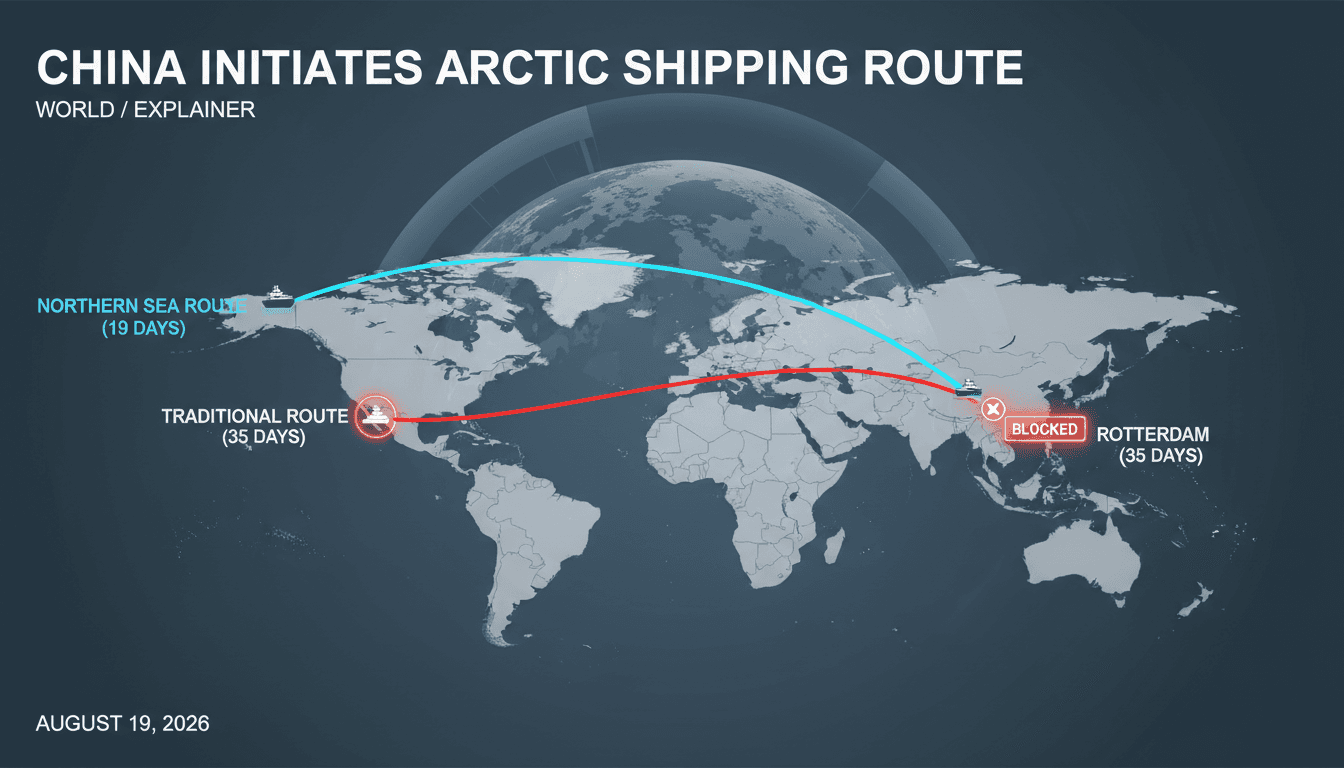
- China launched its first regular Arctic shipping service on August 19, 2026, via the Northern Sea Route, cutting transit time to Europe by half.
- The route was initiated in response to disruptions in the Strait of Hormuz due to geopolitical tensions, increasing shipping costs and insurance premiums.
- Sea Legend Line's inaugural voyage from Ningbo to Felixstowe took approximately 20 days, compared to 40 days via the Suez Canal.
The context you actually need
- Geopolitical tensions escalated in February 2026 with U.S.-Israeli military actions against Iran, effectively closing the Strait of Hormuz.
- China has pursued Arctic access since 2013, with intensified interest in the Northern Sea Route as climate change has extended its navigable window.
- The route remains limited by seasonal ice and Russian oversight, making it a supplementary option rather than a full replacement for traditional routes.
What's really happening
The launch of the 'Ice Silk Road' by Sea Legend Line marks a significant shift in maritime logistics, driven by a combination of geopolitical instability and climate change. Following the closure of the Strait of Hormuz due to military actions and ongoing threats in the Red Sea, shipping costs have surged, prompting companies to seek alternative routes. The Northern Sea Route (NSR) offers a viable solution, allowing for faster transit times—20 days compared to 40 days via the Suez Canal.
China's strategic interest in the Arctic has been long-standing, with efforts dating back to 2013 when the Yong Sheng completed the first Chinese transit to Europe via the NSR. The concept of a 'Polar Silk Road' was proposed in 2017, highlighting China's ambition to establish a robust trade corridor in the Arctic. The recent successful test voyage in October 2025 paved the way for regular services, with Russian state corporation Rosatom providing necessary permits and icebreaker escorts.
However, the NSR is not without its challenges. Seasonal ice limits the operational window, and Russian oversight means that China must navigate a complex regulatory environment. Analysts suggest that while the NSR can alleviate some pressure from traditional routes, it cannot fully replace them due to limited prior traffic volumes—only 23 container ships utilized the route in 2025. This indicates a gradual adoption rather than an immediate overhaul of global shipping practices.
The implications of this shift extend beyond logistics. As shipping patterns diversify, regions like Dubai may experience elevated energy and import costs due to rerouted supply chains and increased insurance premiums. The 'Ice Silk Road' serves as a hedge against the Malacca Dilemma, where reliance on vulnerable chokepoints poses risks to global trade.
In summary, while the Arctic route presents opportunities for faster shipping, it also highlights the fragility of global supply chains and the need for businesses to adapt to evolving maritime landscapes.
Who feels it first (and how)
- Shipping companies: They will need to evaluate the viability of the new route against traditional options.
- Logistics providers: Increased complexity in routing may lead to higher operational costs.
- Businesses reliant on imports: They may face fluctuating costs and delays as supply chains adjust.
- Energy sector: Higher shipping costs could translate to increased energy prices in regions like Dubai.
What to watch next
- Traffic volume on the NSR: Monitoring the number of vessels using the route will indicate its adoption rate and economic viability.
- Geopolitical developments in the Middle East: Ongoing tensions could further influence shipping routes and costs.
- Environmental assessments: As Arctic shipping increases, the impact on climate and local ecosystems will become a critical factor in its sustainability.
The NSR offers faster transit times compared to traditional routes.
Shipping costs will fluctuate as companies adapt to new routes.
The long-term economic viability of the NSR remains to be fully assessed.
Frequently Asked Questions
- Why it matters?
- This new shipping route could reshape global trade dynamics by reducing reliance on traditional chokepoints.
- What happened (in 30 seconds)?
- China launched its first regular Arctic shipping service on August 19, 2026, via the Northern Sea Route, cutting transit time to Europe by half. The route was initiated in response to disruptions in the Strait of Hormuz due to geopolitical tensions, increasing shipping costs and insurance premiums. Sea Legend Line's inaugural voyage from Ningbo to Felixstowe took approximately 20 days, compared to 40 days via the Suez Canal.
- What's really happening?
- The launch of the 'Ice Silk Road' by Sea Legend Line marks a significant shift in maritime logistics, driven by a combination of geopolitical instability and climate change. Following the closure of the Strait of Hormuz due to military actions and ongoing threats in the Red Sea, shipping costs have surged, prompting companies to seek alternative routes. The Northern Sea Route (NSR) offers a viable solution, allowing for faster transit times—20 days compared to 40 days via the Suez Canal. China'
- Who feels it first (and how)?
- Shipping companies: They will need to evaluate the viability of the new route against traditional options. Logistics providers: Increased complexity in routing may lead to higher operational costs. Businesses reliant on imports: They may face fluctuating costs and delays as supply chains adjust. Energy sector: Higher shipping costs could translate to increased energy prices in regions like Dubai.
- What to watch next?
- Traffic volume on the NSR: Monitoring the number of vessels using the route will indicate its adoption rate and economic viability. Geopolitical developments in the Middle East: Ongoing tensions could further influence shipping routes and costs. Environmental assessments: As Arctic shipping increases, the impact on climate and local ecosystems will become a critical factor in its sustainability.
Corporate leadership, finance, technology, and market trends.
"Fortune covers financial trends, leadership, and innovation with a pragmatic editorial approach."
— A47 Editor
Strait of Hormuz chaos has incentivized China to use an alternative trade route: a 3,400 mile frozen Arctic channel dubbed the ‘Ice Silk Road’
Chinese shipping company Sea Legend Line has announced a new Arctic shipping route, known as the 'Ice Silk Road,' which spans 3,400 miles and significantly reduces transit times compared to traditional routes through the Strait of Hormuz. This develo...
Global news coverage with extensive reporting on Middle Eastern conflicts and geopolitics.
"Al Jazeera is a Qatar-based broadcaster known for wide regional coverage and alternative perspectives."
— A47 Editor
Can China’s new Arctic sea route to Europe replace Middle East chokepoints?
Beijing's new 'Ice Silk Road' cuts through a melting Arctic, and could prompt new tensions with the US, analysts say.
Comprehensive coverage of Middle Eastern and global issues.
"Al Jazeera is a prominent voice from the Global South, especially the Middle East, with an emphasis on underreported stories."
— A47 Editor
Can China’s new Arctic sea route to Europe replace Middle East chokepoints?
China is set to enhance its trade connectivity with Europe by launching regular shipping routes through the Arctic's Northern Sea Route, a significant development announced by Rosatom's CEO Aleksey Likhachev. This initiative is part of China's broade...
Science and technology stories including AI.
"Longstanding science magazine with thoughtful AI coverage."
— A47 Editor
How climate change created a new ‘Ice Silk Road’ in the Arctic
China is planning to send container ships along Russia's northern coast, a development that highlights the emergence of a new maritime route known as the 'Ice Silk Road' due to climate change. This route is expected to facilitate shipping in the Arct...
Scientific research, technology, environment, and society.
"Scientific American is one of the oldest and most authoritative science magazines, known for deep dives into science, technology, and society."
— A47 Editor
How climate change created a new ‘Ice Silk Road’ in the Arctic
China is planning to send container ships along Russia's northern coast, a development that highlights the emergence of a new maritime route known as the 'Ice Silk Road' due to climate change. This route is expected to facilitate shipping in the Arct...