
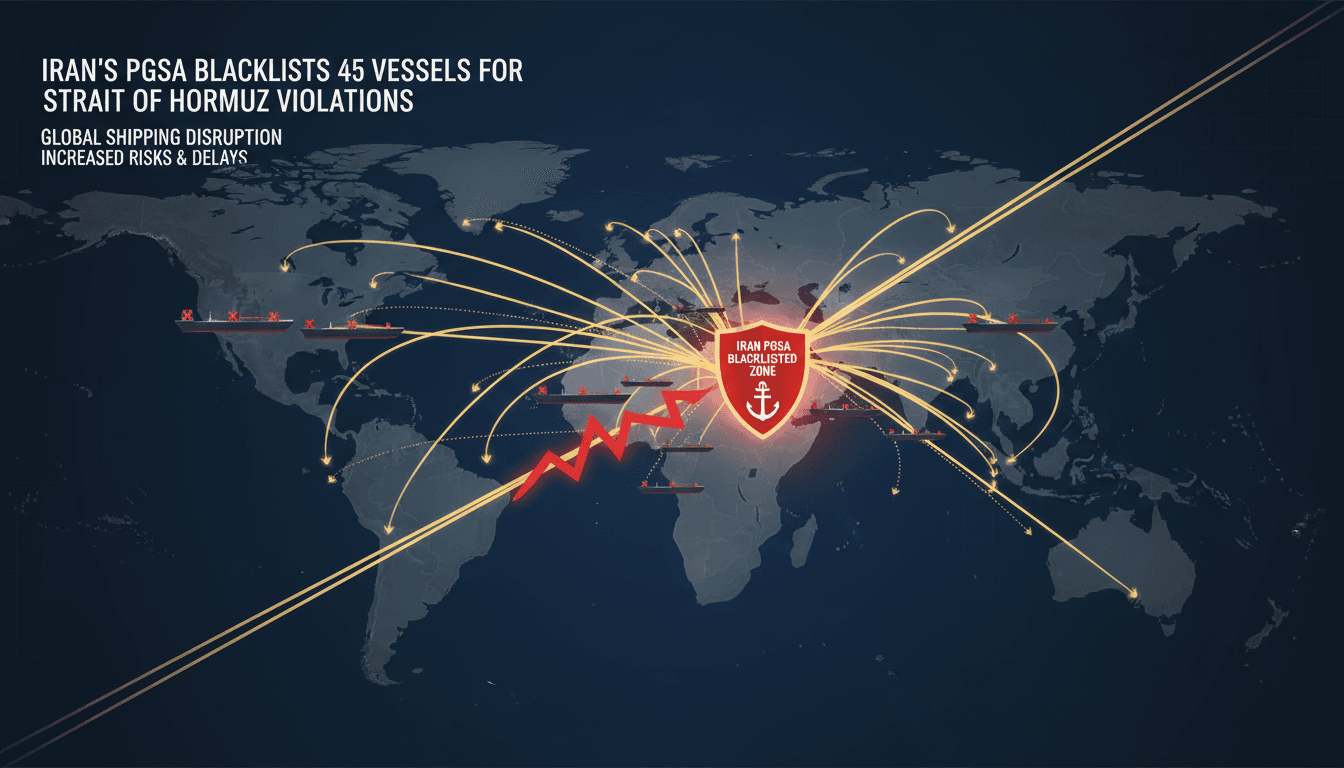
Iran's PGSA Blacklists 45 Vessels for Strait of Hormuz Violations
Why it matters
The Strait of Hormuz is a critical chokepoint for global oil exports, with roughly 30% of the world's crude passing through.
What happened (in 30 seconds)
- On August 24, 2026, Iran's Persian Gulf Strait Authority (PGSA) blacklisted 45 vessels for violating transit protocols.
- Violations could lead to fines, detention, or cargo confiscation for non-compliant vessels, affecting international shipping operations.
- This action escalates tensions amid ongoing U.S.-Iran conflicts and follows U.S. sanctions targeting Iranian maritime operations.
The context you actually need
- The PGSA was established in May 2026 to regulate maritime transit through the Strait of Hormuz amid rising geopolitical tensions.
- Iran's actions challenge international norms of free navigation, as they impose new clearance requirements and service fees on vessels.
- The U.S. has intensified economic measures against Iran, contributing to the backdrop of this regulatory escalation.
What's really happening
The recent blacklisting of 45 vessels by Iran's PGSA marks a significant shift in maritime regulation in the Strait of Hormuz, a vital artery for global oil transportation. This move is part of Iran's broader strategy to assert control over the strait, which is responsible for approximately 30% of the world's crude oil exports. The PGSA's announcement, made via social media platform X, indicates that vessels previously non-compliant with Iran's transit protocols will face severe penalties, including fines, detention, and cargo confiscation.
The PGSA's establishment in May 2026 was a direct response to ongoing conflicts with the United States, which has been imposing stringent economic sanctions on Iran since February 2026. These sanctions, part of what the U.S. has termed "Operation Economic Outcast," aim to isolate Iran economically and limit its ability to operate in international waters. In this context, the PGSA's actions can be seen as a defensive maneuver by Iran to protect its economic interests and assert its sovereignty over a region that has seen increasing U.S. naval presence and intervention.
The blacklisted vessels include a mix of very large crude carriers, LNG/LPG tankers, and product vessels owned by major shipping firms, including ADNOC Logistics and Services from the UAE and Bahri from Saudi Arabia. This broad targeting of vessels indicates Iran's willingness to escalate its regulatory enforcement, potentially leading to increased tensions in the region. The PGSA has warned that any vessel engaging in ship-to-ship transfers with blacklisted vessels could also be added to the list, creating a ripple effect that could deter shipping companies from operating in the area altogether.
As a result, shipping firms are likely to face increased insurance costs and transit risks, which could translate into higher prices for consumers globally. The U.S. Treasury's response, which included sanctions against the PGSA and related entities, further complicates the situation, as it aims to cut financial ties with Iran while also attempting to stabilize global oil markets. The volatility in oil prices has already been felt, with U.S. national average gas prices reaching $4.09 per gallon following the announcement.
In summary, Iran's blacklisting of vessels in the Strait of Hormuz is not just a regulatory action; it is a strategic move that reflects the ongoing geopolitical tensions in the region. The implications for global shipping and energy markets are significant, as stakeholders must navigate the complexities of compliance with Iranian regulations while also responding to U.S. sanctions.
Who feels it first (and how)
- Shipping companies: Increased operational costs and potential fines for non-compliance.
- Energy consumers: Higher fuel prices due to increased shipping costs and insurance.
- Regional economies: Countries relying on oil exports may face disruptions and economic instability.
What to watch next
- Compliance trends: Monitor how shipping companies adapt to Iran's new regulations and whether they choose to comply or risk penalties.
- Oil price fluctuations: Keep an eye on global oil prices, which may rise due to increased shipping costs and geopolitical tensions.
- U.S. response: Watch for further U.S. sanctions or military presence in the region as a countermeasure to Iran's actions.
The PGSA has blacklisted 45 vessels and imposed strict penalties for non-compliance.
Shipping costs and fuel prices will rise as a result of increased risks and regulatory compliance.
The long-term impact on global oil supply and shipping routes remains uncertain as tensions evolve.
Frequently Asked Questions
- Why it matters?
- The Strait of Hormuz is a critical chokepoint for global oil exports, with roughly 30% of the world's crude passing through.
- What happened (in 30 seconds)?
- On August 24, 2026, Iran's Persian Gulf Strait Authority (PGSA) blacklisted 45 vessels for violating transit protocols. Violations could lead to fines, detention, or cargo confiscation for non-compliant vessels, affecting international shipping operations. This action escalates tensions amid ongoing U.S.-Iran conflicts and follows U.S. sanctions targeting Iranian maritime operations.
- What's really happening?
- The recent blacklisting of 45 vessels by Iran's PGSA marks a significant shift in maritime regulation in the Strait of Hormuz, a vital artery for global oil transportation. This move is part of Iran's broader strategy to assert control over the strait, which is responsible for approximately 30% of the world's crude oil exports. The PGSA's announcement, made via social media platform X, indicates that vessels previously non-compliant with Iran's transit protocols will face severe penalties, inclu
- Who feels it first (and how)?
- Shipping companies: Increased operational costs and potential fines for non-compliance. Energy consumers: Higher fuel prices due to increased shipping costs and insurance. Regional economies: Countries relying on oil exports may face disruptions and economic instability.
- What to watch next?
- Compliance trends: Monitor how shipping companies adapt to Iran's new regulations and whether they choose to comply or risk penalties. Oil price fluctuations: Keep an eye on global oil prices, which may rise due to increased shipping costs and geopolitical tensions. U.S. response: Watch for further U.S. sanctions or military presence in the region as a countermeasure to Iran's actions.
Capitol Hill news, legislation, and policy insight.
"The Hill specializes in U.S. politics and policy, with a focus on Capitol Hill developments and a reputation for insider reporting."
— A47 Editor
Iran warns vessels of fines, detention for violating Strait of Hormuz rules
Iran's Persian Gulf Strait Authority has issued a warning to commercial vessels, stating that those violating its protocols for navigating the Strait of Hormuz will face fines and possible detention. The authority has blacklisted 45 vessels, which ma...
Pan-Arab news coverage spanning politics, business, sports, and regional affairs.
"Asharq Al-Awsat reflects a broad Arab editorial perspective with strong attention to regional geopolitics."
— A47 Editor
إيران تتوعد 45 ناقلة بالغرامات والمصادرة في مضيق هرمز
Iran has placed 45 oil tankers on a blacklist, accusing them of violating transit rules imposed in the Strait of Hormuz, and has threatened to impose fines, detain the vessels, and confiscate their cargoes.
Global business headlines with AI angles.
"General business outlet that frequently covers AI."
— A47 Editor
U.S.-Iran Tensions Remain High As Washington Begins 'Economic D-Day.' Oil Is Dropping Anyway.
Tensions between the U.S. and Iran remain elevated as Iran's Persian Gulf Strait Authority warns that vessels violating its transit rules through the Strait of Hormuz may face fines or confiscation. This warning comes amid ongoing military clashes an...
Pan-Arab political news and analysis.
"Al-Quds Al-Arabi is a London-based Arabic newspaper known for political coverage."
— A47 Editor
إيران تحذر السفن التي تنتهك قواعد عبور مضيق هرمز من الغرامات والاحتجاز
The Iranian Strait Management Authority announced on X platform that vessels violating its navigation regulations in the Strait of Hormuz may face penalties, including fines, detention, or confiscation. This new authority has been established by Iran...
Regional coverage and analysis focused on politics, diplomacy, and business across the Middle East.
"Al-Monitor is known for analytical reporting on Middle East politics and policy developments."
— A47 Editor
Iran warns vessels violating Hormuz transit rules of fines, detention
Iran has issued a warning that vessels violating its transit arrangements in the Strait of Hormuz could face fines, detention, or confiscation, as stated by the Persian Gulf Strait Authority. This warning raises concerns for charterers and shipowners...