
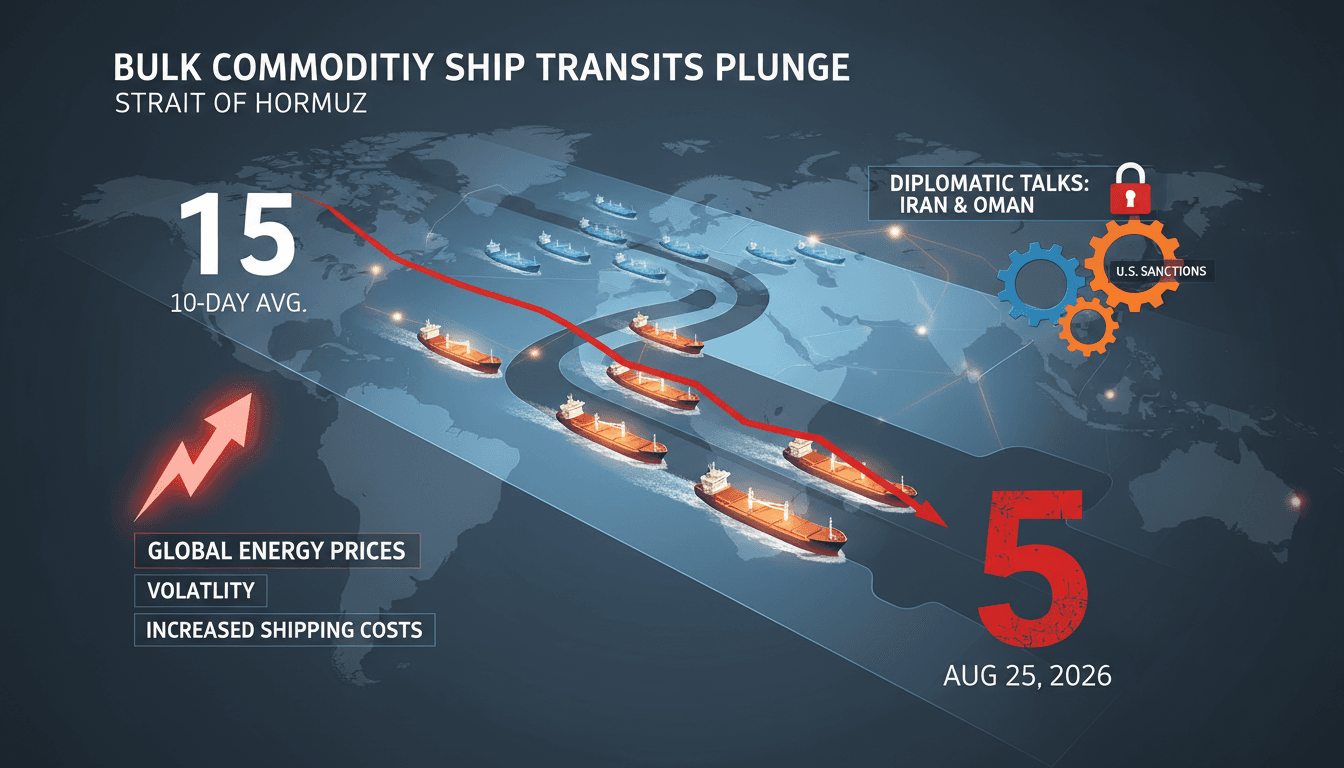
Bulk commodity ship transits through the Strait of Hormuz fall to five vessels
Here's what it means for you.
If you're in Dubai, expect potential increases in energy prices and supply chain disruptions.
Why it matters
The Strait of Hormuz is a critical chokepoint for global energy supplies, and reduced traffic can lead to higher costs and volatility in fuel prices.
What happened (in 30 seconds)
- Five bulk commodity ships transited the Strait of Hormuz on August 25, 2026, significantly below the 10-day average of 15 vessels.
- Ongoing diplomatic talks between Iran and Oman aim to establish a temporary navigation corridor amid heightened geopolitical tensions.
- U.S. sanctions on Iran continue to exert economic pressure, influencing shipping operations and vessel movements in the region.
The context you actually need
- The Strait of Hormuz is vital for global energy exports, handling about 20% of the world's oil and LNG trade.
- Geopolitical tensions have escalated since early 2026, leading to military exchanges and increased caution among ship operators.
- Shipping operators are disabling transponders and altering routes, further suppressing traffic through this crucial maritime corridor.
What's really happening
On August 25, 2026, only five bulk commodity ships transited the Strait of Hormuz, matching the previous day's low and falling well below the recent 10-day average of 15 vessels. This decline in maritime traffic is symptomatic of broader geopolitical tensions, particularly the ongoing U.S. sanctions against Iran under President Trump. The sanctions have created an environment of uncertainty, prompting ship operators to exercise extreme caution. Some vessels have even disabled their transponders to avoid detection, further contributing to the reduced traffic.
The current situation is compounded by diplomatic efforts between Iran and Oman, which are discussing a temporary shared navigation corridor and mine clearance. However, analysts at ING Economics caution that any normalization of shipping traffic will likely require U.S. sanctions relief. Iranian officials have indicated that any new corridor would be temporary and contingent upon Tehran's terms, adding another layer of complexity to the situation.
The implications of this reduced traffic extend beyond immediate shipping concerns. The Strait of Hormuz is a critical artery for energy exports, and any disruption can lead to increased energy prices globally. For Dubai residents, this could mean higher costs for imported goods and volatility in fuel prices, as regional energy supplies become constrained. The decline in traffic has already had ripple effects, with European natural gas prices dropping approximately 7% on market optimism regarding the Iran-Oman talks, although this may be short-lived if tensions escalate again.
As the situation evolves, the potential for further disruptions remains high. The interplay between diplomatic negotiations, U.S. sanctions, and regional military dynamics will continue to shape the maritime landscape in the Strait of Hormuz, affecting global energy markets and local economies.
Who feels it first (and how)
- Shipping companies: Increased operational risks and potential rerouting costs.
- Energy consumers: Higher fuel prices and potential supply chain disruptions for imported goods.
- Local businesses: Increased costs for goods and services reliant on stable energy prices.
What to watch next
- Diplomatic developments: Monitor Iran-Oman talks for any breakthroughs that could stabilize shipping traffic.
- U.S. sanctions policy: Changes in the sanctions regime could significantly impact shipping operations and energy prices.
- Market reactions: Watch for fluctuations in energy prices and shipping costs as the situation evolves.
Traffic through the Strait of Hormuz is currently suppressed.
Energy prices may rise if shipping traffic does not normalize.
The long-term impact of diplomatic negotiations on regional stability and shipping traffic.
Frequently Asked Questions
- Why it matters?
- The Strait of Hormuz is a critical chokepoint for global energy supplies, and reduced traffic can lead to higher costs and volatility in fuel prices.
- What happened (in 30 seconds)?
- Five bulk commodity ships transited the Strait of Hormuz on August 25, 2026, significantly below the 10-day average of 15 vessels. Ongoing diplomatic talks between Iran and Oman aim to establish a temporary navigation corridor amid heightened geopolitical tensions. U.S. sanctions on Iran continue to exert economic pressure, influencing shipping operations and vessel movements in the region.
- What's really happening?
- On August 25, 2026, only five bulk commodity ships transited the Strait of Hormuz, matching the previous day's low and falling well below the recent 10-day average of 15 vessels. This decline in maritime traffic is symptomatic of broader geopolitical tensions, particularly the ongoing U.S. sanctions against Iran under President Trump. The sanctions have created an environment of uncertainty, prompting ship operators to exercise extreme caution. Some vessels have even disabled their transponders
- Who feels it first (and how)?
- Shipping companies: Increased operational risks and potential rerouting costs. Energy consumers: Higher fuel prices and potential supply chain disruptions for imported goods. Local businesses: Increased costs for goods and services reliant on stable energy prices.
- What to watch next?
- Diplomatic developments: Monitor Iran-Oman talks for any breakthroughs that could stabilize shipping traffic. U.S. sanctions policy: Changes in the sanctions regime could significantly impact shipping operations and energy prices. Market reactions: Watch for fluctuations in energy prices and shipping costs as the situation evolves.
Pan-Arab news coverage spanning politics, business, sports, and regional affairs.
"Asharq Al-Awsat reflects a broad Arab editorial perspective with strong attention to regional geopolitics."
— A47 Editor
حركة الملاحة عبر مضيق هرمز دون متوسط 10 أيام
Preliminary data indicated that five ships carrying raw materials transited the Strait of Hormuz on Tuesday, a figure that has not changed significantly from the previous day but is considerably lower than the ten-day average of 15 vessels.
Macro commentary, policy analysis, growth/inflation themes, and global outlooks.
"Contextual macro coverage that complements day-to-day market headlines."
— A47 Editor
Hormuz shipping traffic sits below 10-day average amid fresh diplomacy hopes
Shipping traffic through the Strait of Hormuz has fallen below the 10-day average, coinciding with renewed hopes for diplomatic resolutions in the region. This decline in traffic reflects ongoing geopolitical tensions that have historically impacted ...
Regional coverage and analysis focused on politics, diplomacy, and business across the Middle East.
"Al-Monitor is known for analytical reporting on Middle East politics and policy developments."
— A47 Editor
Gulf ship traffic via Strait of Hormuz hovers below 10-day average, data shows
On August 26, 2026, five commodity vessels transited the Strait of Hormuz, a figure that remains below the 10-day average of 15 vessels, according to preliminary data from shiptracker Kpler. This slight change follows a weekend where fewer than 20 sh...
Arabic-language coverage of political affairs and current events.
"Okaz political coverage typically follows mainstream Saudi framing on national and regional affairs."
— A47 Editor
حركة الملاحة دون المستوى.. إيران تُصعّد: المسار الجديد في هرمز مؤقت
According to initial data from Reuters, five ships carrying essential goods transited the Strait of Hormuz on Tuesday, a figure that remains consistent with the previous day but significantly lower than the ten-day average of 15 vessels. Iranian Depu...
Arabic-language coverage of international news and geopolitics.
"RT Arabic is a Russian state-funded outlet often criticized for promoting Kremlin-aligned narratives."
— A47 Editor
بيانات شحن: حركة ملاحة هرمز تتراجع إلى 5 سفن فقط
Recent data indicates that only five vessels carrying cargo transited the Strait of Hormuz on Tuesday, a figure that remains consistent with the previous day but significantly lower than the recent ten-day average of 15 ships.