
Nepal-Tibet Border Flash Floods Cause Widespread Destruction and Loss of Life
Here's what it means for you.
The devastating flash floods in Nepal could impact global supply chains and humanitarian aid efforts.
Why it matters
The disaster underscores the increasing risks posed by climate change, particularly in vulnerable regions like the Himalayas.
What happened (in 30 seconds)
- On August 26, 2026, a glacier collapse on the Nepal-Tibet border triggered flash floods, killing nearly 600 people and leaving over 2,400 missing.
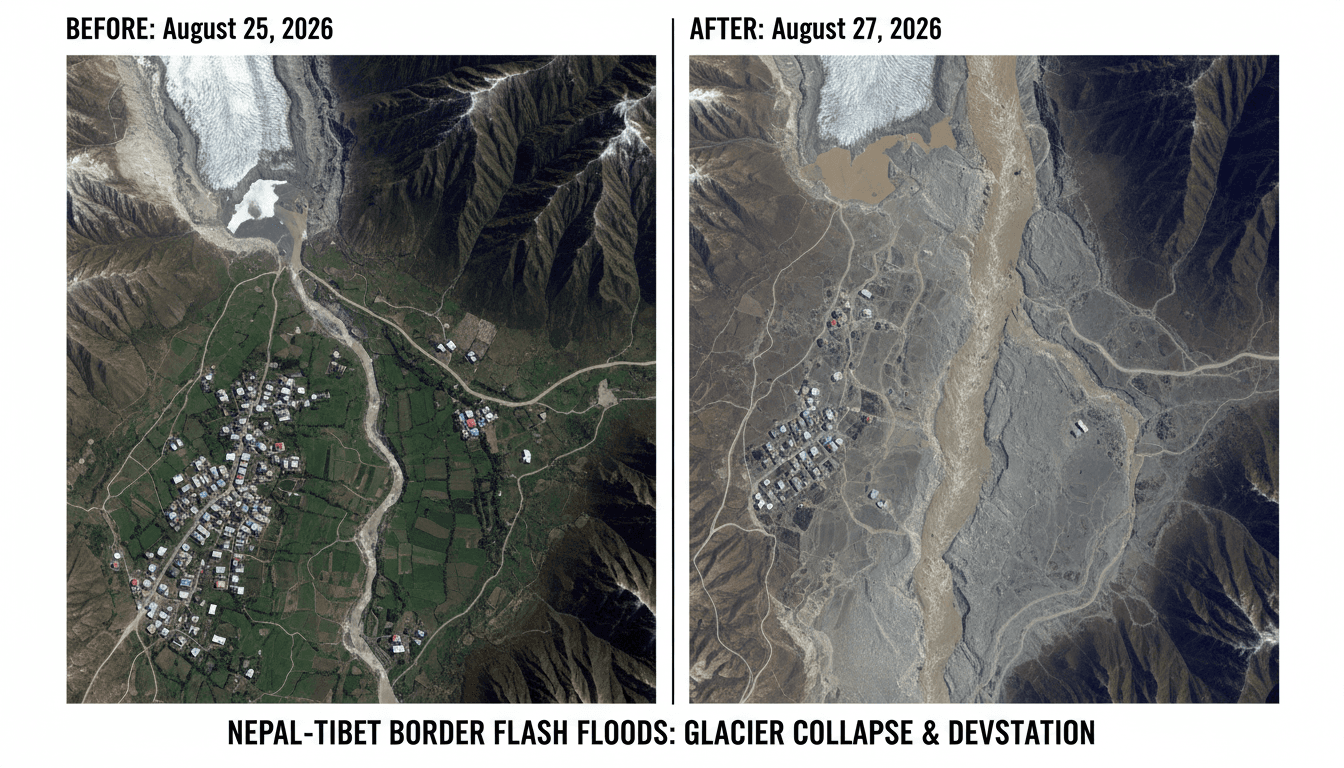
- Satellite imagery confirmed widespread destruction, erasing entire villages and critical infrastructure in Rasuwa and Nuwakot districts.
- Rescue operations are ongoing, with risks of secondary flooding from debris-dammed lakes complicating efforts.
The context you actually need
- Accelerated glacier retreat in the Himalayas has led to increased risks of glacial lake outburst floods, with Nepal losing about one-third of its ice cover in the last 30 years.
- The Lhende River valley, where the glacier collapsed, is at an elevation of approximately 5,200 meters, making it particularly susceptible to climate-induced changes.
- Previous patterns of glacial instability have been observed, but this event marks a significant escalation in the consequences of such collapses.
What's really happening
On August 26, 2026, at approximately 8:40 a.m. local time, a significant glacier collapse occurred in the Lhende River valley, sending a torrent of water, mud, and debris cascading down into the Bhotekoshi and Trishuli rivers. Within just 30 minutes, water levels surged by up to 9 meters, devastating border settlements like Timure and Syapru Besi. The rapid onset of the flood caught many residents and travelers off guard, leading to a catastrophic loss of life and property.
By August 27, the death toll had already surpassed 350, with over 1,300 individuals reported missing. Satellite imagery released shortly after the event documented the extensive destruction, revealing that entire villages had been erased from the landscape. As rescue operations intensified on August 28, the death toll rose to nearly 600, with missing persons climbing to approximately 2,400. The scale of the disaster prompted international aid offers, although Nepali authorities initially declined foreign search-and-rescue teams, deeming them unnecessary.
The ongoing rescue efforts are complicated by the risk of secondary flooding from debris-blocked lakes, which could lead to further evacuations and loss of life. The situation remains fluid, with local authorities coordinating domestic rescue operations while monitoring glacier threats. The event has highlighted the vulnerabilities of communities in the region, particularly as climate change continues to exacerbate glacial instability.
The implications of this disaster extend beyond immediate humanitarian concerns. The destruction of infrastructure, including roads and hydropower projects, poses long-term challenges for recovery and economic stability in the affected areas. As the region grapples with the aftermath, the global community must consider the broader implications of climate change on vulnerable ecosystems and populations.
Who feels it first (and how)
- Local residents: Directly impacted by loss of life, homes, and community infrastructure.
- Emergency responders: Engaged in rescue operations under challenging conditions.
- Tourists: Those in the affected valleys faced immediate danger and potential evacuation.
- Infrastructure sectors: Companies involved in rebuilding efforts will experience increased demand for resources and labor.
What to watch next
- Rescue operation updates: Monitoring the effectiveness and challenges of ongoing rescue efforts will provide insight into the immediate humanitarian response.
- Infrastructure recovery plans: Observing how local and international agencies plan to rebuild will indicate the long-term economic impact on the region.
- Climate policy discussions: Increased attention to climate change and its effects on vulnerable regions may lead to new policies or funding initiatives.
Nearly 600 confirmed fatalities and over 2,400 missing individuals.
Ongoing risks from secondary flooding and challenges in recovery efforts.
The long-term economic impact on the region and potential shifts in climate policy.
Frequently Asked Questions
- Why it matters?
- The disaster underscores the increasing risks posed by climate change, particularly in vulnerable regions like the Himalayas.
- What happened (in 30 seconds)?
- On August 26, 2026, a glacier collapse on the Nepal-Tibet border triggered flash floods, killing nearly 600 people and leaving over 2,400 missing. Satellite imagery confirmed widespread destruction, erasing entire villages and critical infrastructure in Rasuwa and Nuwakot districts. Rescue operations are ongoing, with risks of secondary flooding from debris-dammed lakes complicating efforts.
- What's really happening?
- On August 26, 2026, at approximately 8:40 a.m. local time, a significant glacier collapse occurred in the Lhende River valley, sending a torrent of water, mud, and debris cascading down into the Bhotekoshi and Trishuli rivers. Within just 30 minutes, water levels surged by up to 9 meters, devastating border settlements like Timure and Syapru Besi. The rapid onset of the flood caught many residents and travelers off guard, leading to a catastrophic loss of life and property. By August 27, the de
- Who feels it first (and how)?
- Local residents: Directly impacted by loss of life, homes, and community infrastructure. Emergency responders: Engaged in rescue operations under challenging conditions. Tourists: Those in the affected valleys faced immediate danger and potential evacuation. Infrastructure sectors: Companies involved in rebuilding efforts will experience increased demand for resources and labor.
- What to watch next?
- Rescue operation updates: Monitoring the effectiveness and challenges of ongoing rescue efforts will provide insight into the immediate humanitarian response. Infrastructure recovery plans: Observing how local and international agencies plan to rebuild will indicate the long-term economic impact on the region. Climate policy discussions: Increased attention to climate change and its effects on vulnerable regions may lead to new policies or funding initiatives.
Comprehensive coverage of Middle Eastern and global issues.
"Al Jazeera is a prominent voice from the Global South, especially the Middle East, with an emphasis on underreported stories."
— A47 Editor
Before and after images show catastrophic impact of Nepal flash floods
Recent flash floods in Nepal have caused catastrophic destruction, as revealed by before-and-after satellite images. The floods have resulted in significant loss of life, with at least 270 confirmed deaths and over 1,300 individuals reported missing,...
International stories from NPR’s global desk.
"NPR is an American public media organization known for thoughtful reporting and a slightly left-leaning editorial tone."
— A47 Editor
A melting glacier contributed to the deadly Nepal floods. We can expect more like this
Recent catastrophic floods along the Nepal-Tibet border have resulted from a glacier collapse, leading to significant loss of life, with reports indicating at least 360 confirmed deaths and over 1,400 individuals missing. The disaster has caused wide...
Comprehensive coverage of Middle Eastern and global issues.
"Al Jazeera is a prominent voice from the Global South, especially the Middle East, with an emphasis on underreported stories."
— A47 Editor
Nepal’s mudslide wiped out areas of eastern China, army helps search
A devastating mudslide triggered by a glacier collapse has struck the Nepal-Tibet border, resulting in significant destruction in eastern China, particularly in the town of Gyirong. Hundreds of military personnel have been deployed to assist in searc...
Global news coverage with extensive reporting on Middle Eastern conflicts and geopolitics.
"Al Jazeera is a Qatar-based broadcaster known for wide regional coverage and alternative perspectives."
— A47 Editor
Nepal’s mudslide wiped out areas of eastern China, army helps search
A devastating mudslide triggered by a glacier collapse has struck the Nepal-Tibet border, resulting in significant destruction in eastern China, particularly in the town of Gyirong. Hundreds of military personnel have been deployed to assist in searc...
Pan-Arab news coverage spanning politics, business, sports, and regional affairs.
"Asharq Al-Awsat reflects a broad Arab editorial perspective with strong attention to regional geopolitics."
— A47 Editor
ما أكثر الانهيارات الجليدية حصداً للأرواح في العالم؟
A massive avalanche in the Himalayan region between Nepal and Tibet has resulted in a catastrophic flood, leading to the deaths of at least 270 individuals. This incident highlights the dangers associated with natural disasters in mountainous areas, ...
Science and technology stories including AI.
"Longstanding science magazine with thoughtful AI coverage."
— A47 Editor
Why glacial collapse likely caused the Nepal disaster—and why climate change will make these events more likely
A catastrophic flood in Nepal has resulted in hundreds of fatalities and left at least 1,400 individuals missing, with experts indicating that the disaster may have been triggered by the collapse of a glacier. This event has raised significant concer...
Scientific research, technology, environment, and society.
"Scientific American is one of the oldest and most authoritative science magazines, known for deep dives into science, technology, and society."
— A47 Editor
Why glacial collapse likely caused the Nepal disaster—and why climate change will make these events more likely
A catastrophic flood in Nepal has resulted in hundreds of fatalities and left at least 1,400 individuals missing, with experts indicating that the disaster may have been triggered by the collapse of a glacier. This event has raised significant concer...
Global news coverage with extensive reporting on Middle Eastern conflicts and geopolitics.
"Al Jazeera is a Qatar-based broadcaster known for wide regional coverage and alternative perspectives."
— A47 Editor
Satellite images show destruction from Nepal-Tibet floods
A catastrophic flood struck the Nepal-Tibet border following a glacier collapse in the Himalayas, resulting in at least 165 confirmed deaths and over 1,300 individuals reported missing. The disaster has caused widespread destruction, with rescue oper...
Comprehensive coverage of Middle Eastern and global issues.
"Al Jazeera is a prominent voice from the Global South, especially the Middle East, with an emphasis on underreported stories."
— A47 Editor
Satellite images show destruction from Nepal-Tibet floods
A catastrophic flood triggered by a glacier collapse in the Himalayas has devastated the Nepal-Tibet border, resulting in at least 270 confirmed deaths and over 1,300 individuals reported missing. Satellite images reveal extensive destruction across ...
Breaking news, politics, business, and entertainment from the U.S. and around the world.
"The New York Post is a tabloid-format newspaper known for its sensationalist headlines and conservative-leaning editorial tone."
— A47 Editor
Glacier collapse triggered catastrophic Nepal flash floods that unleashed ‘tsunami from the sky’
A glacier collapse along the Nepal-China border has triggered catastrophic flash floods, resulting in at least 273 fatalities and leaving over 1,300 individuals missing. This disaster has been described by officials as a 'tsunami from the sky,' highl...
Pan-Arab news coverage spanning politics, business, sports, and regional affairs.
"Asharq Al-Awsat reflects a broad Arab editorial perspective with strong attention to regional geopolitics."
— A47 Editor
خبراء: انهيار جليدي ربما يكون السبب في سيول نيبال
Experts have indicated that the deadly floods near the border between Nepal and the Tibetan region of China may have been caused by the detachment of a lower section of a glacier, as revealed by satellite images.
Comprehensive coverage of Middle Eastern and global issues.
"Al Jazeera is a prominent voice from the Global South, especially the Middle East, with an emphasis on underreported stories."
— A47 Editor
CCTV captures terrifying mudslide engulfing Nepal-China border
CCTV footage has captured a terrifying mudslide that engulfed a crossing on the Nepal-China border, showing individuals fleeing moments before the disaster struck. This incident highlights the increasing frequency of extreme weather events in the reg...
Global news coverage with extensive reporting on Middle Eastern conflicts and geopolitics.
"Al Jazeera is a Qatar-based broadcaster known for wide regional coverage and alternative perspectives."
— A47 Editor
CCTV captures terrifying mudslide engulfing Nepal-China border
CCTV footage has captured a terrifying mudslide that engulfed a crossing on the Nepal-China border, showing individuals fleeing moments before the disaster struck. This incident highlights the increasing frequency of extreme weather events in the reg...
Regional coverage and analysis focused on politics, diplomacy, and business across the Middle East.
"Al-Monitor is known for analytical reporting on Middle East politics and policy developments."
— A47 Editor
Factbox-Deadly disasters in the Himalayas over a dozen years
A massive flash flood on the Nepal-Tibet border has resulted in at least nine confirmed fatalities, with hundreds of tourists reported missing. The disaster, triggered by a collapse of mud and rock into a river, has led to significant destruction of ...