
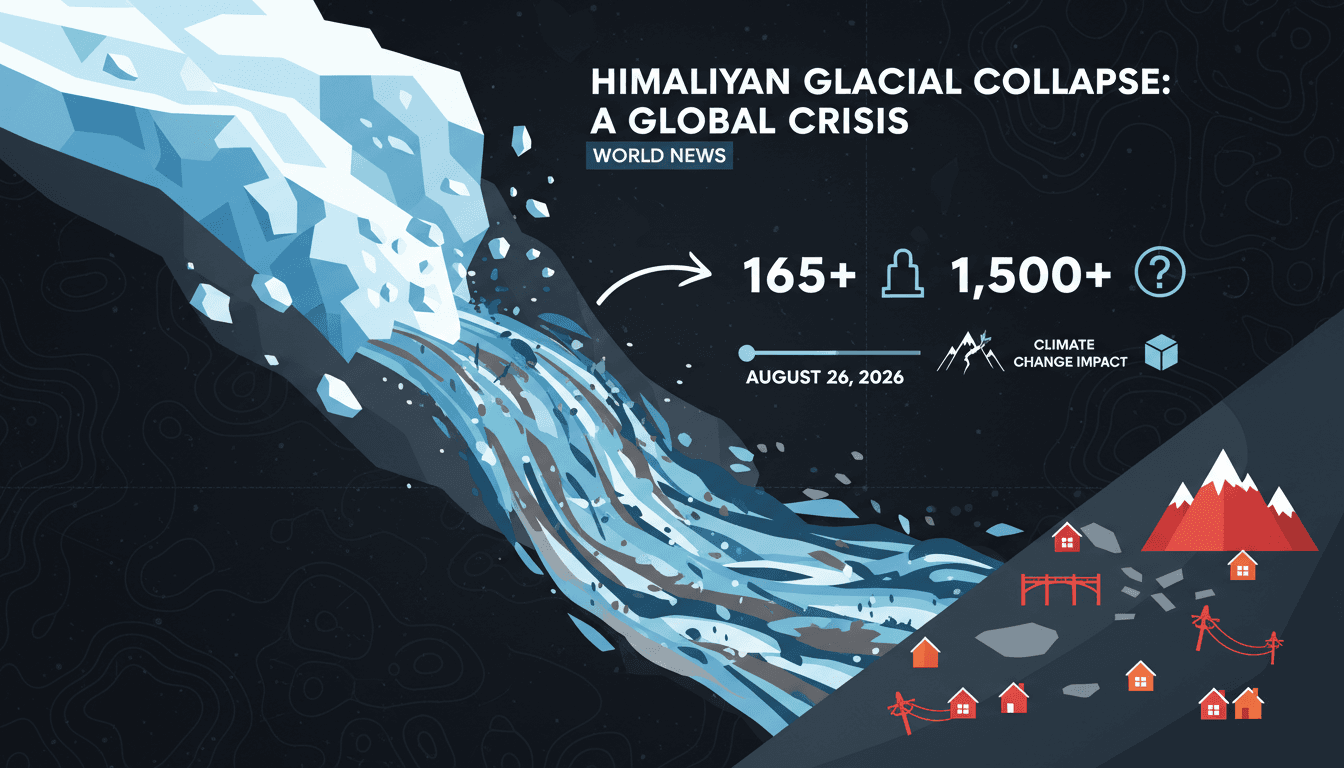
Himalayan flash floods kill over 165 and leave nearly 1,500 missing following glacial collapse
Here's what it means for you.
The recent flash floods in the Himalayas could impact global supply chains and tourism, especially for those involved in outdoor activities in the region.
Why it matters
The disaster highlights the increasing vulnerability of mountainous regions to climate-related events, affecting infrastructure and international relations.
What happened (in 30 seconds)
- On August 26, 2026, a glacial collapse near the Nepal-China border triggered devastating flash floods, killing at least 165 people and leaving nearly 1,500 missing.
- Rescue operations are ongoing, with over 5,000 personnel deployed, including international aid from countries like the US and India.
- Infrastructure damage is extensive, impacting villages, roads, and key trade routes in the region.
The context you actually need
- Seismic activity in the Himalayan region has been linked to glacial instability, raising concerns about future disasters.
- Tourism is a significant economic driver in the area, with many foreign nationals among the missing, complicating rescue efforts and international responses.
- Previous incidents, such as the July 2025 flooding from the Purepa glacier, indicate a troubling trend of increasing glacial melt and associated risks.
What's really happening
The flash floods on August 26, 2026, were triggered by a glacial ice-rock collapse that unleashed a torrent of mud, rock, and water into the Lhende/Bhotekoshi River system. This catastrophic event swept through the mountainous districts of Nepal and Gyirong County in Tibet, China, leading to widespread destruction. The initial seismic signals that were detected were later attributed to the glacial collapse rather than an earthquake, underscoring the unique geological vulnerabilities of the region.
The Himalayan region is seismically active and has been experiencing significant climate changes, which have accelerated glacial melting. This melting increases the risk of glacial lake outburst floods (GLOFs), as seen in previous incidents. The area is also a popular pilgrimage site, attracting thousands of tourists annually, which complicates rescue operations when disasters strike.
As rescue teams mobilized, the Nepali Army and police coordinated efforts with Chinese emergency responders. Over 5,000 personnel were deployed, utilizing helicopters to reach remote areas and distribute emergency supplies. The international community responded swiftly, with countries like the US and India providing aid and resources. The formation of a barrier lake upstream poses an additional risk, potentially leading to further flooding if not managed properly.
The economic implications of this disaster are significant. The affected regions are critical for trade, particularly under the Belt and Road Initiative, which aims to enhance connectivity between China and its neighbors. Damage to infrastructure could disrupt supply chains and impact local economies reliant on tourism and trade. The humanitarian response will likely require sustained international support, as the region grapples with the immediate aftermath and the long-term implications of climate change.
Who feels it first (and how)
- Local residents: Directly affected by loss of life, homes, and livelihoods.
- Tourists and pilgrims: Many foreign nationals are among the missing, impacting travel plans and safety perceptions.
- Emergency responders: Increased pressure on local and international teams to manage rescue and recovery efforts.
- Businesses: Local economies reliant on tourism and trade may face significant downturns due to infrastructure damage.
What to watch next
- Rescue and recovery updates: Monitoring the status of missing persons and the effectiveness of ongoing rescue operations will be crucial.
- Infrastructure assessments: Evaluating the damage to roads, bridges, and power projects will inform recovery timelines and economic impacts.
- Climate policy discussions: Increased focus on climate resilience and disaster preparedness in vulnerable regions may emerge as a response to this event.
At least 165 people have died, and nearly 1,500 are reported missing.
The death toll may rise as rescue operations continue and more information becomes available.
The long-term economic impacts on local communities and international trade routes remain to be fully assessed.
Frequently Asked Questions
- Why it matters?
- The disaster highlights the increasing vulnerability of mountainous regions to climate-related events, affecting infrastructure and international relations.
- What happened (in 30 seconds)?
- On August 26, 2026, a glacial collapse near the Nepal-China border triggered devastating flash floods, killing at least 165 people and leaving nearly 1,500 missing. Rescue operations are ongoing, with over 5,000 personnel deployed, including international aid from countries like the US and India. Infrastructure damage is extensive, impacting villages, roads, and key trade routes in the region.
- What's really happening?
- The flash floods on August 26, 2026, were triggered by a glacial ice-rock collapse that unleashed a torrent of mud, rock, and water into the Lhende/Bhotekoshi River system. This catastrophic event swept through the mountainous districts of Nepal and Gyirong County in Tibet, China, leading to widespread destruction. The initial seismic signals that were detected were later attributed to the glacial collapse rather than an earthquake, underscoring the unique geological vulnerabilities of the regio
- Who feels it first (and how)?
- Local residents: Directly affected by loss of life, homes, and livelihoods. Tourists and pilgrims: Many foreign nationals are among the missing, impacting travel plans and safety perceptions. Emergency responders: Increased pressure on local and international teams to manage rescue and recovery efforts. Businesses: Local economies reliant on tourism and trade may face significant downturns due to infrastructure damage.
- What to watch next?
- Rescue and recovery updates: Monitoring the status of missing persons and the effectiveness of ongoing rescue operations will be crucial. Infrastructure assessments: Evaluating the damage to roads, bridges, and power projects will inform recovery timelines and economic impacts. Climate policy discussions: Increased focus on climate resilience and disaster preparedness in vulnerable regions may emerge as a response to this event.
Oil, metals, and agriculture: supply/demand headlines, OPEC chatter, inventories, and price action.
"Solid tape for energy and metals traders tracking macro and micro catalysts."
— A47 Editor
Rescuers seek nearly 1,500 still missing in Nepal and China after flash flood
Rescuers are currently searching for nearly 1,500 individuals reported missing in Nepal and China following a devastating flash flood. The incident has raised significant concerns about the safety and well-being of those affected, as rescue operation...
International news coverage curated for readers in the UAE and Gulf region.
"Emirates 24|7 world coverage presents global developments through a UAE-facing and Gulf-relevant editorial lens."
— A47 Editor
Missing tourists in Nepal flood: Breakdown by nationality
A catastrophic flash flood on the Nepal-Tibet border has left 579 tourists missing, including over 400 foreigners, as confirmed by tourism officials. Among those reported missing are at least 130 Indians, 34 Australians, 47 Americans, 33 British citi...
Global news coverage with extensive reporting on Middle Eastern conflicts and geopolitics.
"Al Jazeera is a Qatar-based broadcaster known for wide regional coverage and alternative perspectives."
— A47 Editor
Nepal-Tibet floods: What happened, what caused them and who is missing?
A catastrophic flood has struck the Nepal-Tibet border, resulting from a glacier collapse, leading to at least 160 confirmed deaths and hundreds reported missing. The disaster has caused widespread destruction, with survivors recounting harrowing exp...
Comprehensive coverage of Middle Eastern and global issues.
"Al Jazeera is a prominent voice from the Global South, especially the Middle East, with an emphasis on underreported stories."
— A47 Editor
Nepal-Tibet floods: What happened, what caused them and who is missing?
A catastrophic flood has struck the Nepal-Tibet border, resulting from a glacier collapse, leading to at least 160 confirmed deaths and hundreds reported missing. The disaster has caused widespread destruction, with survivors recounting harrowing exp...