
Hurricane Isaias Makes Landfall in Florida as Category 2 Storm
Why it matters
The storm's disruption to energy production and infrastructure highlights vulnerabilities in the Gulf Coast, impacting national energy prices and emergency response capabilities.
What happened (in 30 seconds)
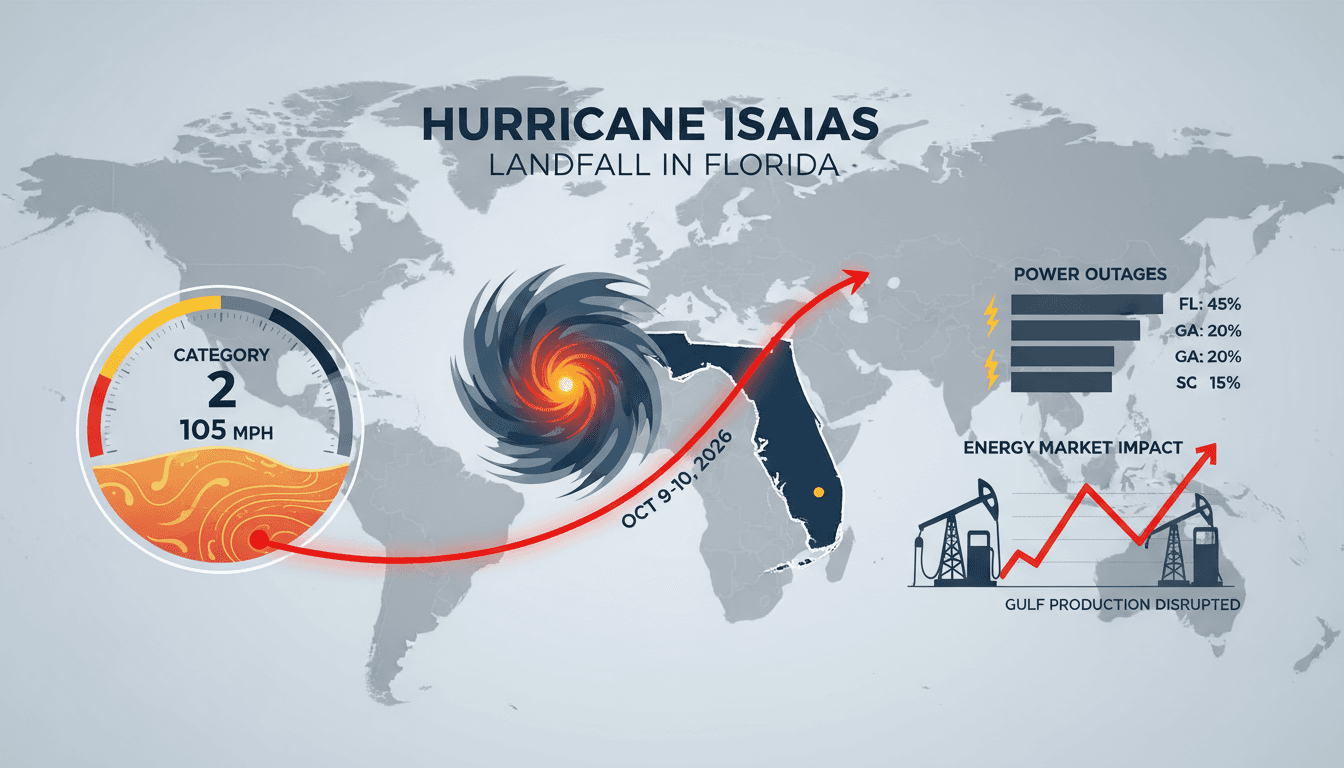
- Hurricane Isaias made landfall near Destin, Florida, on October 9-10, 2026, as a Category 2 storm with winds of 105 mph.
- Emergency declarations were issued across Alabama, Florida, and Mississippi, affecting over 670,000 customers without power.
- The storm weakened quickly after landfall, transitioning to a post-tropical cyclone by October 10, but left significant flooding and tornado risks in its wake.
The context you actually need
- El Niño conditions contributed to an unusually quiet hurricane season, making Isaias the first hurricane of 2026 and the latest first hurricane since 1905.
- Rapid intensification occurred over record-warm Gulf waters, with Isaias strengthening from a tropical storm to a Category 2 hurricane in just days.
- FEMA's restructuring and staffing cuts from the previous administration raised concerns about the agency's preparedness for such storms, as Isaias became its first major test post-restructuring.
What's really happening
Hurricane Isaias emerged as a significant weather event in an otherwise quiet Atlantic hurricane season, primarily influenced by strong El Niño conditions that suppressed storm formation. The storm formed on October 6, 2026, and rapidly intensified over the warm waters of the Gulf of Mexico, reaching Category 3 strength before slightly weakening to Category 2 at landfall. This rapid intensification is indicative of the changing climate, where warmer ocean temperatures can lead to more powerful storms.
As Isaias approached the Gulf Coast, emergency declarations were issued across multiple states, prompting evacuations and preparations for severe impacts. The storm made landfall near Destin, Florida, around 8:30-9:30 p.m. local time on October 9, bringing with it maximum sustained winds of 105 mph and a life-threatening storm surge of up to 7 feet in some areas. The aftermath saw widespread power outages affecting approximately 670,000 customers across Florida, Alabama, Georgia, and Mississippi, with utility crews mobilizing for restoration efforts.
The storm's impact on oil and gas operations was significant, with temporary halts in production leading to market fluctuations. The U.S. government authorized releases from the Strategic Petroleum Reserve to stabilize supply chains. This disruption underscores the interconnectedness of weather events and energy markets, as the Gulf Coast is a critical hub for oil and gas production.
FEMA's response to Isaias has come under scrutiny, particularly given the agency's recent restructuring and staffing cuts, which saw over 4,300 employees lost in FY2025. This event serves as a litmus test for the agency's ability to respond effectively to natural disasters, raising questions about future preparedness in the face of increasingly severe weather patterns.
Who feels it first (and how)
- Utility companies: Facing immediate operational challenges and restoration efforts for power outages.
- Residents in affected areas: Experiencing power outages, flooding, and potential tornado risks.
- Energy markets: Influenced by disruptions in oil and gas production, leading to price fluctuations.
- Emergency response agencies: Evaluating their preparedness and response capabilities in light of the storm's impact.
What to watch next
- Power restoration timelines: Monitoring how quickly utility companies can restore power will indicate the storm's long-term impact on local economies.
- Energy prices: Fluctuations in crude oil production and market responses could affect fuel prices nationally.
- FEMA's response evaluation: Observing how the agency addresses the challenges posed by Isaias will provide insights into future disaster preparedness.
Hurricane Isaias made landfall as a Category 2 storm, causing significant power outages and emergency declarations.
Energy prices may experience volatility due to disruptions in Gulf oil production.
The long-term effectiveness of FEMA's response and recovery efforts remains to be seen.
Frequently Asked Questions
- Why it matters?
- The storm's disruption to energy production and infrastructure highlights vulnerabilities in the Gulf Coast, impacting national energy prices and emergency response capabilities.
- What happened (in 30 seconds)?
- Hurricane Isaias made landfall near Destin, Florida, on October 9-10, 2026, as a Category 2 storm with winds of 105 mph. Emergency declarations were issued across Alabama, Florida, and Mississippi, affecting over 670,000 customers without power. The storm weakened quickly after landfall, transitioning to a post-tropical cyclone by October 10, but left significant flooding and tornado risks in its wake.
- What's really happening?
- Hurricane Isaias emerged as a significant weather event in an otherwise quiet Atlantic hurricane season, primarily influenced by strong El Niño conditions that suppressed storm formation. The storm formed on October 6, 2026, and rapidly intensified over the warm waters of the Gulf of Mexico, reaching Category 3 strength before slightly weakening to Category 2 at landfall. This rapid intensification is indicative of the changing climate, where warmer ocean temperatures can lead to more powerful s
- Who feels it first (and how)?
- Utility companies: Facing immediate operational challenges and restoration efforts for power outages. Residents in affected areas: Experiencing power outages, flooding, and potential tornado risks. Energy markets: Influenced by disruptions in oil and gas production, leading to price fluctuations. Emergency response agencies: Evaluating their preparedness and response capabilities in light of the storm's impact.
- What to watch next?
- Power restoration timelines: Monitoring how quickly utility companies can restore power will indicate the storm's long-term impact on local economies. Energy prices: Fluctuations in crude oil production and market responses could affect fuel prices nationally. FEMA's response evaluation: Observing how the agency addresses the challenges posed by Isaias will provide insights into future disaster preparedness.
International coverage from The Guardian's global desks.
"The Guardian is known for its progressive editorial stance and in-depth analysis."
— A47 Editor
‘Life-threatening storm surge’ headed to US Gulf coast as residents brace for Isais
Hurricane Isaias, now a category 2 storm, is approaching the US Gulf Coast, prompting emergency declarations in Alabama, Florida, and Mississippi as residents prepare for potentially life-threatening storm surges and power outages. The storm is expec...
Science and technology stories including AI.
"Longstanding science magazine with thoughtful AI coverage."
— A47 Editor
How Hurricane Isaias got so dangerously strong so fast
Hurricane Isaias has rapidly intensified into a Category 3 storm and is currently moving toward the U.S. Gulf Coast, raising concerns about its potential impact on the region. Meteorologists have noted that this hurricane has set a record as the late...
Scientific research, technology, environment, and society.
"Scientific American is one of the oldest and most authoritative science magazines, known for deep dives into science, technology, and society."
— A47 Editor
How Hurricane Isaias got so dangerously strong so fast
Hurricane Isaias has rapidly intensified into a Category 3 storm and is currently moving toward the U.S. Gulf Coast, raising concerns about its potential impact on the region. Meteorologists have noted that this hurricane has set a record as the late...
Editor-curated FT homepage stories spanning markets, business, world, and opinion.
"The Financial Times is a globally respected business publication with a centrist/center-left tone and strong markets focus."
— A47 Editor
Oil and gas production disrupted as Hurricane Isaias barrels towards Gulf
Hurricane Isaias, the first major Atlantic storm of the season, is advancing towards the Gulf of Mexico, prompting significant disruptions in oil and gas production across Florida, Alabama, Georgia, and Mississippi. Major companies have begun precaut...
Reports on climate change, environmental science, sustainability, and nature.
"BBC News is widely regarded as a reputable international news organization, known for its impartial tone and public service mandate."
— A47 Editor
BBC on Hurricane Isaias and its expected Gulf Coast landfall
BBC Weather's Chris Fawkes reports that Hurricane Isaias, the first hurricane of the 2026 Atlantic season, is expected to make landfall on the Gulf Coast on Friday, bringing with it dangerous winds, storm surge, and heavy rains.
International coverage of politics, culture, and current affairs.
"BBC News is widely regarded as a reputable international news organization, known for its impartial tone and public service mandate."
— A47 Editor
BBC on Hurricane Isaias and its expected Gulf Coast landfall
BBC Weather's Chris Fawkes reports that Hurricane Isaias, the first hurricane of the 2026 Atlantic season, is expected to make landfall on the Gulf Coast on Friday, bringing with it dangerous winds, storm surge, and heavy rains.