
U.S. Military Strike Kills Five on Suspected Narcotics Vessel in Eastern Pacific
Why it matters
The systemic transition from traditional law enforcement interdiction to direct military kinetic action alters legal risk frameworks and security dynamics in international transit corridors.
What happened (in 30 seconds)
- Lethal maritime engagement: On October 27, 2026, the U.S. military executed a kinetic strike on a suspected go-fast narcotics vessel in the Eastern Pacific Ocean, killing at least five individuals identified as narco-terrorists.
- Official operational command: The operation was directed by U.S. Southern Command (SOUTHCOM) and Joint Task Force Western Hemisphere, utilizing confirmed intelligence along established transit routes without publishing specific cargo data.
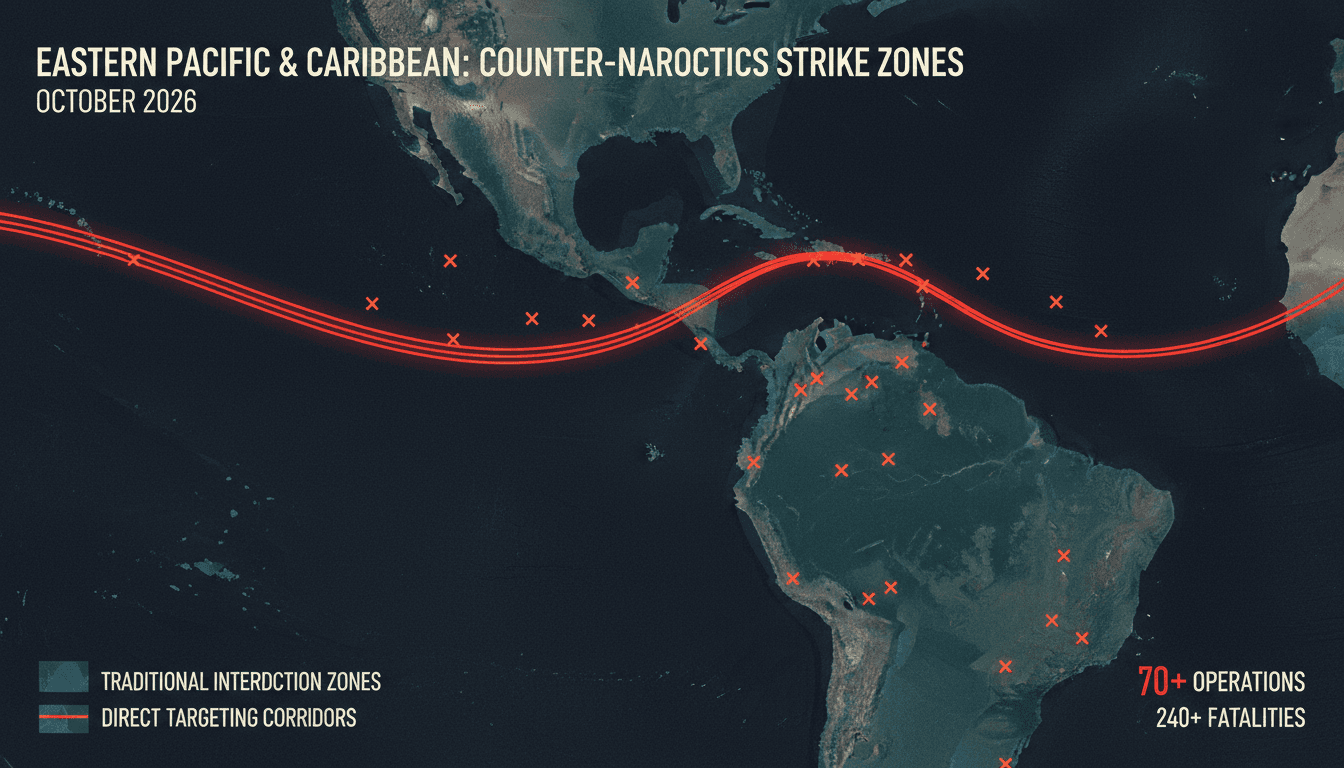
- Sustained campaign scope: This event brings the total to more than 70 maritime strikes and at least 240 fatalities under an expanded military counter-narcotics campaign initiated in September 2025.
The context you actually need
- The policy reclassification: In September 2025, the Trump administration designated drug cartels as narcoterrorist organizations, structurally transferring the mission from standard coast guard interdiction to rules-of-engagement-driven military strikes.
- The operational theater: The expanded campaign specifically focuses on international waters within both the Eastern Pacific Ocean and the Caribbean Sea to disrupt maritime supply chains delivering illicit substances.
- The legal discourse: International legal scholars and human rights organizations continue to evaluate the compliance of these strikes with established maritime law and conventional standards of due process for criminal suspects.
What's really happening
The operational shift in the Eastern Pacific reflects a structural reassessment of how states allocate resources against illicit trafficking networks. Historically, maritime counter-narcotics operations functioned under an interdiction model. In that system, law enforcement agencies—primarily coast guards and domestic law enforcement partners—intercepted vessels, boarded them, seized physical contraband, and processed individuals through civilian judicial systems.
That framework, however, carries specific systemic trade-offs: interdiction requires significant personnel commitments, faces boarding vulnerabilities, and depends on bilateral judicial extraditions that frequently encounter domestic bottlenecks.
By designating cartels as narcoterrorist organizations, the institutional incentive structure shifts toward direct kinetic mitigation. Operating under U.S. Southern Command and Joint Task Force Western Hemisphere, the current operational model applies military force directly to maritime targets in international waters. From an incentive perspective, direct kinetic action reduces the operational friction of high-seas custody, interdiction boarding risks, and complex trial procedures. The declared objective focuses on raising the direct operational cost of maritime transport routes rather than prosecuting individual actors downstream.
This strategy redefines the operational environment across established transit corridors. Over the course of more than 70 strikes resulting in at least 240 fatalities, the military approach treats vessel traffic associated with designated organizations as hostile targets rather than law enforcement subjects. This dynamic alters the behavior of maritime transport actors across the Eastern Pacific and the Caribbean.
For global operators tracking maritime supply chains and regulatory environments, this evolution establishes a clear operational baseline: international transit zones are increasingly subject to national security protocols rather than civilian law enforcement conventions. While primary official justifications emphasize reducing the domestic inflow of narcotics responsible for overdose fatalities, the structural side effect is an altered legal baseline. Because operations occur without public disclosure of physical cargo manifest verification or post-strike salvage documentation, operators face an environment where sovereign authority exercises unilateral kinetic options based on intelligence-led identification rather than post-seizure chain-of-custody evidence.
Who feels it first (and how)
- Commercial shipping and maritime logistics operators: Fleet managers navigating transit corridors off Central and South America must factor enhanced military activity and rapid kinetic engagements into route planning.
- Maritime legal and compliance counsels: Corporate risk officers must navigate ambiguous liability frameworks as the border between military armed conflict and civilian criminal interdiction blurs in international waters.
- Regional security and cross-border transport planners: Operators managing transshipment logistics in adjacent jurisdictions must monitor altered movement patterns as trafficking networks shift routes away from heavily patrolled military sectors.
What to watch next
- Public evidence disclosures: Watch whether SOUTHCOM or Joint Task Force Western Hemisphere begins releasing physical cargo manifests or post-strike forensic data to address legal and regulatory transparency inquiries.
- Judicial and multilateral challenge points: Monitor international maritime bodies or human rights tribunals for legal challenges concerning sovereignty and due process on the high seas, which could redefine maritime risk classifications.
- Corridor migration and route adjustments: Observe whether commercial maritime tracking data indicates an operational rerouting of standard civilian or commercial traffic away from focal points in the Eastern Pacific.
On October 27, 2026, a U.S. military strike in the Eastern Pacific killed five suspected narcotics operators aboard a go-fast boat, marking over 70 strikes and 240 cumulative fatalities since September 2025.
SOUTHCOM will maintain its current rules of engagement along active Pacific and Caribbean transit corridors as long as the narcoterrorist designation remains operational policy.
It remains unverified what specific volume or type of cargo was destroyed aboard the vessel, as official statements were released without accompanying cargo documentation.
Frequently Asked Questions
- Why it matters?
- The systemic transition from traditional law enforcement interdiction to direct military kinetic action alters legal risk frameworks and security dynamics in international transit corridors.
- What happened (in 30 seconds)?
- Lethal maritime engagement: On October 27, 2026, the U.S. military executed a kinetic strike on a suspected go-fast narcotics vessel in the Eastern Pacific Ocean, killing at least five individuals identified as narco-terrorists. Official operational command: The operation was directed by U.S. Southern Command (SOUTHCOM) and Joint Task Force Western Hemisphere, utilizing confirmed intelligence along established transit routes without publishing specific cargo data. Sustained campaign scope: This
- What's really happening?
- The operational shift in the Eastern Pacific reflects a structural reassessment of how states allocate resources against illicit trafficking networks. Historically, maritime counter-narcotics operations functioned under an interdiction model. In that system, law enforcement agencies—primarily coast guards and domestic law enforcement partners—intercepted vessels, boarded them, seized physical contraband, and processed individuals through civilian judicial systems. That framework, however, carr
- Who feels it first (and how)?
- Commercial shipping and maritime logistics operators: Fleet managers navigating transit corridors off Central and South America must factor enhanced military activity and rapid kinetic engagements into route planning. Maritime legal and compliance counsels: Corporate risk officers must navigate ambiguous liability frameworks as the border between military armed conflict and civilian criminal interdiction blurs in international waters. Regional security and cross-border transport planners: Operat
- What to watch next?
- Public evidence disclosures: Watch whether SOUTHCOM or Joint Task Force Western Hemisphere begins releasing physical cargo manifests or post-strike forensic data to address legal and regulatory transparency inquiries. Judicial and multilateral challenge points: Monitor international maritime bodies or human rights tribunals for legal challenges concerning sovereignty and due process on the high seas, which could redefine maritime risk classifications. Corridor migration and route adjustments: Ob
Conservative-leaning political and national coverage.
"The Washington Times is a conservative-leaning newspaper known for its political coverage and advocacy of right-of-center viewpoints."
— A47 Editor
At least 5 killed in U.S. strike on suspected drug smuggling boat
The U.S. military bombed a boat in the Eastern Pacific that it said was involved in drug trafficking, killing at least five people, according to reporting on the strike published by The Washington Times. The operation is part of an ongoing campaign b...
Conservative-leaning coverage of current events.
"Fox News is a highly influential conservative news outlet known for right-leaning political commentary and coverage."
— A47 Editor
US military kills five in eastern Pacific strike on suspected drug-trafficking vessel
Video shows a go-fast vessel erupting into a massive fireball after a US military strike in the eastern Pacific, with SOUTHCOM confirming five suspected narco-terrorists were killed in the attack on a suspected drug-trafficking vessel.
Global news coverage with extensive reporting on Middle Eastern conflicts and geopolitics.
"Al Jazeera is a Qatar-based broadcaster known for wide regional coverage and alternative perspectives."
— A47 Editor
US says it killed five people in strike on alleged drug boat
The United States said it killed five people in a strike on an alleged drug-trafficking boat, according to the base article published by Al Jazeera. The latest strike brings the death toll of the campaign, which has been decried as extrajudicial kill...
Comprehensive coverage of Middle Eastern and global issues.
"Al Jazeera is a prominent voice from the Global South, especially the Middle East, with an emphasis on underreported stories."
— A47 Editor
US says it killed five people in strike on alleged drug boat
The United States said it killed five people in a strike on an alleged drug-trafficking boat, according to the base article published by Al Jazeera. The latest strike brings the death toll of the campaign, which has been decried as extrajudicial kill...
News from the United States including domestic politics, society, and culture.
"The Guardian is known for its progressive editorial stance and in-depth analysis, often advocating for social justice, environmental issues, and liberal values."
— A47 Editor
US military says strike on alleged drug vessel in eastern Pacific kills five people
The US military said on Tuesday it killed five people in an airstrike on a suspected drug-trafficking vessel in the eastern Pacific, according to a statement from Southcom. The strike is the latest in a series of such attacks in the region, part of a...
Top international stories selected by The Guardian editors.
"The Guardian is known for its progressive editorial stance and in-depth analysis."
— A47 Editor
US military says strike on alleged drug vessel in eastern Pacific kills five people
The US military said on Tuesday it killed five people in an airstrike on a suspected drug-trafficking vessel in the eastern Pacific, according to a statement from Southcom. The strike is the latest in a series of such attacks in the region, part of a...