
Iran Deploys Limpet Mines Against Commercial Tanker in Strait of Hormuz Amid US-Iran Conflict
Why it matters
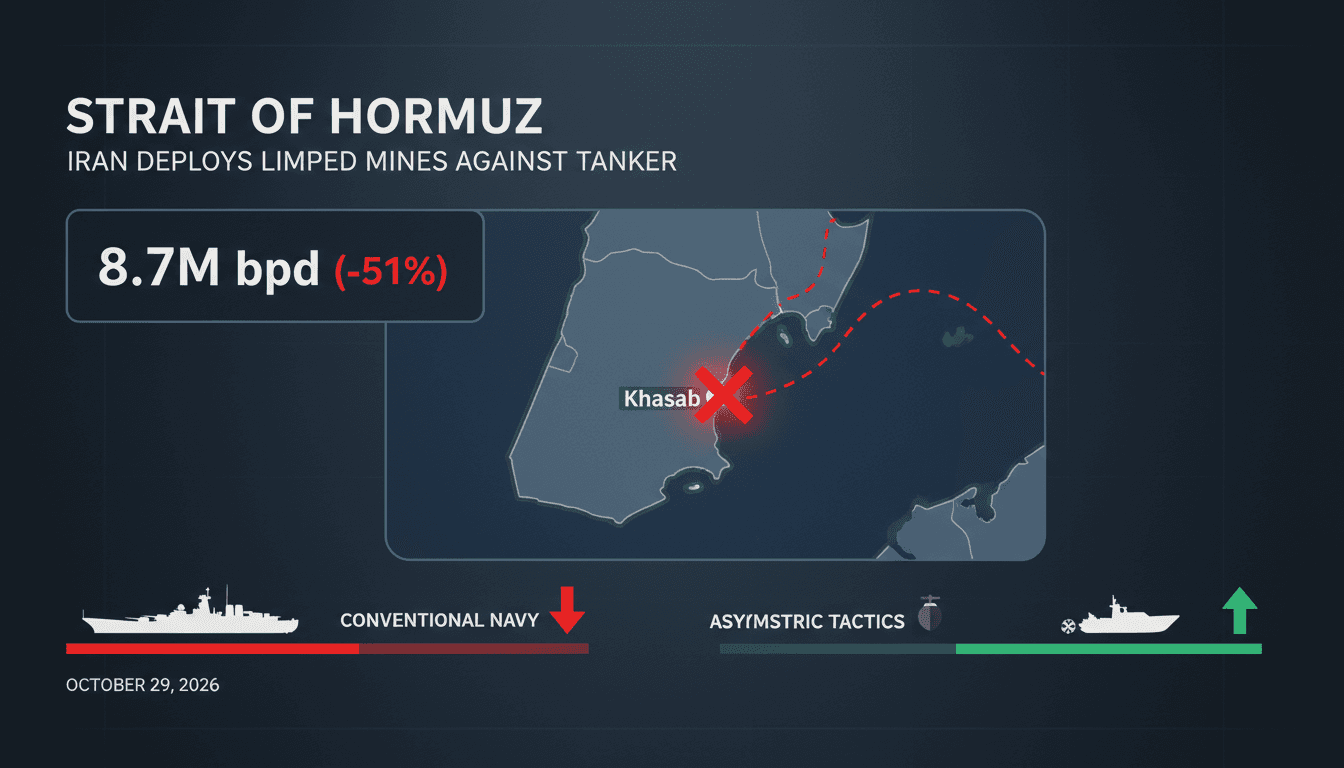
The tactical shift to hull-attached limpet mines in the world's most critical transit chokepoint has contributed to a 51% drop in baseline oil flows, testing the limits of naval escort models and embedding permanent risk premiums into regional operations.
What happened (in 30 seconds)
- A precision strike disabled commercial transit: On October 29, 2026, operatives deployed a small craft to attach two limpet mines above the waterline of the Panama-flagged tanker *Louise 1*, approximately 25 nautical miles northeast of Khasab, Oman.
- Onboard damage was contained without casualties: The detonations ignited an engine-room fire that the crew extinguished, allowing the vessel to proceed under its own power to an anchorage off Khor Fakkan with no reported environmental leaks.
- The operational playbook evolved: This attack represents the first confirmed, successful deployment of limpet mines against merchant shipping since the wider US-Iran conflict escalated in February 2026, following a failed attempt recorded in September.
The context you actually need
- Transit volumes have collapsed by half: Average oil shipments exiting the Strait of Hormuz fell to 8.7 million barrels per day for the seven days ending October 29, 2026—a 51% decline from pre-conflict baseline levels according to Kpler data.
- Navigation rules are being enforced by force: The targeting of *Louise 1* aligns with unilateral routing restrictions asserted by Iranian authorities, who claimed multiple vessels suffered mine damage after utilizing unauthorized sea lanes.
- Dubai-linked assets are directly in the crosshairs: The targeted tanker carries Dubai-based ownership, linking maritime disruption directly to commercial hubs and bunkering ports along the United Arab Emirates coast.
What's really happening
The deployment of limpet mines marks an intentional transition from high-signature naval presence to low-cost, deniable asymmetric leverage. While United States Central Command previously noted a decrease in visible Iranian naval hull counts across the Strait of Hormuz, that drawdown did not indicate a de-escalation. Instead, it signaled a shift in tactical doctrine toward small-boat, close-quarter mine application.
Limpets alter the risk calculus for merchant traffic because they require minimal logistical overhead while creating disproportionate operational denial. A single fast boat navigating congested littoral waters off Khasab can approach a slow-moving, laden crude carrier, secure magnetic charges above the waterline, and withdraw before maritime patrol craft can effectively intercept. The outcome is not total hull loss or catastrophic environmental release, but rather selective disablement: localized fires, disabled engine compartments, and forced diversions to emergency anchorages like Khor Fakkan.
This threshold management serves a dual economic and diplomatic purpose. Iran is utilizing the threat of intermittent physical interdiction to assert de facto sovereignty over navigable lanes without triggering a direct, conventional engagement with US naval escort groups. By framing the incidents as enforcement actions against vessels using "unauthorized routes," the operating forces maintain calibrated leverage while third-party mediators, including Qatari diplomatic channels, broker negotiations regarding sanctions relief and nuclear concessions.
The structural impact is borne by commercial shipping infrastructure. Escort missions conducted by US naval forces are resource-intensive, difficult to sustain across every commercial transit window, and fundamentally mismatched against low-profile small-craft operations in narrow waterways. As energy transit drops to 8.7 million barrels per day, the 51% reduction in throughput is not purely the result of damaged steel; it is the mathematical result of commercial shipowners, insurers, and crews refusing transit without pricing in substantial conflict buffers. The mechanical constraint on Hormuz shifts the Gulf’s entire maritime logistical architecture from a frictionless highway to a contested access corridor.
Who feels it first (and how)
- Dubai-based vessel owners and ship managers: Asset holders face immediate balance-sheet pressure from surging hull and machinery insurance premiums, compulsory security protocol upgrades, and potential vessel strandings.
- Global commodity traders and refinery procurement heads: Supply planners must absorb heightened crude pricing volatility and secure alternative, longer-distance tanker routing as Gulf liftings stall.
- UAE bunkering and logistics operators: Marine services clustered around Khor Fakkan and regional hubs must manage port congestion and emergency repair backlogs as damaged or diverted tonnage seeks safe harbor.
- Energy-dependent consumer sectors: Downstream businesses across transport, manufacturing, and utilities face persistent input-cost inflation as oil supply reductions ripple into fuel and feedstocks.
What to watch next
- Escort capacity metrics from US Central Command: Watch whether naval forces expand convoy-style physical escorts or limit coverage to designated priority convoys, which will determine commercial transit viability.
- Qatari mediation signals: Monitor whether technical compromises around nuclear concessions and sanctions relief lead to a documented pause in mine deployments.
- Tanker rerouting via non-Hormuz pipelines: Track utilization rates of alternative regional terrestrial bypass pipelines, which will signal whether the 51% drop in seaborne transit becomes a structural shift.
The Panama-flagged tanker *Louise 1*, owned by Dubai-based entities, was struck above the waterline by two limpet mines placed via small craft 25 nautical miles off Khasab, causing an engine fire but no casualties.
Iranian naval elements will continue utilizing low-signature asymmetric mining to enforce routing mandates, keeping weekly Hormuz transit volumes depressed well below historical norms.
Whether current Qatari diplomatic engagement will successfully produce an operational compromise before rising maritime insurance costs induce a full private-sector boycott of unescorted transits.
Frequently Asked Questions
- Why it matters?
- The tactical shift to hull-attached limpet mines in the world's most critical transit chokepoint has contributed to a 51% drop in baseline oil flows, testing the limits of naval escort models and embedding permanent risk premiums into regional operations.
- What happened (in 30 seconds)?
- A precision strike disabled commercial transit: On October 29, 2026, operatives deployed a small craft to attach two limpet mines above the waterline of the Panama-flagged tanker *Louise 1*, approximately 25 nautical miles northeast of Khasab, Oman. Onboard damage was contained without casualties: The detonations ignited an engine-room fire that the crew extinguished, allowing the vessel to proceed under its own power to an anchorage off Khor Fakkan with no reported environmental leaks. The oper
- What's really happening?
- The deployment of limpet mines marks an intentional transition from high-signature naval presence to low-cost, deniable asymmetric leverage. While United States Central Command previously noted a decrease in visible Iranian naval hull counts across the Strait of Hormuz, that drawdown did not indicate a de-escalation. Instead, it signaled a shift in tactical doctrine toward small-boat, close-quarter mine application. Limpets alter the risk calculus for merchant traffic because they require minim
- Who feels it first (and how)?
- Dubai-based vessel owners and ship managers: Asset holders face immediate balance-sheet pressure from surging hull and machinery insurance premiums, compulsory security protocol upgrades, and potential vessel strandings. Global commodity traders and refinery procurement heads: Supply planners must absorb heightened crude pricing volatility and secure alternative, longer-distance tanker routing as Gulf liftings stall. UAE bunkering and logistics operators: Marine services clustered around Khor Fa
- What to watch next?
- Escort capacity metrics from US Central Command: Watch whether naval forces expand convoy-style physical escorts or limit coverage to designated priority convoys, which will determine commercial transit viability. Qatari mediation signals: Monitor whether technical compromises around nuclear concessions and sanctions relief lead to a documented pause in mine deployments. Tanker rerouting via non-Hormuz pipelines: Track utilization rates of alternative regional terrestrial bypass pipelines, which
Global business headlines with AI angles.
"General business outlet that frequently covers AI."
— A47 Editor
Iran is Changing Tactics to Prevent Ships From Crossing the Hormuz Strait. It is Now Resorting to Limpet Mines.
Iranian forces are reportedly using speedboats to attach limpet mines to ships transiting the Strait of Hormuz, a tactic that signals a shift in how Tehran is trying to deter shipping through the vital oil waterway, as Iran and Washington weigh propo...
Regional coverage and analysis focused on politics, diplomacy, and business across the Middle East.
"Al-Monitor is known for analytical reporting on Middle East politics and policy developments."
— A47 Editor
Limpet mine attack in Hormuz suggests Iran may be shifting tactics
Al-Monitor reports a UKMTO account of the first successful limpet mine attack on a commercial vessel in the Middle East since 2019, an incident that appeared to undermine the Pentagon's claims that the Strait of Hormuz had been fully cleared and open...
Global markets, investing, and macroeconomics from a premier financial newsroom.
"Bloomberg is respected for in-depth financial reporting and data-driven analysis."
— A47 Editor
Rare Speedboat Attack in Hormuz Ignites Tanker’s Engine Room
A speedboat crew attached explosives to the outside of a tanker in the Strait of Hormuz, damaging the larger vessel's engine and igniting its engine room. Reporting by Bloomberg describes it as the first attack of this kind in the current conflict, a...