
Chemical Evidence of Red Blood Cell Remnants Identified in 115-Million-Year-Old Brazilian Dinosaur Fossil
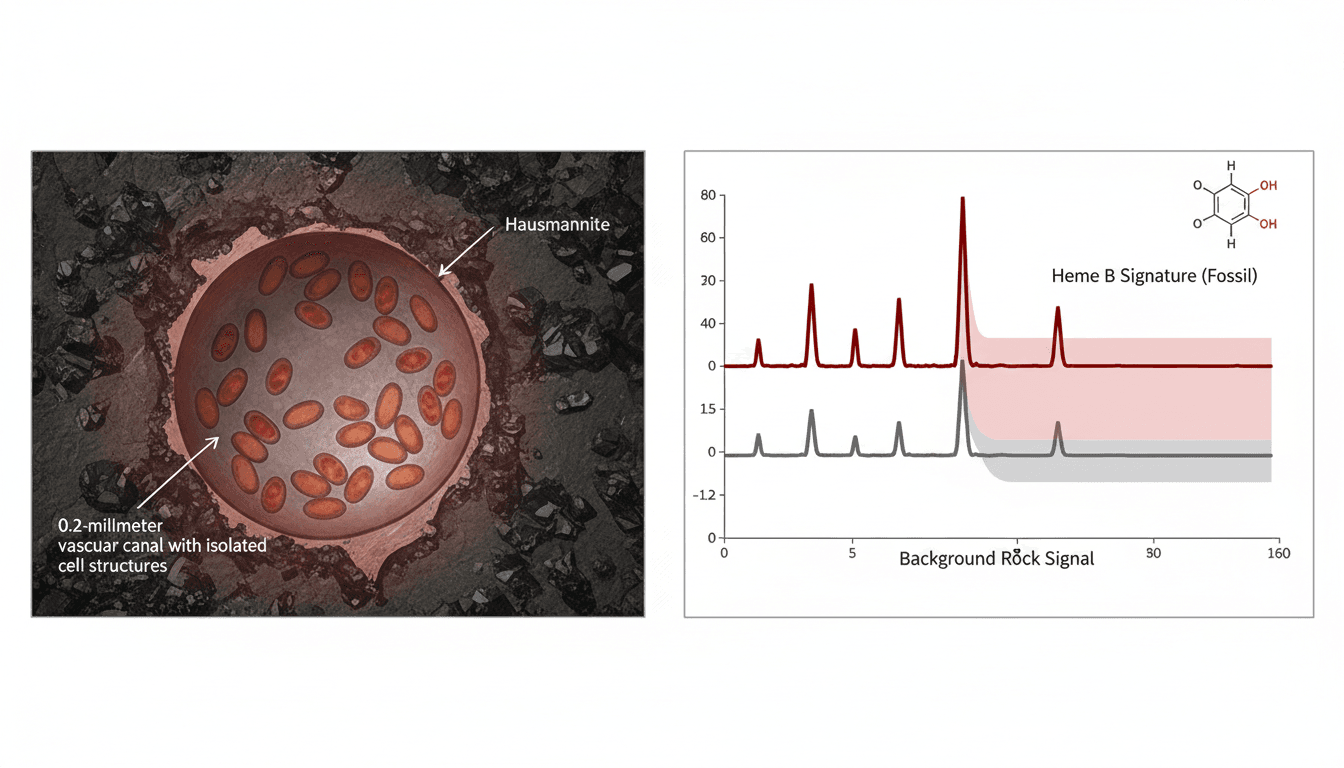
Why it matters
Pushing the verified boundary of organic preservation from 80 million to 115 million years challenges long-standing chemical decay models and establishes empirical benchmarks for identifying deep-time biomolecules.
What happened (in 30 seconds)
- Molecular detection extended: An international research team led by Kliti Grice of Curtin University identified heme chemical signatures and blood cell-like structures in a 115-million-year-old fossil of the theropod *Aratasaurus museunacionali*.
- Direct in situ confirmation: Published in the *Proceedings of the National Academy of Sciences* on November 2, 2026, the study combined electron microscopy with mass spectrometry to confirm heme B and 3,8-diethyl heme B inside vascular bone canals.
- Microscopic concentration: Researchers observed 20 ellipsoidal structures resembling red blood cells within a single 0.2-millimeter-wide cross-section slide extracted from the fossil's right leg bone.
The context you actually need
- The prior threshold: Previous paleontological research had established soft tissue and collagen preservation in specimens dated up to roughly 80 million years old, leaving older strata largely unverified for specific heme markers.
- A 2008 discovery: The three-meter Early Cretaceous theropod specimen was originally excavated from a mine in northeastern Brazil before undergoing multi-institution chemical scrutiny.
- The preservation mechanism: The fossil was preserved through rapid burial in a low-oxygen, microbially active environment, followed by hausmannite mineralization that structurally stabilized delicate biological components.
What's really happening
The identification of organic blood markers in a 115-million-year-old fossil rests on the convergence of two distinct analytical techniques: high-resolution morphological imaging and selective mass spectrometry. Historically, assertions of ancient soft tissue preservation faced substantial skepticism because visual artifacts, microbial biofilms, and modern organic contaminants frequently mimic biological microstructures under standard microscopic examination.
To overcome this evidential hurdle, the research consortium—drawing expertise from Curtin University, the Japan Agency for Marine-Earth Science and Technology, the Brazilian National Museum, the Regional University of Cariri, and Johns Hopkins University—isolated the vascular canals of the fossilized right leg bone. Within these channels, electron microscopy mapped distinct ellipsoidal bodies averaging 23 micrometers in length and 20 micrometers in width.
The structural imaging alone was not considered definitive, as debate continues among paleontologists over whether these dimensions align precisely with expected reptilian red blood cell morphology. The conclusive shift in evidence stems from spectroscopic and mass spectrometry readings taken directly from the observed microstructures. These instruments detected distinct chemical signatures of heme B and its derivative, 3,8-diethyl heme B. Crucially, these iron-binding porphyrin compounds were differentiated from surrounding microbial signatures, indicating that the molecules were intrinsic to the preserved marrow structures rather than post-mortem biological intrusions.
The chemical durability of these iron complexes over 115 million years is tied directly to the taphonomic setting of northeastern Brazil's deposit. Rapid sedimentation created an anoxic micro-environment that arrested typical oxidative decomposition. Subsequently, mineralization involving hausmannite—a manganese oxide—encapsulated the cellular remnants into a stable mineral matrix. This inorganic casing insulated the organic porphyrin rings from hydrological leaching and mechanical shearing across geological epochs.
For scientific operators and laboratory directors, this discovery shifts the baseline methodology for molecular paleontology. The focus moves away from simple visual morphology toward chemical mass verification. Demonstrating that complex organic complexes can survive 35 million years longer than prior empirical benchmarks incentivizes institutions to re-evaluate archival fossil collections with non-destructive, high-sensitivity spectrometers.
Who feels it first (and how)
- Molecular paleontologists and geochemists: Research teams must update biological degradation timelines and recalibrate kinetic models for biomolecular decay.
- Analytical instrumentation laboratories: Facilities operating secondary ion mass spectrometers and micro-spectroscopy arrays will see increased demand for in situ verification of archived geological specimens.
- Museum collection curators: Institutions holding well-preserved Cretaceous vertebrate fossils from anoxic formations will face calls to re-examine specimens previously assumed to be entirely remineralized.
What to watch next
- Independent morphological replications: Peer validation focusing on whether the 23-by-20-micrometer ellipsoids represent actual cellular outlines or mineralized internal casts.
- Protocol adoption across legacy archives: Whether major research facilities begin non-destructive mass spectrometry sweeps across other pre-80-million-year fossil collections.
- Mineralogical mapping of anoxic sites: Increased excavation targeting manganese-rich, rapid-burial formations capable of replicating hausmannite encapsulation.
Heme B and 3,8-diethyl heme B are chemically present in the vascular canals of the 115-million-year-old *Aratasaurus museunacionali* leg bone, stabilized by hausmannite mineralization.
The specific low-oxygen, mineral-heavy taphonomic conditions of the Brazilian deposit were the critical variable enabling organic survival over deep geological time.
Whether the physical structures strictly reflect the original red blood cell membrane boundaries of theropod dinosaurs or secondary mineral replacement matching ancient cell volumes.
Frequently Asked Questions
- Why it matters?
- Pushing the verified boundary of organic preservation from 80 million to 115 million years challenges long-standing chemical decay models and establishes empirical benchmarks for identifying deep-time biomolecules.
- What happened (in 30 seconds)?
- Molecular detection extended: An international research team led by Kliti Grice of Curtin University identified heme chemical signatures and blood cell-like structures in a 115-million-year-old fossil of the theropod *Aratasaurus museunacionali*. Direct in situ confirmation: Published in the *Proceedings of the National Academy of Sciences* on November 2, 2026, the study combined electron microscopy with mass spectrometry to confirm heme B and 3,8-diethyl heme B inside vascular bone canals. Micr
- What's really happening?
- The identification of organic blood markers in a 115-million-year-old fossil rests on the convergence of two distinct analytical techniques: high-resolution morphological imaging and selective mass spectrometry. Historically, assertions of ancient soft tissue preservation faced substantial skepticism because visual artifacts, microbial biofilms, and modern organic contaminants frequently mimic biological microstructures under standard microscopic examination. To overcome this evidential hurdle
- Who feels it first (and how)?
- Molecular paleontologists and geochemists: Research teams must update biological degradation timelines and recalibrate kinetic models for biomolecular decay. Analytical instrumentation laboratories: Facilities operating secondary ion mass spectrometers and micro-spectroscopy arrays will see increased demand for in situ verification of archived geological specimens. Museum collection curators: Institutions holding well-preserved Cretaceous vertebrate fossils from anoxic formations will face calls
- What to watch next?
- Independent morphological replications: Peer validation focusing on whether the 23-by-20-micrometer ellipsoids represent actual cellular outlines or mineralized internal casts. Protocol adoption across legacy archives: Whether major research facilities begin non-destructive mass spectrometry sweeps across other pre-80-million-year fossil collections. Mineralogical mapping of anoxic sites: Increased excavation targeting manganese-rich, rapid-burial formations capable of replicating hausmannite en
Scientific discoveries, health, technology, and natural phenomena.
"Live Science reports on scientific discoveries, health, technology, and natural phenomena with a popular science tone."
— A47 Editor
Traces of ancient blood found in 115 million-year-old dinosaur fossil, new study claims
Scientists report that chemical signatures found in a 115-million-year-old dinosaur bone from Brazil, belonging to the small meat-eating Aratasaurus, may be preserved red blood cells and heme traces, though not all experts agree on the interpretation...
Reports on science policy, discoveries, and public debate in the scientific realm.
"The Guardian’s science section is known for thoughtful and critical reporting on global research, ethics, and public understanding of science."
— A47 Editor
Fossilised red blood cells found in 115m-year-old dinosaur’s bone, say scientists
Scientists examining hind leg bones of Aratasaurus, a small meat-eating dinosaur that lived and died in what is now north-eastern Brazil about 115 million years ago, report finding what appear to be fossilised red blood cells and traces of heme, the ...
Reporting on North, Central, and South America, plus the Caribbean.
"The Guardian is known for its progressive editorial stance and in-depth analysis."
— A47 Editor
Fossilised red blood cells found in 115m-year-old dinosaur’s bone, say scientists
Scientists examining hind leg bones of Aratasaurus, a small meat-eating dinosaur that lived and died in what is now north-eastern Brazil about 115 million years ago, report finding what appear to be fossilised red blood cells and traces of heme, the ...
News in science and technology, with a focus on consumer and innovation stories.
"Popular Science simplifies complex scientific topics for general audiences and celebrates innovation."
— A47 Editor
Dinosaur blood found in fossils for the first time
Scientists have reported finding dinosaur blood molecules preserved in fossils for the first time, with the discovery made in bones roughly 15 million years old from Brazil, a finding previously considered unlikely. The report was published by Popula...