
Intelligence Reports Allege Russian Preparations for Nuclear-Armed Satellite Launch in Late 2026
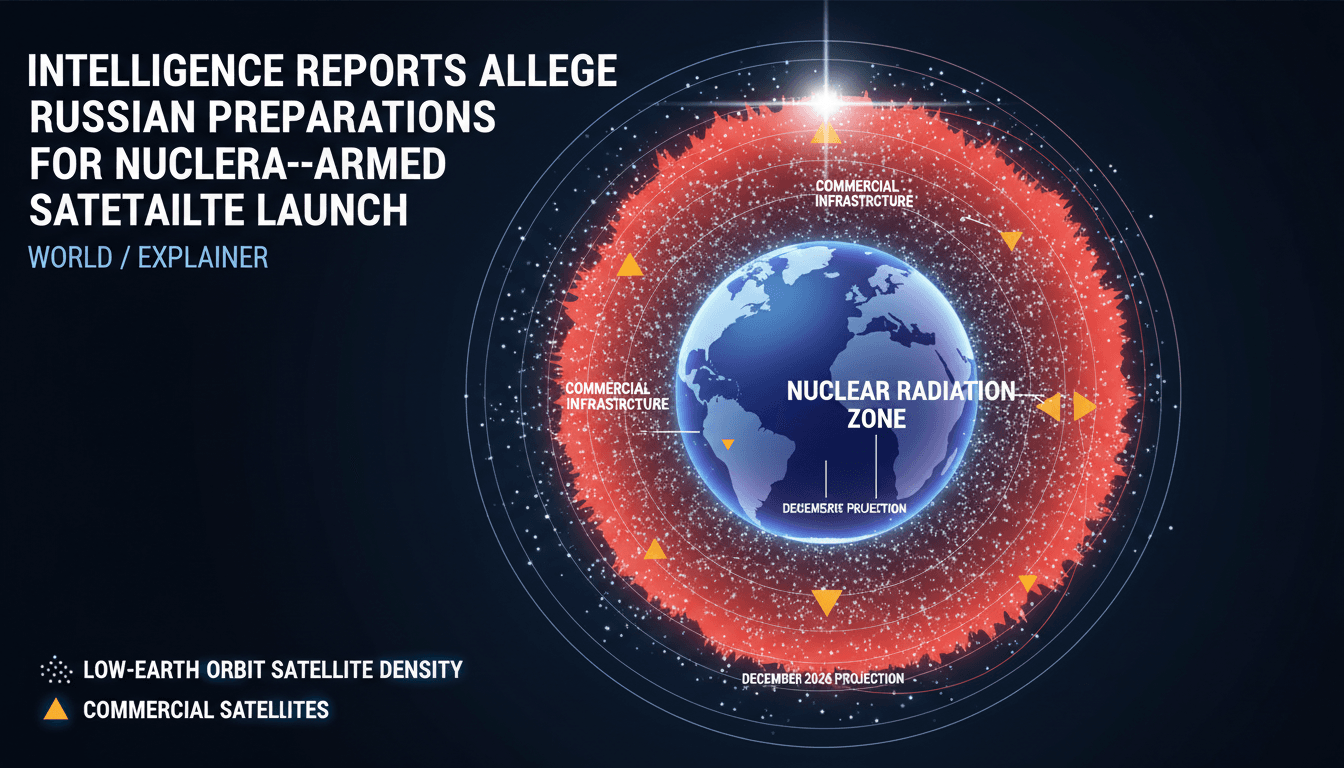
Why it matters
The weaponization of low-Earth orbit places critical dual-use orbital infrastructure at risk, threatening baseline satellite operations that sustain global logistics, financial timestamping, and international telecommunications.
What happened (in 30 seconds)
* Intelligence leaks surface deployment timelines: On November 23, 2026, German investigative reporting revealed Western intelligence claims that Russia may deploy a nuclear-capable orbital device, designated Sputnik-S, as early as December 2026. * NATO alliance issues readiness warnings: Germany's Bundeswehr Space Command estimated an operational launch window within 60 days of early November assessments, prompting NATO Secretary General Mark Rutte to publicly affirm the alliance's space-domain deterrence posture. * Official denials follow assessment releases: Russian state officials dismissed the reports as speculative propaganda, maintaining formal adherence to peaceful space operations despite earlier October 2026 U.S. Defense Intelligence Agency assessments pointing to active satellite weapon development.
The context you actually need
* The 1967 Outer Space Treaty faces structural erosion: The multilateral pact prohibiting weapons of mass destruction in Earth's orbit remains formally active, yet diplomatic efforts to reaffirm its provisions at the United Nations Security Council have faced procedural vetoes. * Precursor missions tested high-radiation orbital environments: Western intelligence previously linked the 2022 launch of the Kosmos-2553 satellite to research measuring radiation exposure effects on equipment, serving as an empirical foundation for orbital nuclear systems. * A single detonation presents asymmetric collateral fallout: Analytical studies indicate that an unshielded nuclear burst in low-Earth orbit could disable up to 98% of operational satellites within one week, rendering vast orbital corridors unusable.
What's really happening
The intelligence reporting surrounding the Sputnik-S platform highlights a structural shift in strategic deterrence: moving leverage from terrestrial borders to the shared orbital commons. Orbital mechanics and satellite communications have fundamentally transitioned over the last decade from exclusive state surveillance assets to the underlying nervous system of private commercial trade, supply-chain monitoring, and high-frequency transaction networks.
The core incentive driving the development of nuclear anti-satellite capabilities is asymmetric deterrence. Terrestrial military apparatuses and advanced commercial economies maintain dense satellite constellations across low-Earth orbit for real-time tracking, edge data connectivity, and precision command. Conventional anti-satellite kinetic weapons, such as direct-ascent missiles, target single assets sequentially while producing discrete fields of debris. By contrast, an orbital nuclear detonation utilizes high-altitude electromagnetic pulses (HEMP) and intense radiation fields. This creates an indiscriminate disruption zone that neutralizes non-hardened, commercially sourced satellites regardless of ownership.
From a strategic perspective, sovereign actors operating with smaller commercial satellite footprints face lower proportional exposure to orbital infrastructure loss than economies that depend heavily on commercial space constellations. A platform assembled and prepositioned near Moscow provides an operational hedge. Even without detonation, the verifiable readiness to launch such an apparatus functions as a counter-intervention shield.
Furthermore, the legal architecture that maintained orbital stability for more than half a century is under strain. The 1967 Outer Space Treaty relies on voluntary compliance, collective verification, and mutual deterrence. Because dual-use space programs blur the boundary between scientific radiation experiments and weapons research, verification remains difficult. The Kosmos-2553 mission illustrated that state actors can collect vital orbital-radiation data while citing scientific research objectives.
If sovereign actors deploy nuclear-capable assets to orbit, low-Earth orbit shifts from an open commercial logistics corridor into an active military theater. The structural risk is not limited to state-to-state conflict; it introduces operational fragility to civil communications, maritime positioning systems, and border security platforms worldwide.
Who feels it first (and how)
* Global Satellite Operators: Fleet managers in low-Earth orbit face steep capital reallocation toward radiation shielding and redundant orbital configurations. * Enterprise Supply-Chain Directors: Multimodal logistics operators reliant on real-time satellite tracking and automated fleet telemetry must account for potential telemetry blackout risks. * Financial Infrastructure Engineers: Institutions utilizing satellite-based precision timing for trade execution and transaction settlement must verify terrestrial backup clocks. * Aviation and Maritime Navigators: Commercial transport corridors navigating international waters and polar routes face sudden systemic dependencies on legacy inertial navigation tools.
What to watch next
* Launch site telemetry and site alerts: Continuous monitoring of Russian space launch installations over the 60-day window following November 2026 warnings will signal whether deployment timelines are active. * NATO space command strategic adjustments: Formal doctrinal updates or defensive posture statements from NATO members will clarify the alliance's orbital response framework. * UN Security Council space resolutions: Diplomatic maneuvers around orbital weapon prohibitions will measure international leverage and formal adherence to the Outer Space Treaty.
German intelligence assessments, backed by U.S. Defense Intelligence Agency reports, evaluate that Russia developed an orbital nuclear-capable payload known as Sputnik-S, stored near Moscow, while Russian officials formally deny all allegations.
The deployment of a high-altitude nuclear asset would act primarily as an asymmetric deterrent designed to threaten the commercial space constellations of orbital-reliant nations rather than function as a first-strike weapon.
Whether the physical launch of the Sputnik-S platform is scheduled for immediate late-2026 execution, or if intelligence releases were timed to deter an imminent test operation.
Frequently Asked Questions
- Why it matters?
- The weaponization of low-Earth orbit places critical dual-use orbital infrastructure at risk, threatening baseline satellite operations that sustain global logistics, financial timestamping, and international telecommunications.
- What happened (in 30 seconds)?
- Intelligence leaks surface deployment timelines: On November 23, 2026, German investigative reporting revealed Western intelligence claims that Russia may deploy a nuclear-capable orbital device, designated Sputnik-S, as early as December 2026. NATO alliance issues readiness warnings: Germany's Bundeswehr Space Command estimated an operational launch window within 60 days of early November assessments, prompting NATO Secretary General Mark Rutte to publicly affirm the alliance's space-domain det
- What's really happening?
- The intelligence reporting surrounding the Sputnik-S platform highlights a structural shift in strategic deterrence: moving leverage from terrestrial borders to the shared orbital commons. Orbital mechanics and satellite communications have fundamentally transitioned over the last decade from exclusive state surveillance assets to the underlying nervous system of private commercial trade, supply-chain monitoring, and high-frequency transaction networks. The core incentive driving the developmen
- Who feels it first (and how)?
- Global Satellite Operators: Fleet managers in low-Earth orbit face steep capital reallocation toward radiation shielding and redundant orbital configurations. Enterprise Supply-Chain Directors: Multimodal logistics operators reliant on real-time satellite tracking and automated fleet telemetry must account for potential telemetry blackout risks. Financial Infrastructure Engineers: Institutions utilizing satellite-based precision timing for trade execution and transaction settlement must verify t
- What to watch next?
- Launch site telemetry and site alerts: Continuous monitoring of Russian space launch installations over the 60-day window following November 2026 warnings will signal whether deployment timelines are active. NATO space command strategic adjustments: Formal doctrinal updates or defensive posture statements from NATO members will clarify the alliance's orbital response framework. UN Security Council space resolutions: Diplomatic maneuvers around orbital weapon prohibitions will measure internation
24/7 international news from a French perspective in multiple languages.
"France 24 is viewed as a globally focused outlet with balanced coverage and a European perspective."
— A47 Editor
Is Russia preparing to launch a nuclear-armed satellite?
German media reports, citing unnamed German military and BND intelligence sources, say Russia may launch a nuclear-armed satellite within weeks that could destroy other satellites. NATO Secretary General Mark Rutte responded on Monday that the allian...
Arabic-language reporting on global and regional news.
"BBC Arabic is part of the BBC, generally regarded for editorial standards and broad international coverage."
— A47 Editor
حلف الناتو يتعهد بردع التهديدات الفضائية وسط تقارير استخباراتية عن سلاح نووي روسي مداري
NATO has pledged to deter space-based threats amid intelligence reports that Russia intends to launch a satellite carrying a nuclear warhead into space within the coming weeks, according to German media outlets cited in the coverage.
Arabic-language coverage of political affairs and current events.
"Okaz political coverage typically follows mainstream Saudi framing on national and regional affairs."
— A47 Editor
«سبوتنيك إس».. سلاح نووي روسي يهدد أقمار العالم
Western intelligence assessments warned that Russia could launch a satellite carrying a nuclear warhead into Earth orbit within weeks, with reports from German outlets WDR, NDR and Die Zeit saying NATO intelligence services exchanged information on a...
Editor-curated FT homepage stories spanning markets, business, world, and opinion.
"The Financial Times is a globally respected business publication with a centrist/center-left tone and strong markets focus."
— A47 Editor
Russia poised to put nuclear weapon in space within 60 days, Germany warns
Germany says Berlin is taking seriously intelligence reports shared by Western allies that Moscow could deploy the armed 'Sputnik-S' satellite, carrying a nuclear weapon, into space as soon as next month, within roughly 60 days, according to the Fina...