
Myanmar Rejects Parts of ICJ Genocide Ruling on Rohingya Despite Landmark Finding
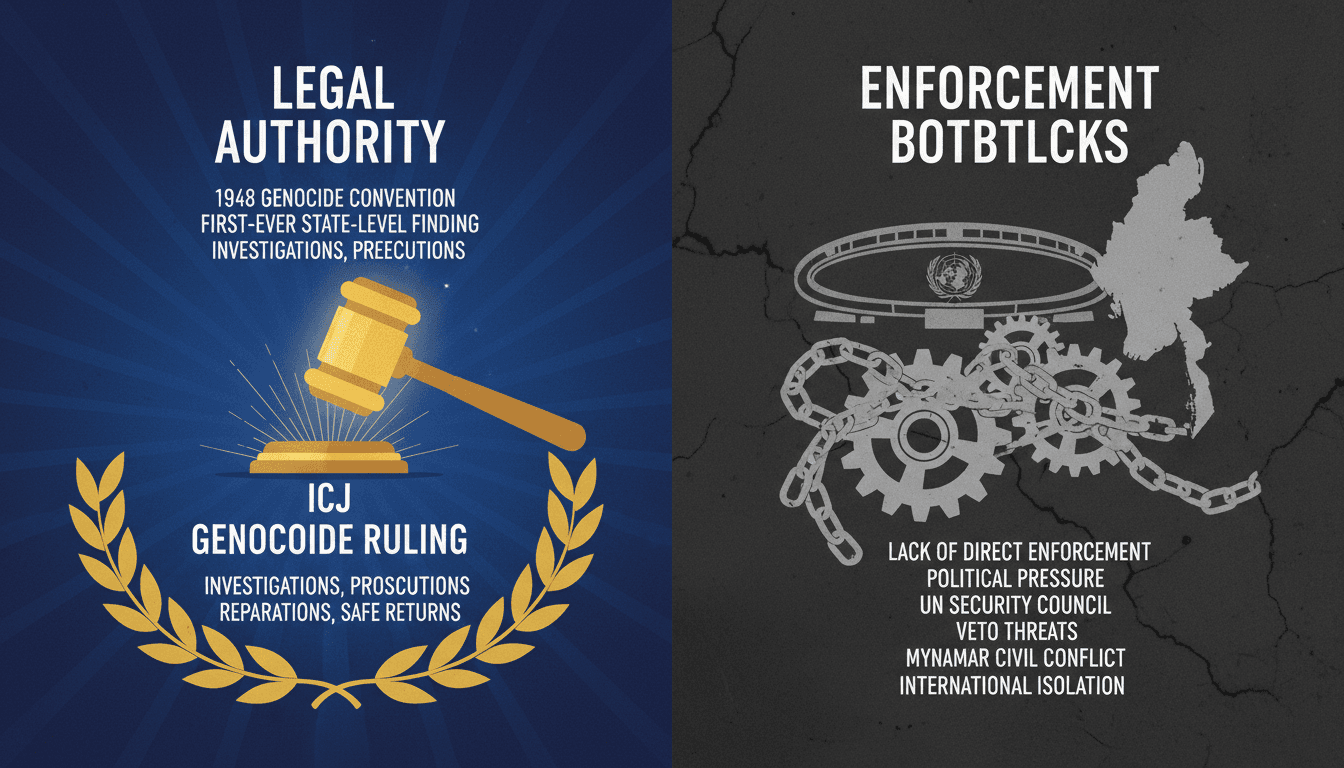
Why it matters
The formal refusal to execute key directives from the International Court of Justice exposes the structural gap in sovereign legal enforcement, directly influencing sovereign risk assessments, multilateral sanctions, and regional trade security across Southeast Asia.
What happened (in 30 seconds)
- A historic verdict emerged: In November 2026, the International Court of Justice issued a 9-6 ruling finding Myanmar responsible for genocide against the Rohingya minority under the 1948 Genocide Convention, marking the first time the court held a state directly accountable for such violations.
- Selective adherence was declared: On November 26, 2026, Myanmar President Min Aung Hlaing announced during a cabinet meeting that Naypyidaw would not comply with "inappropriate" provisions of the ruling, asserting that the genocide designation damaged national standing.
- Specific mandates were rejected: While the court ordered Myanmar to halt violations, prosecute perpetrators, arrange reparations, and guarantee safe refugee returns, Myanmar stated it would only pursue actions it deems suitable as a "responsible country."
The context you actually need
- The origin of the case: The proceedings stem from 2017 military operations in Rakhine State, which resulted in an estimated 10,000 violent deaths and forced over 700,000 Rohingya across the border into Bangladesh.
- The legal architecture: The Republic of The Gambia initiated the dispute in 2019 under the Genocide Convention; while ICJ judgments are final and binding on member states, the court possesses no independent police or administrative apparatus to enforce its decisions.
- The political reality: Myanmar continues to navigate internal armed conflict and economic isolation following its 2021 coup, leaving its external engagement heavily defined by existing bilateral relationships rather than broad multilateral compliance.
What's really happening
The tension between international legal rulings and state compliance always comes down to leverage and enforcement mechanisms. Under the United Nations Charter, the International Court of Justice acts as the primary judicial branch of the multilateral order. Its judgments carry binding legal weight upon sovereign participants. However, the court has no structural mechanism to independently execute asset seizures, arrest warrants, or administrative mandates. When an administration chooses not to execute an order, the mechanism for enforcement shifts entirely from the legal sphere to the political theater of the United Nations Security Council.
For Myanmar's governing leadership, the calculation is strictly incentive-driven. Complying fully with the November 2026 ruling would require state-level investigations into military operations, the prosecution of senior defense figures, the disbursement of financial reparations (amounts to be determined later), and the formal reintegration of hundreds of thousands of displaced persons. For President Min Aung Hlaing, accepting the specific legal label of genocide threatens domestic authority and core defense structures during an ongoing internal conflict. By framing the decision as an assertion of national sovereignty against "inappropriate" external mandates, the administration aims to preserve internal cohesion while offering a generic pledge to act as a "responsible country."
The economic and diplomatic fallout operates on specific tracks. Following the announcement, the European Union pushed for complete implementation, and the United Kingdom enacted sanctions directly targeting military leaders. Yet, because Myanmar has been under extensive Western economic restrictions since 2021, the immediate economic shock is muted. There have been no sudden regional market disruptions.
The structural risk now transfers to the multilateral enforcement system itself. If an ICJ decision cannot be implemented on the ground, the injured party must seek recourse through international diplomacy or a referral to the UN Security Council. Within the Security Council, any binding resolution face-to-face encounters permanent member vetoes. The result is a persistent stalemate: the legal benchmark for state responsibility is formally set on paper, but the operational incentives on the ground remain largely unaltered, sustaining long-term regional friction without resolving the underlying refugee and governance challenges.
Who feels it first (and how)
- Rohingya displaced populations: Over 700,000 refugees living in camps across Bangladesh face continued uncertainty, as Myanmar's rejection of safe return provisions directly stalls structured repatriation timelines.
- Cross-border trade and compliance officers: Corporate legal departments tracking regional operations in Southeast Asia must account for enhanced reputational risk, heightened scrutiny on supply lines, and expanding targeted sanctions from jurisdictions like the UK and the EU.
- Regional diplomatic and security bodies: Neighboring nations managing border stability and irregular migration flows must navigate regional diplomatic coordination without the operational backing of an enforceable legal settlement.
- Multilateral legal and human rights practitioners: International litigators confront the reality that securing a landmark state responsibility verdict at The Hague does not guarantee on-the-ground operational compliance.
What to watch next
- UN Security Council referral motions: Watch whether The Gambia or allied delegations escalate the matter to the UN Security Council, where the potential for permanent member vetoes will define the limits of multilateral enforcement.
- Expansion of Western targeted sanctions: Monitor secondary sanction packages from the European Union and allied jurisdictions targeting specific state-linked economic entities or military officials following the UK's immediate measures.
- ICJ reparations proceedings: Track upcoming sessions at The Hague aimed at calculating specific monetary and structural reparations, which will establish long-term legal claims against state assets abroad.
The ICJ issued a 9-6 verdict confirming Myanmar's state responsibility under the 1948 Genocide Convention, and Myanmar's leadership has formally stated it will reject what it terms "inappropriate" aspects of the judgment.
The dispute will move to political and diplomatic forums within the United Nations, where international enforcement measures will face veto-driven gridlock.
The exact timeline and mechanism for determining monetary reparations, as well as whether any verifiable path exists for the safe, voluntary return of displaced Rohingya refugees.
Frequently Asked Questions
- Why it matters?
- The formal refusal to execute key directives from the International Court of Justice exposes the structural gap in sovereign legal enforcement, directly influencing sovereign risk assessments, multilateral sanctions, and regional trade security across Southeast Asia.
- What happened (in 30 seconds)?
- A historic verdict emerged: In November 2026, the International Court of Justice issued a 9-6 ruling finding Myanmar responsible for genocide against the Rohingya minority under the 1948 Genocide Convention, marking the first time the court held a state directly accountable for such violations. Selective adherence was declared: On November 26, 2026, Myanmar President Min Aung Hlaing announced during a cabinet meeting that Naypyidaw would not comply with "inappropriate" provisions of the ruling,
- What's really happening?
- The tension between international legal rulings and state compliance always comes down to leverage and enforcement mechanisms. Under the United Nations Charter, the International Court of Justice acts as the primary judicial branch of the multilateral order. Its judgments carry binding legal weight upon sovereign participants. However, the court has no structural mechanism to independently execute asset seizures, arrest warrants, or administrative mandates. When an administration chooses not to
- Who feels it first (and how)?
- Rohingya displaced populations: Over 700,000 refugees living in camps across Bangladesh face continued uncertainty, as Myanmar's rejection of safe return provisions directly stalls structured repatriation timelines. Cross-border trade and compliance officers: Corporate legal departments tracking regional operations in Southeast Asia must account for enhanced reputational risk, heightened scrutiny on supply lines, and expanding targeted sanctions from jurisdictions like the UK and the EU. Regiona
- What to watch next?
- UN Security Council referral motions: Watch whether The Gambia or allied delegations escalate the matter to the UN Security Council, where the potential for permanent member vetoes will define the limits of multilateral enforcement. Expansion of Western targeted sanctions: Monitor secondary sanction packages from the European Union and allied jurisdictions targeting specific state-linked economic entities or military officials following the UK's immediate measures. ICJ reparations proceedings: T
Arabic-language reporting on global and regional news.
"BBC Arabic is part of the BBC, generally regarded for editorial standards and broad international coverage."
— A47 Editor
ميانمار ترفض الامتثال لبعض بنود حكم محكمة العدل الدولية بشأن الإبادة الجماعية
The International Court of Justice found Myanmar guilty of genocide against the Rohingya Muslim minority over the 2017 military campaign, which killed thousands and forced more than 700,000 people to flee; the base coverage reports that Myanmar is re...
English-language reporting on Saudi politics, policy, and society.
"Saudi Gazette reflects mainstream Saudi institutional perspectives."
— A47 Editor
Myanmar refuses to comply with ICJ genocide ruling
Myanmar's leader Min Aung Hlaing said his government would not comply with "inappropriate" aspects of a landmark International Court of Justice ruling that found Myanmar committed genocide against its Rohingya Muslim minority during the 2017 military...
International news, politics, and culture.
"Sky News is a UK-based 24-hour channel known for fast-breaking news and political coverage."
— A47 Editor
Myanmar says it will not comply with 'inappropriate' ICJ genocide orders
Myanmar's President Min Aung Hlaing has said his government will not comply with all measures ordered by the International Court of Justice, after the court ruled that Myanmar committed genocide against its Rohingya Muslim minority during a 2017 mili...
International coverage of politics, culture, and current affairs.
"BBC News is widely regarded as a reputable international news organization, known for its impartial tone and public service mandate."
— A47 Editor
Myanmar refuses to comply with parts of ICJ genocide ruling
The International Court of Justice has ruled that Myanmar committed genocide against its Rohingya Muslim minority during a 2017 military crackdown in Rakhine State, a campaign that displaced at least 730,000 people, mostly to Bangladesh. The case was...
Global news coverage with extensive reporting on Middle Eastern conflicts and geopolitics.
"Al Jazeera is a Qatar-based broadcaster known for wide regional coverage and alternative perspectives."
— A47 Editor
Malaysia set to return thousands of Rohingya refugees to Myanmar
Malaysia has announced plans to return thousands of Rohingya refugees to Myanmar, a move that comes five days after the International Court of Justice ruled that Myanmar committed genocide against its Rohingya Muslim minority during a 2017 military c...
Comprehensive coverage of Middle Eastern and global issues.
"Al Jazeera is a prominent voice from the Global South, especially the Middle East, with an emphasis on underreported stories."
— A47 Editor
Malaysia set to return thousands of Rohingya refugees to Myanmar
Malaysia has announced plans to return thousands of Rohingya refugees to Myanmar, a move that comes five days after the International Court of Justice ruled that Myanmar committed genocide against its Rohingya Muslim minority during a 2017 military c...