
Pennsylvania Measles Outbreak Driven by Low Amish and Plain Community MMR Uptake Costs National Elimination Status
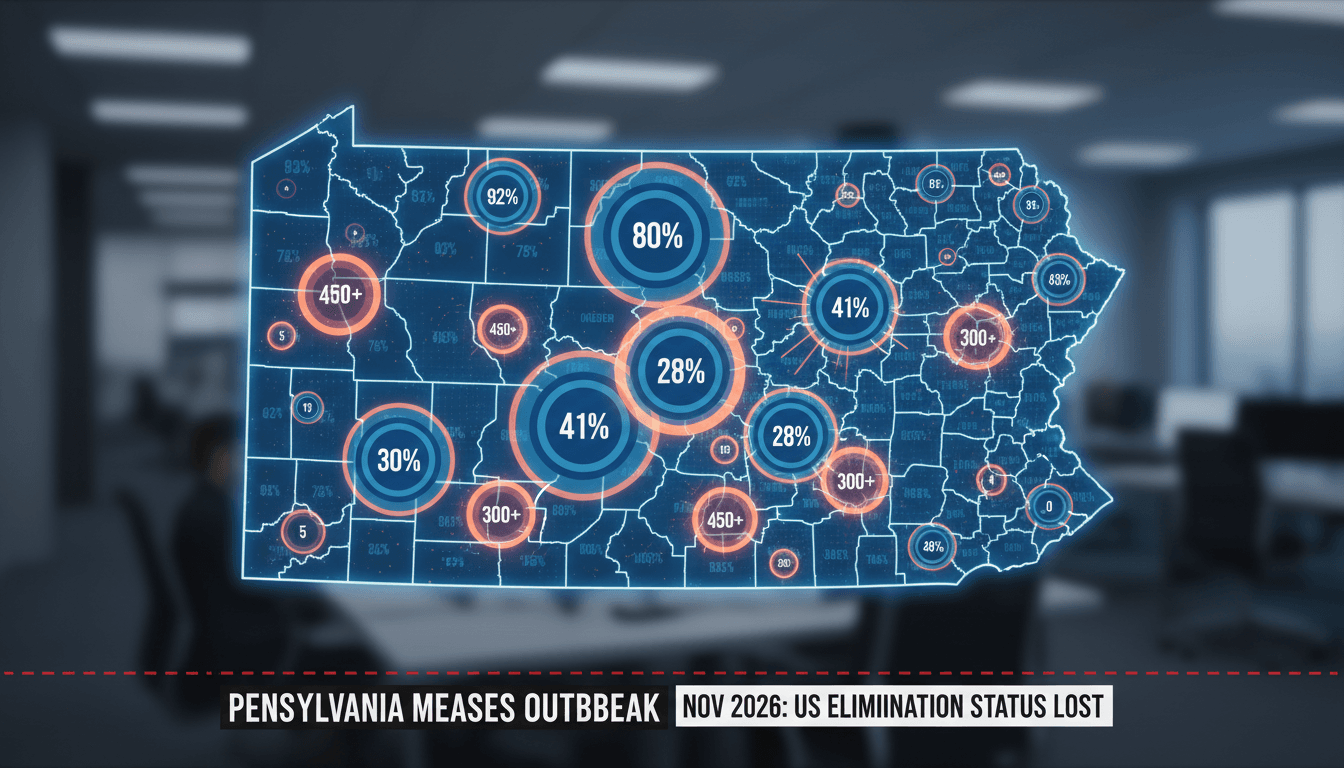
: For international operators and health systems managing cross-border exposure, localized drops in baseline immunization disrupt long-standing epidemiological safety nets and elevate compliance burdens.
Why it matters
The loss of national disease elimination status signals structural vulnerabilities in baseline health infrastructure, altering public health interventions and operational risk models across interconnected supply chains.
What happened (in 30 seconds)
- Concentrated outbreak: Pennsylvania has recorded more than 1,600 confirmed measles cases and nine associated deaths since April 2026, marking the nation's most acute transmission event.
- National elimination lost: The sustained domestic transmission across rural enclaves contributed to the United States officially losing its measles elimination status in mid-November 2026.
- Operational intervention: Health departments have deployed door-to-door immunization teams across Chester, Lancaster, Mifflin, and Jefferson counties ahead of large seasonal community gatherings.
The context you actually need
- Historical protection broken: Measles achieved verified eliminated status in the United States in 2000 through sustained high MMR coverage, a milestone maintained for over two decades.
- Baseline coverage gaps: While MMR uptake softened nationally following the COVID-19 pandemic, uptake in regional Plain and Amish communities has historically remained below 30 percent.
- Micro-demographic vulnerability: The current concentration of cases highlights how high-density social networks with low baseline immunization function as continuous transmission engines once a pathogen is introduced.
What's really happening
The operational challenge in Pennsylvania reflects an incentive structure rather than a purely institutional failure. Measles carries a reproduction number that demands approximately 95 percent population immunity to maintain herd protection. When localized pockets fall significantly below that threshold—reaching levels under 30 percent—the statistical barrier collapses entirely.
The mechanism behind this acceleration traces back to household-level operational frameworks. Public health outreach reports indicate that resistance to immunization in these rural enclaves is guided primarily by decentralized household decision-making models rather than systemic community-wide doctrines. Because individual households balance perceived clinical necessity against local traditions, uptake remains fragmented. Without collective, coordinated vaccination protocols, baseline vulnerability accumulated across decades.
The arrival of the pathogen in spring 2026 exposed this structural deficit. In high-contact rural populations, social density fluctuates predictably around seasonal events. Public health workers identified winter and late-fall wedding gatherings as major catalysts for secondary transmission chains, where hundreds of individuals from distinct regional settlements congregate in close quarters.
To counter this transmission velocity, institutional responses shifted from passive clinic-based models to targeted field operations. In Chester County alone, mobile teams conducted direct doorstep visits to deliver nearly 500 doses of the MMR vaccine. By engaging community leaders and adapting logistics to regional norms, field staff bypassed typical administrative barriers to increase coverage.
However, the institutional friction remains acute. Restoring regional herd immunity requires continuous administration of secondary doses across distributed rural geographies. Because the United States lost its measles elimination status in mid-November 2026, the regulatory and monitoring landscape has changed. Federal and state health agencies are now compelled to allocate higher budgetary and field personnel resources toward containment, diverting administrative capacity away from routine preventative programs.
For global and national health planners, this dynamic illustrates that aggregate national health metrics can obscure hyper-localized vulnerabilities. When localized coverage drops below critical thresholds, modern supply chains and mobility corridors ensure that clinical, logistical, and reputational costs scale rapidly across the entire system.
Who feels it first (and how)
- Rural healthcare providers: Clinics in Lancaster, Chester, Mifflin, and Jefferson counties absorb direct clinical strain, triage costs, and quarantine overhead.
- Public health field teams: Municipal and state personnel are diverted from standard programs to manage door-to-door intervention logistics and monitoring.
- Under-immunized households: Unvaccinated family members face direct clinical outcomes, driving hospitalizations and regional mortality.
- Cross-border travel and health monitors: International surveillance teams must adjust entry screenings and risk assessments following the shift in national elimination status.
What to watch next
- Post-gathering transmission metrics: Case velocity following fall and winter social gatherings will indicate whether door-to-door dosing halted secondary household spread.
- Re-elimination benchmarks: The timeline and surveillance benchmarks required by federal authorities to petition for the restoration of domestic elimination status.
- Doorstep coverage conversion: Dose acceptance rates during continuing mobile visits across Mifflin and Lancaster counties will measure the efficacy of direct outreach models.
Pennsylvania has verified over 1,600 cases and nine deaths since spring 2026, and the United States officially lost its measles elimination status in mid-November 2026.
Targeted door-to-door delivery strategies will limit urban secondary spread while regional rural pockets continue to register isolated clusters.
Whether baseline MMR vaccination rates among Plain community households will systematically normalize above historical 30 percent levels after current emergency operations subside.
Frequently Asked Questions
- Why it matters?
- The loss of national disease elimination status signals structural vulnerabilities in baseline health infrastructure, altering public health interventions and operational risk models across interconnected supply chains.
- What happened (in 30 seconds)?
- Concentrated outbreak: Pennsylvania has recorded more than 1,600 confirmed measles cases and nine associated deaths since April 2026, marking the nation's most acute transmission event. National elimination lost: The sustained domestic transmission across rural enclaves contributed to the United States officially losing its measles elimination status in mid-November 2026. Operational intervention: Health departments have deployed door-to-door immunization teams across Chester, Lancaster, Mifflin
- What's really happening?
- The operational challenge in Pennsylvania reflects an incentive structure rather than a purely institutional failure. Measles carries a reproduction number that demands approximately 95 percent population immunity to maintain herd protection. When localized pockets fall significantly below that threshold—reaching levels under 30 percent—the statistical barrier collapses entirely. The mechanism behind this acceleration traces back to household-level operational frameworks. Public health outreach
- Who feels it first (and how)?
- Rural healthcare providers: Clinics in Lancaster, Chester, Mifflin, and Jefferson counties absorb direct clinical strain, triage costs, and quarantine overhead. Public health field teams: Municipal and state personnel are diverted from standard programs to manage door-to-door intervention logistics and monitoring. Under-immunized households: Unvaccinated family members face direct clinical outcomes, driving hospitalizations and regional mortality. Cross-border travel and health monitors: Interna
- What to watch next?
- Post-gathering transmission metrics: Case velocity following fall and winter social gatherings will indicate whether door-to-door dosing halted secondary household spread. Re-elimination benchmarks: The timeline and surveillance benchmarks required by federal authorities to petition for the restoration of domestic elimination status. Doorstep coverage conversion: Dose acceptance rates during continuing mobile visits across Mifflin and Lancaster counties will measure the efficacy of direct outrea
Public health, medical research, healthcare policy, and pharmaceutical developments.
"Dow Jones is a major financial news provider with a professional tone and broad coverage, including specialized health-sector reporting."
— A47 Editor
Pennsylvania’s measles outbreak, the nation’s worst, has predominantly hit the state’s Amish and Plain communities
Pennsylvania is experiencing the nation's worst measles outbreak in 35 years, and the base report says it has predominantly hit the state's Amish and Plain communities. After a young woman's death shook a tightknit valley, some families are reconside...
Conservative-leaning coverage of current events.
"Fox News is a highly influential conservative news outlet known for right-leaning political commentary and coverage."
— A47 Editor
Unvaccinated Pennsylvania resident dies of measles in state's ninth fatal case this year
Pennsylvania officials report that an unvaccinated Centre County resident died of measles, the ninth measles-related death in the state this year, as Pennsylvania leads the nation in measles cases.
Global news coverage with extensive reporting on Middle Eastern conflicts and geopolitics.
"Al Jazeera is a Qatar-based broadcaster known for wide regional coverage and alternative perspectives."
— A47 Editor
Pennsylvania reports ninth measles death in ongoing state outbreak
Pennsylvania has reported its ninth measles death in an ongoing state outbreak, with CDC and state figures on measles deaths differing as the state faces an escalating health crisis across 46 counties, according to Al Jazeera.
Comprehensive coverage of Middle Eastern and global issues.
"Al Jazeera is a prominent voice from the Global South, especially the Middle East, with an emphasis on underreported stories."
— A47 Editor
Pennsylvania reports ninth measles death in ongoing state outbreak
Pennsylvania has reported its ninth measles death in an ongoing state outbreak, with CDC and state figures on measles deaths differing as the state faces an escalating health crisis across 46 counties, according to Al Jazeera.