
Saudi Arabia Shuts Down East-West Oil Pipeline Following Drone Attacks
Why it matters
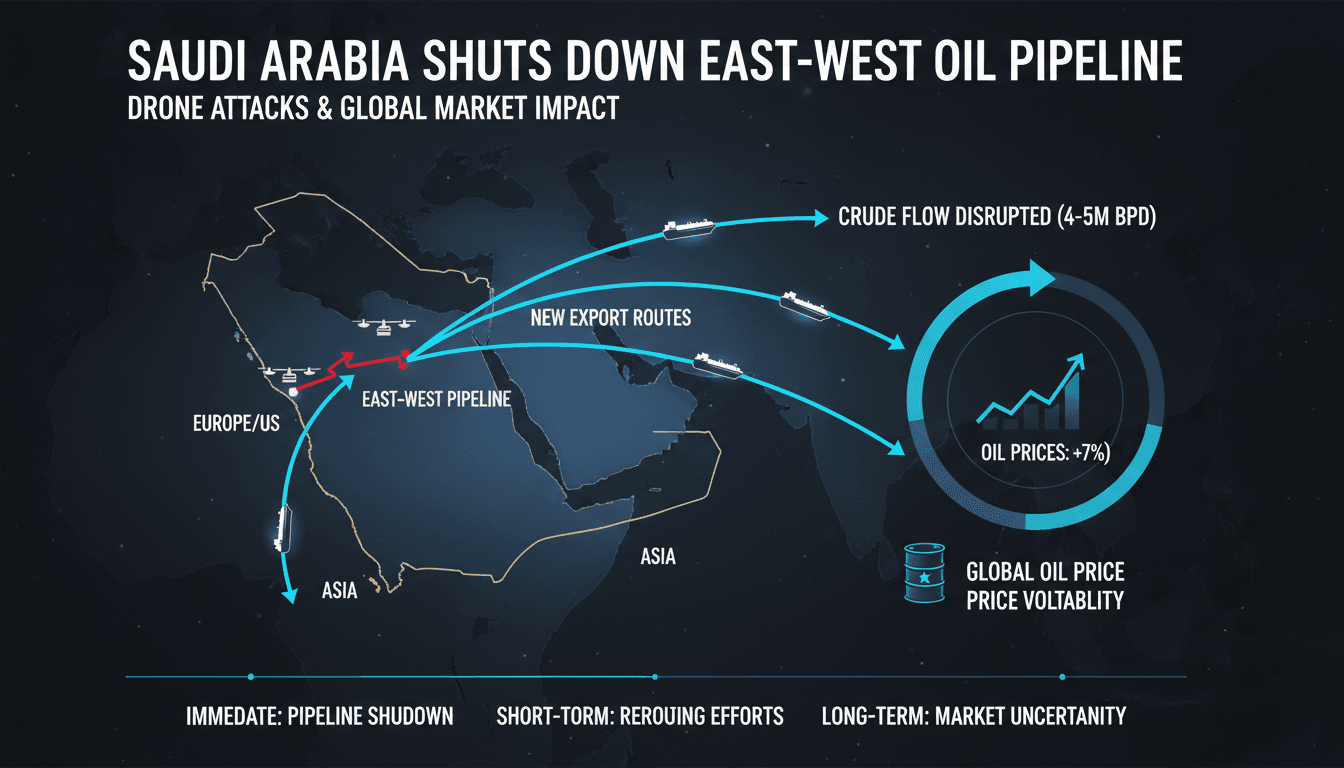
The disruption of 4-5 million barrels per day from Saudi Arabia represents about 4% of global oil supply, affecting markets worldwide.
What happened (in 30 seconds)
- Saudi Arabia shut down its East-West oil pipeline on September 11, 2026, following drone attacks attributed to Iran-backed Iraqi militias.
- Exports were rerouted to Gulf terminals, increasing reliance on ship-to-ship transfers outside the Strait of Hormuz.
- Oil prices spiked above $100 per barrel, reflecting immediate market reactions to the disruption.
The context you actually need
- The East-West pipeline, with a capacity of 7 million barrels per day, had been crucial for Saudi exports, especially amid regional tensions.
- Houthi threats and Iranian actions have already complicated shipping routes, forcing Saudi Arabia to adapt its export strategies.
- Recent military conflicts involving the U.S., Israel, and Iran have heightened risks in the region, leading to increased volatility in oil markets.
What's really happening
On September 10, 2026, drone strikes targeted pumping stations along Saudi Arabia's East-West pipeline, causing significant damage and prompting a precautionary shutdown the following day. This pipeline had been a vital artery for Saudi crude, transporting 4-5 million barrels per day to international markets, particularly in Asia. The immediate aftermath saw Saudi Arabia pivoting to alternative export routes, primarily through its Gulf terminals, including Ras Tanura and Juaymah, and utilizing ship-to-ship transfers off the coast of Oman to bypass the increasingly perilous Strait of Hormuz.
The decision to reroute exports was not merely a logistical adjustment; it was a strategic necessity. The East-West pipeline had been a lifeline for Saudi Arabia, especially in light of the ongoing U.S.-Israel-Iran conflict that began in February 2026. With Iranian actions severely restricting traffic through the Strait of Hormuz, the pipeline had initially served as a critical bypass. However, the recent drone attacks underscored the vulnerability of this infrastructure, compelling Saudi Arabia to seek alternative routes.
The economic implications are significant. The disruption of 4-5 million barrels per day translates to a substantial portion of global oil supply, leading to immediate spikes in oil prices, which exceeded $100 per barrel shortly after the attacks. This price increase has a cascading effect on global markets, influencing everything from fuel costs to the prices of goods reliant on oil for transportation and production.
Moreover, the geopolitical landscape is shifting. Saudi Arabia's response to the attacks included increased military actions against the groups responsible, further escalating tensions in the region. Iraq's investigation into the drone strikes adds another layer of complexity, as the country navigates its own internal and external pressures.
As Saudi Arabia works to restore the pipeline, which could take 4-6 weeks for full repairs, the market remains on edge. Analysts warn of sustained volatility, particularly as European refiners report canceled or delayed cargoes. The situation is fluid, and the long-term implications for Saudi Arabia's oil strategy and global energy markets are still unfolding.
Who feels it first (and how)
- Consumers: Higher fuel prices will directly impact household energy costs and transportation expenses.
- Businesses: Companies reliant on oil for logistics and production may face increased operational costs, affecting pricing strategies.
- Expatriates in Dubai: Rising energy costs could lead to economic pressure, impacting job stability and living expenses.
- Investors: Volatility in oil prices may affect stock markets and investment portfolios, particularly in energy sectors.
What to watch next
- Oil price trends: Monitor Brent crude prices for indications of market stability or further volatility.
- Restoration timelines: Keep an eye on Saudi Arabia's progress in repairing the East-West pipeline and its impact on export volumes.
- Geopolitical developments: Watch for any escalations in military actions or diplomatic negotiations involving Iran, Iraq, and Saudi Arabia.
The East-West pipeline is currently offline, and oil prices have spiked above $100 per barrel.
Continued volatility in oil markets as geopolitical tensions persist and restoration efforts unfold.
The long-term impact on Saudi Arabia's oil export strategy and global supply chains.
Frequently Asked Questions
- Why it matters?
- The disruption of 4-5 million barrels per day from Saudi Arabia represents about 4% of global oil supply, affecting markets worldwide.
- What happened (in 30 seconds)?
- Saudi Arabia shut down its East-West oil pipeline on September 11, 2026, following drone attacks attributed to Iran-backed Iraqi militias. Exports were rerouted to Gulf terminals, increasing reliance on ship-to-ship transfers outside the Strait of Hormuz. Oil prices spiked above $100 per barrel, reflecting immediate market reactions to the disruption.
- What's really happening?
- On September 10, 2026, drone strikes targeted pumping stations along Saudi Arabia's East-West pipeline, causing significant damage and prompting a precautionary shutdown the following day. This pipeline had been a vital artery for Saudi crude, transporting 4-5 million barrels per day to international markets, particularly in Asia. The immediate aftermath saw Saudi Arabia pivoting to alternative export routes, primarily through its Gulf terminals, including Ras Tanura and Juaymah, and utilizing s
- Who feels it first (and how)?
- Consumers: Higher fuel prices will directly impact household energy costs and transportation expenses. Businesses: Companies reliant on oil for logistics and production may face increased operational costs, affecting pricing strategies. Expatriates in Dubai: Rising energy costs could lead to economic pressure, impacting job stability and living expenses. Investors: Volatility in oil prices may affect stock markets and investment portfolios, particularly in energy sectors.
- What to watch next?
- Oil price trends: Monitor Brent crude prices for indications of market stability or further volatility. Restoration timelines: Keep an eye on Saudi Arabia's progress in repairing the East-West pipeline and its impact on export volumes. Geopolitical developments: Watch for any escalations in military actions or diplomatic negotiations involving Iran, Iraq, and Saudi Arabia.
Global markets, investing, and macroeconomics from a premier financial newsroom.
"Bloomberg is respected for in-depth financial reporting and data-driven analysis."
— A47 Editor
Saudi Pivots Oil Routes After Pipeline Attack
Saudi Arabia has increased crude oil sales from sources outside the Strait of Hormuz following the shutdown of its East-West pipeline, which was prompted by drone attacks. This closure has disrupted a vital route for transporting oil to the Red Sea, ...
Global political, business, and cultural coverage from WSJ international desks.
"The Wall Street Journal offers extensive international reporting with a reputation for financial insight and a center-right editorial stance."
— A47 Editor
Crude Oil Futures Post Back-to Back Losses
Crude oil futures have experienced back-to-back losses as oil prices fell due to expectations that Saudi Arabia may soon restore oil flows through its damaged East-West pipeline and resume shipping crude through the Strait of Hormuz. This decline fol...
English-language digital publication covering business, politics, technology, and current affairs.
"The Arabian Post mixes original and syndicated-style coverage with a broad regional and global business-news orientation."
— A47 Editor
Oil retreats 1.2% as Saudi reroutes exports
Global oil prices experienced a decline of 1.2% on Thursday, with Brent crude dropping to $104.59 per barrel and US West Texas Intermediate falling to $101.29. This retreat follows Saudi Arabia's decision to reroute crude exports to Asian refiners vi...
English-language digital publication covering business, politics, technology, and current affairs.
"The Arabian Post mixes original and syndicated-style coverage with a broad regional and global business-news orientation."
— A47 Editor
Oil retreats as Saudi Oman shipments ease fears
Oil prices declined on Wednesday as Saudi Arabia provided additional crude shipments to Asian refiners via Oman, alleviating concerns over potential disruptions in the Middle East. Brent crude fell by $2.92 to $105.83 per barrel, while US West Texas ...
Global markets, investing, and macroeconomics from a premier financial newsroom.
"Bloomberg is respected for in-depth financial reporting and data-driven analysis."
— A47 Editor
Oil Extends Drop as Saudi Arabia Moves to Restore Vital Pipeline
Oil prices have declined for a second consecutive day as Saudi Arabia moves to restore its East-West pipeline, which had been shut down following a series of drone attacks. This restoration signals a potential easing of supply disruptions in the Midd...
English-language digital publication covering business, politics, technology, and current affairs.
"The Arabian Post mixes original and syndicated-style coverage with a broad regional and global business-news orientation."
— A47 Editor
Saudi pipeline outage lifts oil prices further
Oil prices have surged following the shutdown of Saudi Arabia's East-West oil pipeline due to multiple drone attacks attributed to Houthi militants. Brent crude rose to $106.93 per barrel, while US West Texas Intermediate reached $102.65, reflecting ...