
Meta Launches Record Near-100 Billion Equity Offering to Fund AI Infrastructure Diluting Shareholders by Approximately 6 Percent
Why it matters
The transaction marks the moment Big Tech exhausted operating cash flows to finance the AI buildout, transitioning from equity repurchaser to primary market capital issuer.
What happened (in 30 seconds)
- A record equity raise opened: On October 26, 2026, Meta launched an offering of up to approximately $100 billion, pricing $25 billion in Class A common stock at $625 per share alongside $12.5 billion in 6.5% mandatory convertible preferred stock.
- Capital expenditure surpassed operating cash: Surging AI data center investments pushed Q3 2026 capital expenditures near $34 billion, generating negative free cash flow for the first time since the company’s 2012 initial public offering.
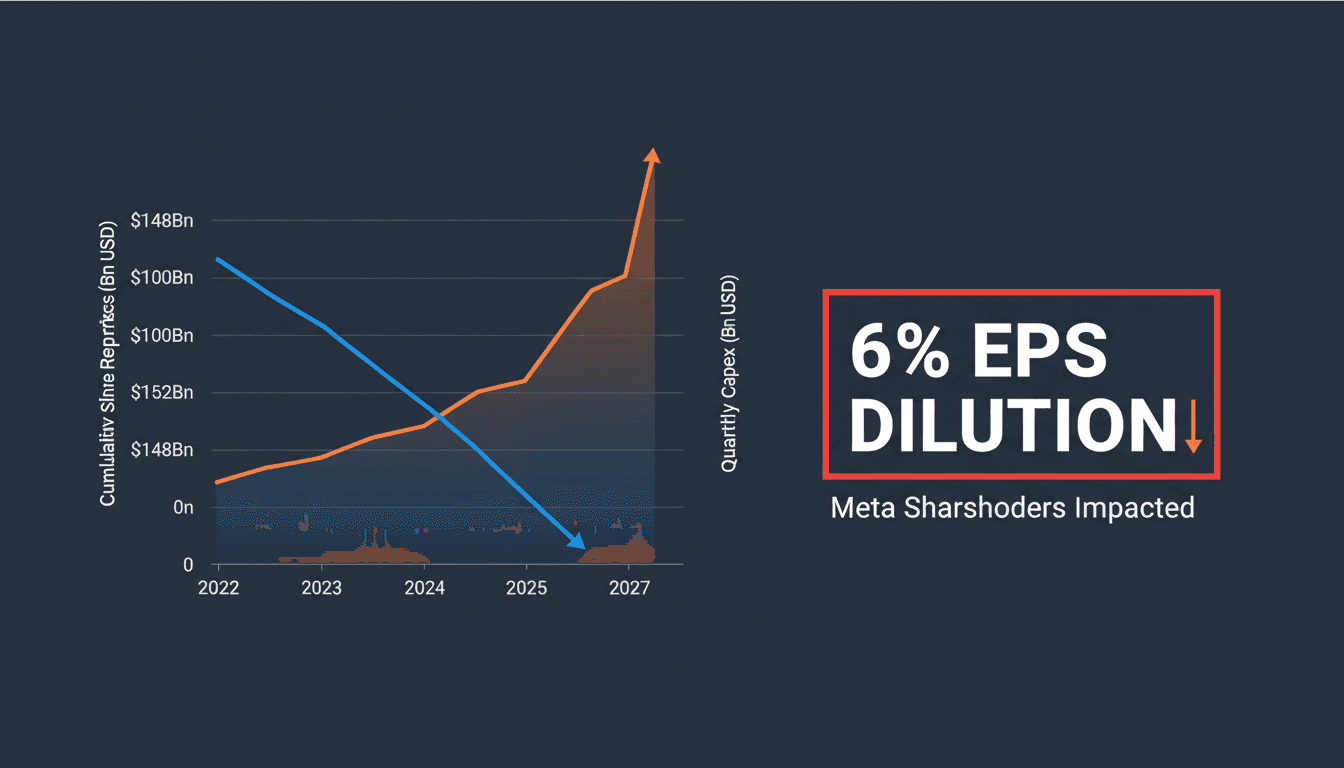
- Future dilution was locked in: Meta planned an additional at-the-market program of up to $60 billion in non-voting Class C shares scheduled for the first quarter of 2027, yielding an estimated 6% earnings per share dilution according to Bank of America.
The context you actually need
- The buyback era paused: Between 2021 and 2025, Meta deployed more than $148 billion into share repurchases, functioning as a structural buyer of its own stock to concentrate equity value rather than expand share count.
- Infrastructure projections expanded: Management raised full-year 2026 capital expenditure forecasts to a range between $135 billion and $145 billion, widening the operational shortfall created by high-volume hardware procurement.
- Hardware suppliers aligned as investors: Semiconductor vendors Nvidia, AMD, and Broadcom expressed interest in acquiring up to $5 billion combined of the equity offering, tying vendor balance sheets directly to their customer's funding mechanism.
What's really happening
The mechanics of financing artificial intelligence have outgrown traditional balance sheet capacity. Between 2021 and 2025, Meta operated as a net capital distributor, spending over $148 billion to retire common shares. That model depended on operating cash flows comfortably exceeding reinvestment requirements. In the third quarter of 2026, that equation inverted: capital expenditures reached approximately $34 billion, outpacing cash generation and producing Meta's first negative free cash flow quarter since its 2012 IPO.
To bridge an annual capex guidance raised to $135–$145 billion, management opted against traditional debt accumulation or capex reductions. Instead, Meta initiated an equity pipeline targeting up to $97.5–$100 billion. The mechanics of this structure balance immediate liquidity against structural control. Underwritten by Morgan Stanley and Goldman Sachs, the initial tranche priced $25 billion in Class A common shares at $625—a 2.7% discount to market—alongside $12.5 billion in 6.5% mandatory convertible preferred stock.
Investor absorption revealed clear structural incentives. The common offering drew five-times oversubscription, with institutional allocations prioritizing long-term holders. Simultaneously, hardware suppliers Nvidia, AMD, and Broadcom signaled plans to take down up to $5 billion of the issuance. This dynamic establishes a circular capital pathway: cash raised from hardware suppliers flows back to those same vendors through purchase orders for accelerators and networking silicon.
The long-term cost of this liquidity falls on the ownership base. A Bank of America analysis calculated that issuing roughly $95 billion near $640 per share dilutes existing earnings per share by approximately 6%. To dilute earnings while avoiding governance shifts, Meta structured the remaining $60 billion tranche—slated for early 2027—entirely around non-voting Class C shares via an at-the-market program.
This capital strategy shifts public equity markets into public utility financiers for high-performance computing clusters. Institutional buyers accepted modest immediate share price declines—nearly 2% on October 26 and roughly 1% on October 27—in exchange for direct exposure to concentrated infrastructure deployment.
Who feels it first (and how)
- Public index and retail equity holders: Portfolios tracking the S&P 500 or direct tech holdings face an automatic ~6% dilution in Meta's forward earnings per share, lowering proportional claims on future net income.
- Institutional asset allocators: Sovereign wealth funds and global pension managers gain newly priced equity tranches, securing oversubscribed primary allocations at a 2.7% discount ($625 per share).
- Semiconductor balance sheets: Equipment vendors such as Nvidia, AMD, and Broadcom deploy up to $5 billion in corporate cash reserves into customer equity, converting trade accounts into long-term equity positions.
- Global cross-border investors: Shareholders operating out of financial centers like Dubai experience proportional capital dilution identically to North American investors, without differential tax or exchange advantages.
What to watch next
- The Class C ATM execution in Q1 2027: Track whether Meta activates the $60 billion non-voting share program at full capacity, which will confirm whether operating cash flows remain negative into early 2027.
- Sustained capex run-rates above $35 billion quarterly: Monitor whether fourth-quarter 2026 spending maintains Meta's revised $135–$145 billion annual trajectory or accelerates further.
- Peer funding shifts: Watch if cash-rich hyperscalers follow Meta by turning to primary equity markets rather than operating cash flows or debt to underwrite hardware procurement.
Meta launched up to approximately $100 billion in equity offerings, priced an oversubscribed $37.5 billion combined initial tranche ($25 billion Class A common stock at $625 per share, $12.5 billion in 6.5% convertible preferred stock), and generated negative free cash flow in Q3 2026 due to ~$34 billion in capital expenditures.
Existing shareholders will experience roughly 6% forward earnings per share dilution once the broader program, including the $60 billion Class C share issuance, completes deployment in 2027.
Whether the estimated $5 billion equity participation by Nvidia, AMD, and Broadcom will be structured as strategic corporate reserves or standard balance sheet marketable securities.
Frequently Asked Questions
- Why it matters?
- The transaction marks the moment Big Tech exhausted operating cash flows to finance the AI buildout, transitioning from equity repurchaser to primary market capital issuer.
- What happened (in 30 seconds)?
- A record equity raise opened: On October 26, 2026, Meta launched an offering of up to approximately $100 billion, pricing $25 billion in Class A common stock at $625 per share alongside $12.5 billion in 6.5% mandatory convertible preferred stock. Capital expenditure surpassed operating cash: Surging AI data center investments pushed Q3 2026 capital expenditures near $34 billion, generating negative free cash flow for the first time since the company’s 2012 initial public offering. Future dilutio
- What's really happening?
- The mechanics of financing artificial intelligence have outgrown traditional balance sheet capacity. Between 2021 and 2025, Meta operated as a net capital distributor, spending over $148 billion to retire common shares. That model depended on operating cash flows comfortably exceeding reinvestment requirements. In the third quarter of 2026, that equation inverted: capital expenditures reached approximately $34 billion, outpacing cash generation and producing Meta's first negative free cash flow
- Who feels it first (and how)?
- Public index and retail equity holders: Portfolios tracking the S&P 500 or direct tech holdings face an automatic ~6% dilution in Meta's forward earnings per share, lowering proportional claims on future net income. Institutional asset allocators: Sovereign wealth funds and global pension managers gain newly priced equity tranches, securing oversubscribed primary allocations at a 2.7% discount ($625 per share). Semiconductor balance sheets: Equipment vendors such as Nvidia, AMD, and Broadcom dep
- What to watch next?
- The Class C ATM execution in Q1 2027: Track whether Meta activates the $60 billion non-voting share program at full capacity, which will confirm whether operating cash flows remain negative into early 2027. Sustained capex run-rates above $35 billion quarterly: Monitor whether fourth-quarter 2026 spending maintains Meta's revised $135–$145 billion annual trajectory or accelerates further. Peer funding shifts: Watch if cash-rich hyperscalers follow Meta by turning to primary equity markets rather
Stock market news, investing ideas, and trading analysis.
"TheStreet provides market news and retail-investor-focused analysis."
— A47 Editor
Meta's $100 billion stock sale shrinks your slice of the company
Meta Platforms is seeking to raise up to $100 billion from shareholders, as its AI buildout outpaces the cash the company generates, according to TheStreet's report on the stock sale that would shrink existing investors' ownership stake.
Curated tech headlines including AI stories.
"Influential aggregator surfacing the day’s top tech/AI links."
— A47 Editor
Sources: Meta's $25B share sale was oversubscribed 5x as it seeks $98B for AI spending; the 15 largest investors in the sale accounted for ~70% of shares (Anthony Hughes/Bloomberg)
Meta Platforms' upsized $25 billion share sale drew demand roughly five times the shares available, according to sources cited by Bloomberg, as the company seeks as much as $98 billion overall to fund its artificial intelligence spending. The 15 larg...
Macro commentary, policy analysis, growth/inflation themes, and global outlooks.
"Contextual macro coverage that complements day-to-day market headlines."
— A47 Editor
Meta eyes record $97.5 billion equity raise to fund AI expansion
Meta has announced plans to raise up to $95 billion through a stock offering to help fund its artificial intelligence expansion, including datacentre infrastructure, according to Investing.com reporting that frames the move as a record equity raise o...
Curated insights and thought leadership in enterprise technology.
"Ciente.io delivers curated insights, thought leadership, and trends in B2B tech and innovation."
— A47 Editor
Meta’s $95 Billion AI Cash Grab: Silicon Valley’s Latest Desperate Gamble
Meta has announced plans to raise as much as $95 billion in financing, including a stock offering, to fund its heavy investments in artificial-intelligence infrastructure and what it calls "personal superintelligence," according to the Wall Street Jo...
Corporate leadership, finance, technology, and market trends.
"Fortune covers financial trends, leadership, and innovation with a pragmatic editorial approach."
— A47 Editor
Tech bulls are barely winning their fight against the oil bears
Meta's stock fell nearly 2% after the company announced it would offer $95 billion in new, dilutive stock to fund its artificial intelligence buildout, even as the company reported third-quarter revenue of $64.6 billion that exceeded expectations.