
Big Tech AI Capex Concerns Drive Asian Chip Stock Selloff on October 30 2026
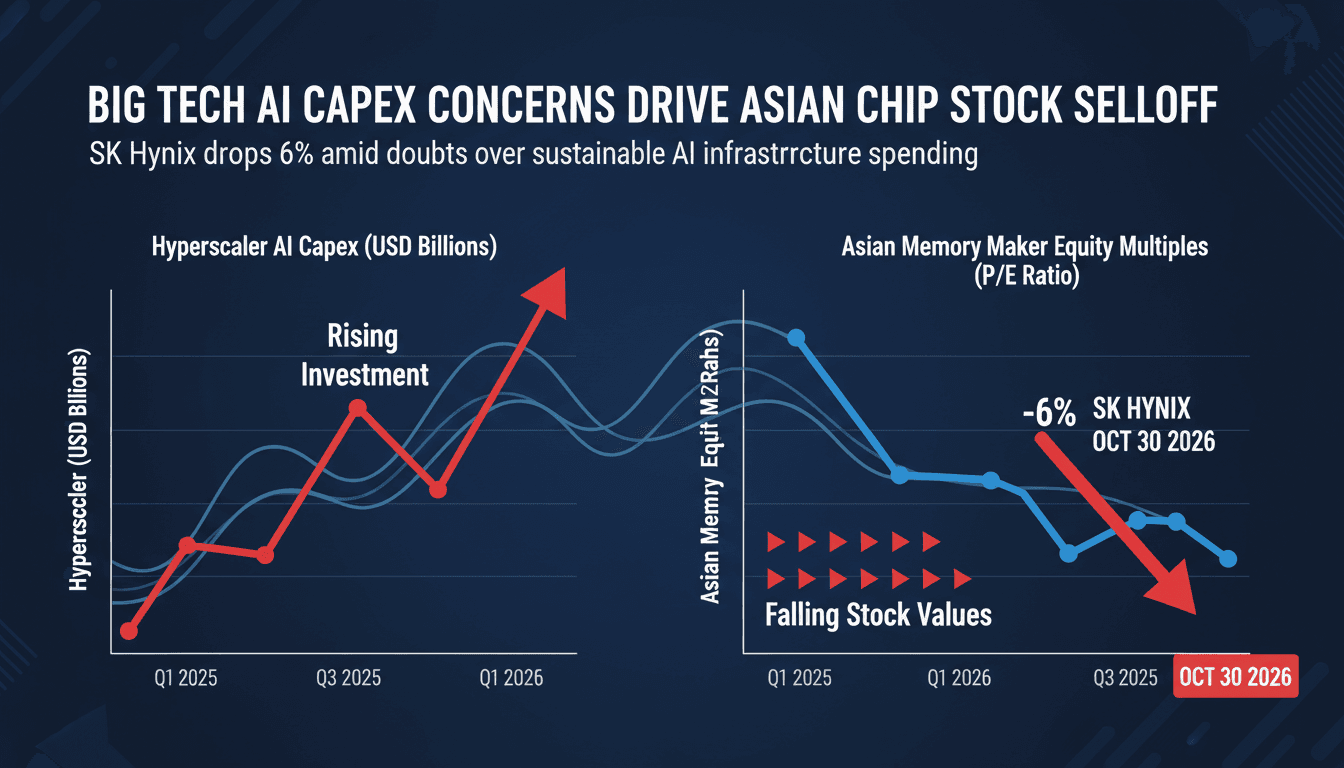
If your portfolio or corporate balance sheet carries exposure to global technology funds, the shifting economics of artificial intelligence infrastructure will directly influence your equity valuations and capital allocation assumptions.
Why it matters
The gap between rising data center capital expenditure and immediate revenue generation is challenging the valuation floor of the global semiconductor supply chain.
What happened (in 30 seconds)
- Earnings disclosures triggered an equity slide, after Amazon.com Inc. revealed elevated capital spending and Intel Corp. issued a weaker-than-expected sales forecast linked to softening personal computer chip demand.
- Asian semiconductor leaders absorbed steep drops, with South Korea's SK Hynix dropping more than 6% alongside declines across TSMC and Samsung Electronics.
- Regional indices sustained sharp retreats, as South Korea’s Kospi and Japan’s Nikkei 225 extended multi-session losses driven by investor reassessments of global artificial intelligence hardware demand.
The context you actually need
- U.S. chip benchmarks entered late October under pressure, affected by macroeconomic headcurrents including climbing oil prices, persistent inflation readings, and investor scrutiny of debt-funded data center buildouts.
- Long-term balance sheet risks are surfacing, with financial models projecting potential asset impairment risks exceeding $3.5 trillion by 2030 if enterprise software revenues fail to offset hardware deployment costs.
- Competition in advanced memory is expanding, as Chinese memory manufacturers make tangible strides, introducing new pricing dynamics for established Asian chipmakers.
What's really happening
The market reaction across Asian trading desks on October 30, 2026, exposes a core friction point in the hardware buildout: hyperscale platforms are accelerating capital spending precisely as end-market revenue visibility begins to blur.
For roughly eighteen months, the semiconductor sector operated on an assumption of uninterrupted upstream momentum. Hyperscalers such as Amazon, Microsoft, and Alphabet committed hundreds of billions of dollars to secure server capacity, high-bandwidth memory, and advanced silicon. However, when Amazon reported elevated capital expenditure figures alongside Intel’s tempered forward forecast for personal computer processors, the narrative shifted from capability expansion to cost sustainability.
The structural incentive for Big Tech management teams is asymmetric. Underinvesting risks forfeiting architectural dominance in artificial intelligence workloads; overinvesting merely risks asset writedowns or compressed operating margins years down the line. Because tech leadership is heavily incentivized to avoid falling behind in compute capacity, balance sheets continue to deploy capital at elevated volumes.
Public equity markets, however, operate on compressed time horizons. Investors evaluate return on invested capital (ROIC) on a quarter-by-quarter basis. When hardware deployment outpaces monetizable enterprise software applications, equity multiples contract. Intel's subdued guidance illuminated an additional vulnerability: traditional computing components—such as enterprise personal computer processors—are experiencing demand fatigue, leaving companies unable to use legacy high-margin volume to subsidize specialized artificial intelligence research and fabrication.
The pressure cascades down the supply chain into Asia. Upstream manufacturers such as SK Hynix, Samsung Electronics, and TSMC rely on stable multi-year order books from North American hyperscalers. When doubts arise over whether cloud providers will maintain capex at current rates into 2027 and beyond, Asian suppliers absorb rapid selloffs. SK Hynix’s single-session decline of more than 6% underscores how tightly coupled Asian contract fabrication and high-bandwidth memory production are to the liquidity profiles and investment pacing of U.S. technology conglomerates.
Compounding this cyclical tension is the capital structure underwriting the buildout. Much of the global data center expansion relies on substantial debt obligations and cash reserves accumulated during prior expansionary cycles. With rising oil prices introducing energy cost uncertainties and broader macroeconomic indicators pointing toward elevated cost of capital, the enterprise return hurdle rates for artificial intelligence investments have shifted higher. Unless generative workloads generate measurable operational efficiencies or clear subscription revenues, public markets will continue treating high capital spending figures as margin liabilities rather than drivers of future enterprise value.
Who feels it first (and how)
- Equity portfolio managers in Dubai and global financial hubs: Wealth managers and family offices holding broad tech allocations or emerging Asia exchange-traded funds experience equity drawdowns and must recalibrate exposure between software and hardware holdings.
- Semiconductor supply chain executives in East Asia: Leadership teams at foundries and memory fabrication hubs face shorter planning windows and potential inventory adjustments if cloud providers moderate hardware procurement cycles.
- Enterprise software buyers: Corporate technology officers seeking artificial intelligence tools may observe vendor pricing shifts, as infrastructure providers look to pass along the high capital costs of their server installations.
What to watch next
- Hyperscaler quarterly cash flow allocations: Monitor upcoming earnings disclosures from cloud infrastructure operators for any explicit downward revisions to 2027 infrastructure budgets.
- High-bandwidth memory contract pricing: Track whether contract prices for advanced memory modules hold firm or face discounting pressures from expanded production and Chinese competition.
- Enterprise software deployment metrics: Observe corporate adoption rates and license monetization, which indicate whether business applications are generating cash flow to match infrastructure overhead.
Asian chip stocks declined on October 30, 2026, led by a drop of more than 6% in SK Hynix shares, following Amazon's elevated capital spending data and Intel’s muted sales outlook.
Semiconductor valuations will remain sensitive to quarterly capital expenditure commentary from U.S. hyperscale cloud operators throughout the upcoming fiscal cycles.
Whether enterprise demand for software integrations will scale fast enough to prevent a structural asset impairment cycle across hardware deployments before 2030.
Frequently Asked Questions
- Why it matters?
- The gap between rising data center capital expenditure and immediate revenue generation is challenging the valuation floor of the global semiconductor supply chain.
- What happened (in 30 seconds)?
- Earnings disclosures triggered an equity slide, after Amazon.com Inc. revealed elevated capital spending and Intel Corp. issued a weaker-than-expected sales forecast linked to softening personal computer chip demand. Asian semiconductor leaders absorbed steep drops, with South Korea's SK Hynix dropping more than 6% alongside declines across TSMC and Samsung Electronics. Regional indices sustained sharp retreats, as South Korea’s Kospi and Japan’s Nikkei 225 extended multi-session losses driven b
- What's really happening?
- The market reaction across Asian trading desks on October 30, 2026, exposes a core friction point in the hardware buildout: hyperscale platforms are accelerating capital spending precisely as end-market revenue visibility begins to blur. For roughly eighteen months, the semiconductor sector operated on an assumption of uninterrupted upstream momentum. Hyperscalers such as Amazon, Microsoft, and Alphabet committed hundreds of billions of dollars to secure server capacity, high-bandwidth memory,
- Who feels it first (and how)?
- Equity portfolio managers in Dubai and global financial hubs: Wealth managers and family offices holding broad tech allocations or emerging Asia exchange-traded funds experience equity drawdowns and must recalibrate exposure between software and hardware holdings. Semiconductor supply chain executives in East Asia: Leadership teams at foundries and memory fabrication hubs face shorter planning windows and potential inventory adjustments if cloud providers moderate hardware procurement cycles. En
- What to watch next?
- Hyperscaler quarterly cash flow allocations: Monitor upcoming earnings disclosures from cloud infrastructure operators for any explicit downward revisions to 2027 infrastructure budgets. High-bandwidth memory contract pricing: Track whether contract prices for advanced memory modules hold firm or face discounting pressures from expanded production and Chinese competition. Enterprise software deployment metrics: Observe corporate adoption rates and license monetization, which indicate whether bus
Global markets, investing, and macroeconomics from a premier financial newsroom.
"Bloomberg is respected for in-depth financial reporting and data-driven analysis."
— A47 Editor
Big Tech’s Deepening AI Funding Concerns Sink Asian Chip Stocks
Shares of global chipmakers, particularly across Asia, fell as a critical earnings season for the artificial intelligence trade failed to reassure investors, according to Bloomberg. Concerns over soaring infrastructure costs and whether AI-driven dem...
Markets desk coverage, trading insights, and investor updates.
"WSJ’s markets reporting provides in-depth analysis and context for investors."
— A47 Editor
Alphabet Stock Sinks, Dragging Nasdaq Lower
Shares of Alphabet, Google's parent company, fell sharply after its third-quarter 2026 earnings disappointed investors, with revenue of $127.6 billion missing forecasts and renewed worries about heavy AI spending dragging the Nasdaq Composite lower.
Technology business and AI-related headlines.
"Data-driven tech newsroom with global scope."
— A47 Editor
Nasdaq 100 Falls as AI Trade Shows New Cracks
Nasdaq 100 futures and the broader global technology rally faltered after disappointing earnings from Alphabet, the parent of Google, revived doubts over whether heavy artificial-intelligence spending will deliver sufficient returns. Alphabet shares ...
Technology business news, market impacts, and innovation trends.
"Bloomberg is a premier financial and tech news provider, respected for its in-depth reporting and analytical rigor."
— A47 Editor
Nasdaq 100 Falls as AI Trade Shows New Cracks
Nasdaq 100 futures and the broader global technology rally faltered after disappointing earnings from Alphabet, the parent of Google, revived doubts over whether heavy artificial-intelligence spending will deliver sufficient returns. Alphabet shares ...
Technology business and AI-related headlines.
"Data-driven tech newsroom with global scope."
— A47 Editor
China AI Hardware Firms Face Earnings Test After Stock Selloff
China's AI hardware firms are facing a test of investor confidence as they approach upcoming earnings reports, following a brutal selloff in sector stocks, according to Bloomberg Technology. The base coverage frames the sector's sharp decline as the ...
Technology business news, market impacts, and innovation trends.
"Bloomberg is a premier financial and tech news provider, respected for its in-depth reporting and analytical rigor."
— A47 Editor
China AI Hardware Firms Face Earnings Test After Stock Selloff
China's AI hardware firms are facing a test of investor confidence as they approach upcoming earnings reports, following a brutal selloff in sector stocks, according to Bloomberg Technology. The base coverage frames the sector's sharp decline as the ...
Macro commentary, policy analysis, growth/inflation themes, and global outlooks.
"Contextual macro coverage that complements day-to-day market headlines."
— A47 Editor
Big Tech earnings to test AI boom amid market turmoil
Big Tech companies are set to report earnings that will test investor confidence in the artificial intelligence boom, as broader market turmoil weighs on sentiment, according to Investing.com's markets coverage.
International coverage from The Guardian's global desks.
"The Guardian is known for its progressive editorial stance and in-depth analysis."
— A47 Editor
Chinese markets lose trillions as race for AI supremacy with US takes its toll
Trillions of dollars have been wiped from China's stock markets in recent months amid rising anxiety over the future of artificial intelligence, as Beijing competes with the United States for dominance in the sector. The STAR 50 Index, which tracks t...
Tech culture, product news, and critical takes on the tech industry's social impact.
"The Guardian's tech coverage blends mainstream news, critical analysis, and cultural commentary on emerging technologies and digital trends."
— A47 Editor
Chinese markets lose trillions as race for AI supremacy with US takes its toll
Trillions of dollars have been wiped from China's stock markets in recent months amid rising anxiety over the future of artificial intelligence, as Beijing competes with the United States for dominance in the sector. The STAR 50 Index, which tracks t...
News and features on AI from The Guardian.
"Progressive-leaning international outlet with critical AI coverage."
— A47 Editor
Chinese markets lose trillions as race for AI supremacy with US takes its toll
Trillions of dollars have been wiped from China's stock markets in recent months amid rising anxiety over the future of artificial intelligence, as Beijing competes with the United States for dominance in the sector. The STAR 50 Index, which tracks t...