
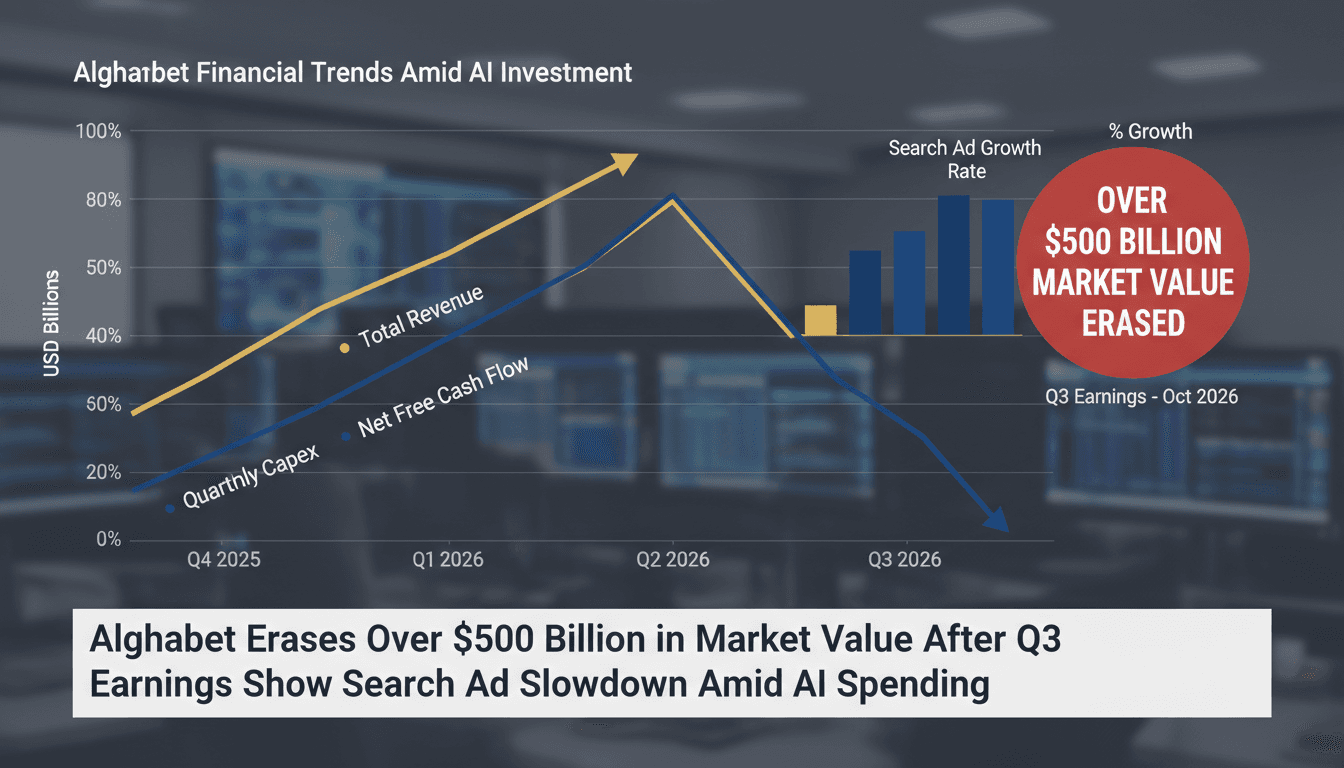
Alphabet Erases Over $500 Billion in Market Value After Q3 Earnings Show Search Ad Slowdown Amid AI Spending
Why it matters
Wall Street is shifting from rewarding aggressive capital expenditure on computing infrastructure to demanding measurable returns, setting off a systemic reassessment of technology valuations across global markets.
What happened (in 30 seconds)
- Alphabet lost over $500 billion in market capitalization on October 29, 2026, as shares dropped roughly 13 percent to a six-month low of $3.46 trillion following third-quarter earnings.
- Search advertising growth decelerated to 12 percent, missing expectations as new AI features changed user behavior and compressed legacy digital advertising placements.
- Free cash flow fell below negative $9 billion, driven by expanding infrastructure spending and a 25 percent net profit decline despite a 25 percent increase in overall quarterly revenue to $127.6 billion.
The context you actually need
- The infrastructure buildout demands sustained capital outflows, requiring tech leaders to deploy hundreds of billions of dollars into high-performance data centers, custom silicon, and power-dense computing clusters.
- AI-generated summaries directly disrupt legacy ad inventory, as integrated direct answers reduce the total volume of clickable blue links that historically generated high-margin monetization.
- Sector-wide earnings calls show synchronized margin pressure, with parallel reports from peers Microsoft and Amazon demonstrating that the cost of serving complex inference requests is compressing software profit margins across the board.
What's really happening
The market correction on October 29, 2026, marks the end of an era where capital markets offered tech operators a blank check for artificial intelligence infrastructure. For years, the market operating assumption was straightforward: expand computational scale at any cost, capture baseline architectural dominance, and address unit economics later. Alphabet’s third-quarter results demonstrated that the trade-off between deployment expenses and core revenue generation has finally surfaced on the balance sheet.
Alphabet generated $127.6 billion in quarterly revenue, reflecting a nominal 25 percent year-over-year expansion. However, profits declined by 25 percent. The central culprit is the mechanical cost structure of advanced AI inference. In the legacy Google Search model, serving a query was an exceptionally low-cost computing event that surfaced auction-priced advertising links with minimal processing overhead. Serving complex AI-generated summaries via AI Mode requires substantially more computational capacity per transaction. This architectural shift creates a dual negative incentive: it materially increases the capital cost per query while reducing the surface area available for traditional performance ads.
Because users receive direct, synthesized outputs, their incentive to scan and select external commercial sponsored links diminishes. This dynamic slowed Search advertising growth to 12 percent during the quarter, missing analyst estimates. At the same time, Alphabet’s commitment to computing hardware and data centers pushed the quarter’s free cash flow into negative territory, exceeding negative $9 billion.
This dynamic is not an isolated execution issue within Mountain View. The drop rippled across markets, dragging the Nasdaq Composite down 1.38 percent and the S&P 500 down 0.3 percent on the same day. Cross-read updates from competitors Microsoft and Amazon confirmed that high ongoing capital outlays are simultaneously hitting their operating margins. When the three largest cloud and enterprise software operators in the world experience synchronized margin compression due to infrastructure requirements, capital allocators adjust their discount rates. The half-trillion-dollar erasure of equity value reflects a structural pricing reset: enterprise technology valuations are realigning from hyper-growth multiples back to standard, industrial-scale return-on-invested-capital calculations.
Who feels it first (and how)
- Digital marketing leaders and ad-spend allocators: Face changing auction economics, altered click-through dynamics, and volatile ad-inventory pricing as search interfaces replace link placement with generative answers.
- Enterprise software and cloud procurement officers: Experience higher vendor pricing scrutiny and shifting contract terms as cloud providers seek to protect their margins against expensive infrastructure investments.
- Institutional asset managers and equity analysts: Must reprice technology balance sheets that now register negative free cash flow profiles against higher hurdle rates and extended payback timelines.
- Technology infrastructure and semiconductor vendors: Face incoming pressure from hyper-scale buyers to deliver higher performance per dollar and lower power consumption as corporate boards scrutinize capex efficiency.
What to watch next
- Inference cost per query metrics: Track whether Alphabet and its competitors can optimize model efficiency to lower the computational cost of direct generative search answers relative to legacy serving expenses.
- Search ad-load redesigns: Monitor how Alphabet integrates sponsor-driven commerce and monetized attribution models directly into its AI summaries without degrading the consumer user experience.
- Capex guidance adjustments from hyperscalers: Watch upcoming quarterly capital expenditure guidance from Alphabet, Microsoft, and Amazon to see if infrastructure investments plateau in response to market feedback.
Alphabet’s valuation declined by more than $500 billion in a single day, dropping its enterprise capitalization to $3.46 trillion while generating negative free cash flow of over $9 billion.
Digital ad buyers will face lower click-through yields on core informational search queries as users rely entirely on direct generative interfaces, forcing marketing budgets into alternative channels.
Whether enterprise cloud revenue expansion and novel AI monetizations can re-accelerate overall net profits quickly enough to offset the persistent costs of the data center buildout.
Frequently Asked Questions
- Why it matters?
- Wall Street is shifting from rewarding aggressive capital expenditure on computing infrastructure to demanding measurable returns, setting off a systemic reassessment of technology valuations across global markets.
- What happened (in 30 seconds)?
- Alphabet lost over $500 billion in market capitalization on October 29, 2026, as shares dropped roughly 13 percent to a six-month low of $3.46 trillion following third-quarter earnings. Search advertising growth decelerated to 12 percent, missing expectations as new AI features changed user behavior and compressed legacy digital advertising placements. Free cash flow fell below negative $9 billion, driven by expanding infrastructure spending and a 25 percent net profit decline despite a 25 perce
- What's really happening?
- The market correction on October 29, 2026, marks the end of an era where capital markets offered tech operators a blank check for artificial intelligence infrastructure. For years, the market operating assumption was straightforward: expand computational scale at any cost, capture baseline architectural dominance, and address unit economics later. Alphabet’s third-quarter results demonstrated that the trade-off between deployment expenses and core revenue generation has finally surfaced on the b
- Who feels it first (and how)?
- Digital marketing leaders and ad-spend allocators: Face changing auction economics, altered click-through dynamics, and volatile ad-inventory pricing as search interfaces replace link placement with generative answers. Enterprise software and cloud procurement officers: Experience higher vendor pricing scrutiny and shifting contract terms as cloud providers seek to protect their margins against expensive infrastructure investments. Institutional asset managers and equity analysts: Must reprice t
- What to watch next?
- Inference cost per query metrics: Track whether Alphabet and its competitors can optimize model efficiency to lower the computational cost of direct generative search answers relative to legacy serving expenses. Search ad-load redesigns: Monitor how Alphabet integrates sponsor-driven commerce and monetized attribution models directly into its AI summaries without degrading the consumer user experience. Capex guidance adjustments from hyperscalers: Watch upcoming quarterly capital expenditure gui
Corporate news, economic trends, and markets with UK and global scope.
"BBC News is widely regarded as reputable and impartial, with a public service mandate."
— A47 Editor
Google value plunges by $500bn as AI fears rattle Wall Street
Alphabet, the parent company of Google, saw its stock fall sharply after third-quarter 2026 results disappointed investors, with revenue of $127.6 billion missing forecasts and the company acknowledging that its AI search summaries were affecting ad ...
Global business headlines with AI angles.
"General business outlet that frequently covers AI."
— A47 Editor
Stocks Break Winning Streak Dragged by Alphabet's Worst Ever Post-Earnings Performance
Alphabet's shares fell more than 12% after the parent of Google reported negative free cash flow of $9.07 billion for the third quarter, erasing roughly $500 billion in market value and dragging the Nasdaq lower in a move that snapped a winning strea...
Markets desk coverage, trading insights, and investor updates.
"WSJ’s markets reporting provides in-depth analysis and context for investors."
— A47 Editor
Alphabet Sheds Half a Trillion in Market Value in Stock’s Worst Day Ever
Alphabet, Google's parent company, saw its shares drop sharply, erasing roughly $500 billion in market value in what the Wall Street Journal described as the stock's worst day ever, after third-quarter 2026 results disappointed investors. Revenue of ...
Business, investment, entrepreneurship, leadership, and innovation.
"Forbes is known for its coverage of business leaders, market trends, and entrepreneurial ventures with a pro-business editorial stance."
— A47 Editor
Google Parent’s Stock Tank Erases Nearly $500 Billion In Second-Biggest Daily Market Cap Loss Ever
Alphabet, Google's parent company, lost about $480 billion in market capitalization on Thursday as its shares plunged roughly 12% after disappointing third-quarter earnings, according to Forbes. Coverage cited revenue of $127.6 billion falling short ...
Technology business and AI-related headlines.
"Data-driven tech newsroom with global scope."
— A47 Editor
Google Erases a Record $500 Billion as AI Eats Into Sales
Alphabet Inc.'s shares fell more than 13% after the Google parent reported disappointing search and advertising sales, erasing more than $500 billion in market value in the company's biggest-ever market plunge, as investors grew concerned that AI is ...
Technology business news, market impacts, and innovation trends.
"Bloomberg is a premier financial and tech news provider, respected for its in-depth reporting and analytical rigor."
— A47 Editor
Google Erases a Record $500 Billion as AI Eats Into Sales
Alphabet Inc.'s shares fell more than 13% after the Google parent reported disappointing search and advertising sales, erasing more than $500 billion in market value in the company's biggest-ever market plunge, as investors grew concerned that AI is ...
UK and global business, economy, and markets coverage.
"Sky News is often seen as a center-right outlet in the UK, known for rolling news and breaking business stories."
— A47 Editor
Google owner Alphabet suffers its worst-ever day on stock market - as value plunges $500bn
Shares in Alphabet, the parent company of Google, suffered their worst-ever single-day fall on the US stock market, dropping more than 12% and wiping roughly $500bn from the company's value.
Tech industry news, innovation, gadgets, and startups from a UK broadcaster.
"Sky News is often seen as a center-right outlet in the UK, known for its rolling coverage and breaking stories."
— A47 Editor
Google owner Alphabet suffers its worst-ever day on stock market - as value plunges $500bn
Shares in Alphabet, the parent company of Google, suffered their worst-ever single-day fall on the US stock market, dropping more than 12% and wiping roughly $500bn from the company's value.
International news, politics, and culture.
"Sky News is a UK-based 24-hour channel known for fast-breaking news and political coverage."
— A47 Editor
Google owner Alphabet suffers its worst-ever day on stock market - as value plunges $500bn
Shares in Alphabet, the parent company of Google, suffered their worst-ever single-day fall on the US stock market, dropping more than 12% and wiping roughly $500bn from the company's value.
Business, investment, entrepreneurship, leadership, and innovation.
"Forbes is known for its coverage of business leaders, market trends, and entrepreneurial ventures with a pro-business editorial stance."
— A47 Editor
Google’s Larry Page, Sergey Brin Lose Combined $60 Billion As Alphabet Stock Drops
Alphabet, Google's parent company, saw its stock fall after investors reacted negatively to the company spending $51.4 billion on capital expenditures, including data centers and power capacity, in just three months; the sell-off reduced the combined...
Business and tech news excluding paywalled content.
"High-volume business/tech outlet with frequent AI coverage."
— A47 Editor
Google faces a $500 billion stock wipeout — one of the biggest-ever market cap drops
Alphabet shares plunged more than 13% in early trading after the parent company of Google reported third-quarter results that disappointed investors, a drop that threatens to erase about $500 billion in market value and rank among the second-worst ma...