
Microsoft Prices $25 Billion Bond Offering to Fund AI Infrastructure Expansion
Why it matters
The transaction establishes that even triple-A balance sheets must tap external credit to sustain the physical hardware demands of artificial intelligence infrastructure.
What happened (in 30 seconds)
- A $25 billion offering: Microsoft priced its first U.S. investment-grade debt sale in more than nine years across multiple tranches maturing between two and 40 years.
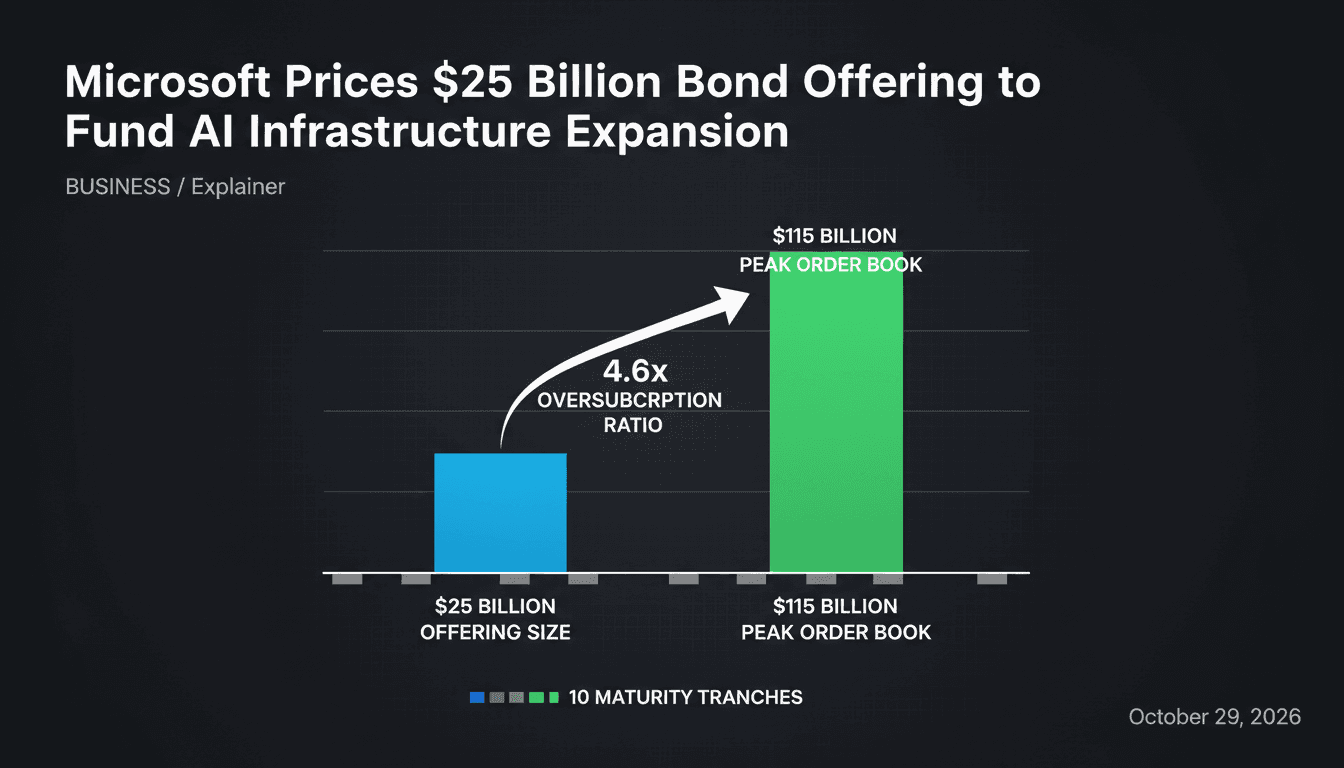
- Historic order volume: Underwriters recorded peak investor demand of $115 billion, resulting in a 4.6-times oversubscription that compressed borrowing spreads across the curve.
- Capital redeployment: Net proceeds from the transaction are formally designated for general corporate purposes, including capital expenditures on cloud and compute capacity.
The context you actually need
- First issuance since 2017: Microsoft previously maintained a self-funded operational posture, relying heavily on free cash flow rather than external debt markets to finance internal expansion.
- Earnings call inflection: On October 28, 2026, CFO Amy Hood confirmed that the company would evaluate alternative funding channels to preserve liquidity and operating flexibility amid rising compute outlays.
- Surging quarterly spend: Capital expenditures and finance leases reached $45.2 billion during the quarter ended September 2026, driven directly by capacity constraints within the Azure platform.
What's really happening
The mechanics of hyperscale computing have crossed an operational threshold where internal cash generation alone no longer covers the velocity of compute buildouts. By tapping the U.S. investment-grade market for $25 billion, Microsoft executed a clear shift in corporate balance sheet management. The move demonstrates how physical asset requirements—specifically advanced data centers, specialized silicon, and power-grid infrastructure—are reshaping capital structures across the technology sector.
For nearly a decade, enterprise technology operators viewed top-tier software providers as software-margin businesses that spun off more free cash flow than their balance sheets could absorb. That dynamic changed when the requirements for artificial intelligence infrastructure began competing directly with short-term liquidity. During the quarter ended September 2026, Microsoft registered $45.2 billion in capital expenditures and finance leases. Because Azure operates under severe compute constraints, management faced a distinct incentive structure: slow physical buildouts and forfeit market position, liquidate liquid working capital, or lock in long-term institutional debt at favorable spreads.
The institutional credit markets offered an immediate funding path. Fixed-income investors placed over $115 billion in orders across 10 tranches, oversubscribing the initial offering by 4.6 times. This depth of liquidity allowed book-running managers—led by Wells Fargo Securities, JPMorgan Chase, and UBS Securities—to tighten pricing aggressively. The longest maturity, a 40-year note due in 2066, priced at an incremental spread of just 1.05 percentage points over U.S. Treasuries.
By locking in 40-year capital at tight credit spreads, Microsoft effectively converts multi-year infrastructure costs into a predictable liability structure. The company secures access to physical compute capacity without drawing down balance-sheet reserves that preserve its strategic flexibility. However, shifting to debt financing for hardware infrastructure ties corporate margins to fixed debt-servicing schedules across long horizons. The debt market is no longer treating hyperscalers purely as asset-light software platforms, but rather as foundational utility operators requiring extensive physical capital.
Who feels it first (and how)
- Enterprise software buyers: IT leadership negotiating multi-year enterprise agreements will see capacity constraints gradually loosen as infrastructure capital deploys, but vendor pricing will reflect sustained hardware depreciation costs.
- Fixed-income portfolio managers: High-grade bond funds absorbing the paper secure high-quality corporate yield, establishing a benchmark pricing baseline for future tech debt sales.
- Competing cloud providers: Competing hyperscalers face direct capital-market pressure to match infrastructure spending and maintain external liquidity without compromising their credit profiles.
- Public equity investors: Microsoft equity participants absorbed a 0.7 percent decline during afternoon trading, reflecting the structural reality that ongoing revenue must absorb substantial balance sheet liabilities.
What to watch next
- November 4, 2026 closing settlement: Final execution details will confirm the total net proceeds and definitive balance-sheet impact across all active tranches.
- Azure gross margin shifts: Quarterly earnings following deployment will indicate whether external capital expenditure accelerates revenue conversion enough to offset continuous hardware write-downs.
- Peer-group high-grade issuance: Subsequent debt filings from rival hyperscalers will signal whether long-duration debt issuance has become standard financing architecture for global data center expansion.
Microsoft completed pricing for a $25 billion multi-tranche offering on October 29, 2026, marking its first U.S. bond sale since 2017 after peak demand surpassed $115 billion.
The proceeds will directly relieve near-term liquidity pressure caused by Azure's capacity constraints and quarterly capital expenditures that exceeded $45 billion.
The exact long-term return on invested capital remains unconfirmed as data center deployment costs continue to accelerate relative to recurring cloud subscription revenues.
Frequently Asked Questions
- Why it matters?
- The transaction establishes that even triple-A balance sheets must tap external credit to sustain the physical hardware demands of artificial intelligence infrastructure.
- What happened (in 30 seconds)?
- A $25 billion offering: Microsoft priced its first U.S. investment-grade debt sale in more than nine years across multiple tranches maturing between two and 40 years. Historic order volume: Underwriters recorded peak investor demand of $115 billion, resulting in a 4.6-times oversubscription that compressed borrowing spreads across the curve. Capital redeployment: Net proceeds from the transaction are formally designated for general corporate purposes, including capital expenditures on cloud and
- What's really happening?
- The mechanics of hyperscale computing have crossed an operational threshold where internal cash generation alone no longer covers the velocity of compute buildouts. By tapping the U.S. investment-grade market for $25 billion, Microsoft executed a clear shift in corporate balance sheet management. The move demonstrates how physical asset requirements—specifically advanced data centers, specialized silicon, and power-grid infrastructure—are reshaping capital structures across the technology sector
- Who feels it first (and how)?
- Enterprise software buyers: IT leadership negotiating multi-year enterprise agreements will see capacity constraints gradually loosen as infrastructure capital deploys, but vendor pricing will reflect sustained hardware depreciation costs. Fixed-income portfolio managers: High-grade bond funds absorbing the paper secure high-quality corporate yield, establishing a benchmark pricing baseline for future tech debt sales. Competing cloud providers: Competing hyperscalers face direct capital-market p
- What to watch next?
- November 4, 2026 closing settlement: Final execution details will confirm the total net proceeds and definitive balance-sheet impact across all active tranches. Azure gross margin shifts: Quarterly earnings following deployment will indicate whether external capital expenditure accelerates revenue conversion enough to offset continuous hardware write-downs. Peer-group high-grade issuance: Subsequent debt filings from rival hyperscalers will signal whether long-duration debt issuance has become s
Market-moving headlines impacting equities, bonds, and related risk assets.
"Real-time catalysts and volatility drivers across indices and sectors."
— A47 Editor
Microsoft expects to raise $25 billion in US bond sale, source says
Microsoft is expected to raise about $25 billion through a US bond sale, according to a source cited by Investing.com. The base report is neutral in tone and does not detail the bond's terms or intended use of proceeds.
Technology business and AI-related headlines.
"Data-driven tech newsroom with global scope."
— A47 Editor
Microsoft Turns to Bond Market as AI Spending Grows
Microsoft is looking to raise at least $25 billion through its first US investment-grade bond offering in nearly a decade, according to people familiar with the matter, a move that highlights how the company is turning to debt markets to fund its gro...
Technology business news, market impacts, and innovation trends.
"Bloomberg is a premier financial and tech news provider, respected for its in-depth reporting and analytical rigor."
— A47 Editor
Microsoft Turns to Bond Market as AI Spending Grows
Microsoft is looking to raise at least $25 billion through its first US investment-grade bond offering in nearly a decade, according to people familiar with the matter, a move that highlights how the company is turning to debt markets to fund its gro...
Curated tech headlines including AI stories.
"Influential aggregator surfacing the day’s top tech/AI links."
— A47 Editor
Sources: Microsoft is seeking to raise $25B+ in its first US investment-grade bond sale since 2017, when it raised $17B, to fund AI-related capital expenditures (Bloomberg)
Microsoft is seeking to raise at least $25 billion through its first US investment-grade bond sale since 2017, when it raised $17 billion, to fund AI-related capital expenditures, according to Bloomberg sources. The move follows the company's first-q...
Technology business and AI-related headlines.
"Data-driven tech newsroom with global scope."
— A47 Editor
Microsoft $25 Billion Blowout Bond Puts It in AI Winners’ Circle
Microsoft Corp. drew a strong reception for its $25 billion bond offering, a mega-sized debt sale that investors welcomed, according to the base report. The deal places the company among the perceived winners of the artificial intelligence spending r...
Technology business news, market impacts, and innovation trends.
"Bloomberg is a premier financial and tech news provider, respected for its in-depth reporting and analytical rigor."
— A47 Editor
Microsoft $25 Billion Blowout Bond Puts It in AI Winners’ Circle
Microsoft Corp. drew a strong reception for its $25 billion bond offering, a mega-sized debt sale that investors welcomed, according to the base report. The deal places the company among the perceived winners of the artificial intelligence spending r...