
Wall Street Indices React to U.S.-Iran Ceasefire Over Strait of Hormuz
Here's what it means for you.
Your investment strategy may need to adapt to shifting geopolitical landscapes that directly impact market stability.
Why it matters
The ceasefire announcement affects global oil supply chains and market sentiment, influencing economic conditions worldwide.
What happened (in 30 seconds)
- Wall Street closed mixed on April 7, 2026, with the Dow down 85 points while the S&P 500 and Nasdaq posted minor gains.
- A two-week ceasefire was announced between the U.S. and Iran, contingent on reopening the Strait of Hormuz, which is critical for oil transport.
- Oil prices plummeted by 14.71% following the ceasefire news, impacting energy markets and investor confidence.
The context you actually need
- Tensions escalated in late February 2026 when Iran restricted access to the Strait of Hormuz, a vital chokepoint for 20% of global oil supply.
- President Trump issued multiple deadlines threatening military action if the strait remained closed, leading to heightened market anxiety.
- The announcement of a ceasefire came after weeks of conflict, with negotiators expressing skepticism about reaching a lasting agreement.
What's really happening
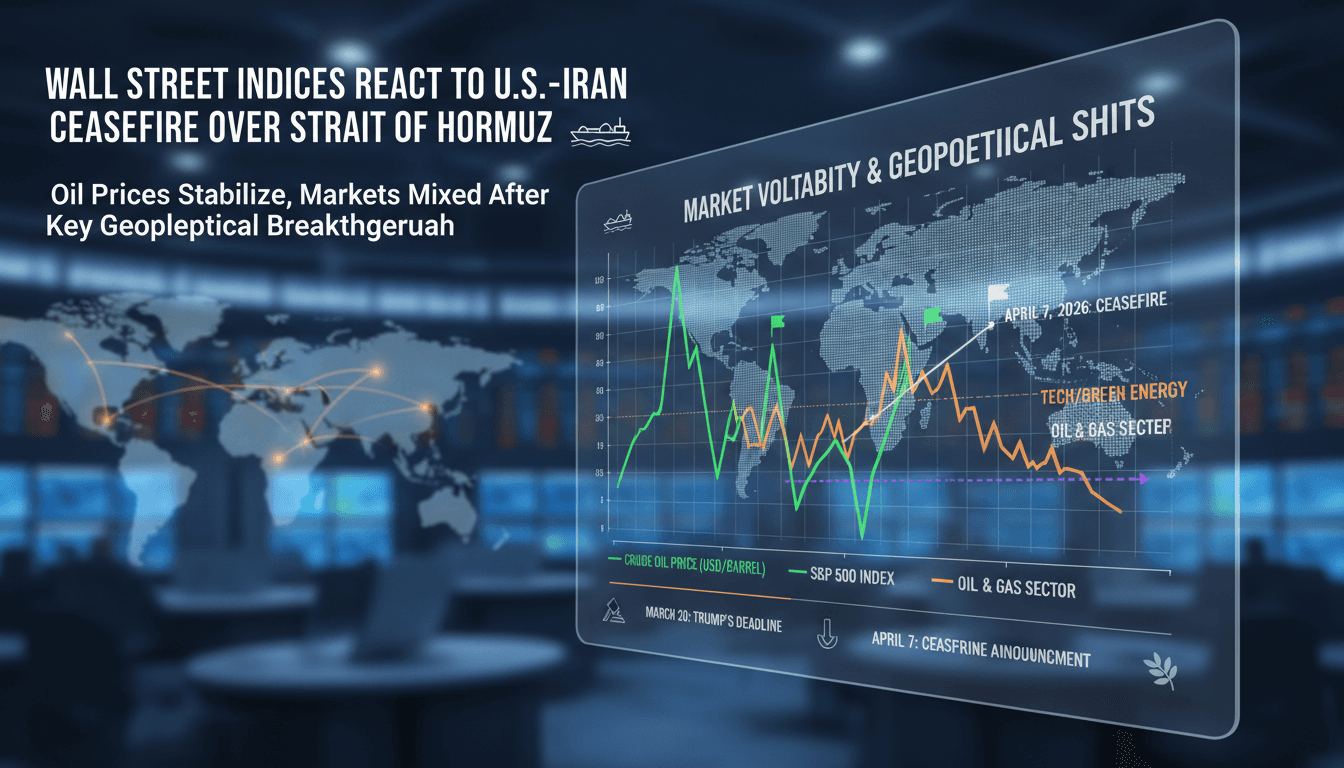
The recent mixed performance of Wall Street indices reflects a complex interplay of geopolitical tensions and economic indicators. On April 7, the Dow Jones Industrial Average fell by 85 points, while the S&P 500 and Nasdaq Composite saw marginal gains of 0.08% and 0.10%, respectively. This divergence illustrates how investor sentiment can shift rapidly in response to external events.
The initial decline in the indices was driven by disappointing economic data, particularly a 1.4% drop in February durable goods orders, which fell short of expectations. This economic backdrop heightened concerns about the U.S. economy's resilience amid ongoing geopolitical conflicts. As the day progressed, attention turned to President Trump's 8 p.m. ET deadline for a potential resolution regarding the Strait of Hormuz, which had been a focal point of U.S.-Iran tensions.
The announcement of a two-week ceasefire, contingent on reopening the Strait, provided a momentary boost to market sentiment. Trump's declaration via Truth Social, following Iran's 10-point proposal, reversed early declines in the stock market. The ceasefire announcement also led to a significant drop in West Texas Intermediate crude oil prices, which fell by 14.71% to $96.34 per barrel. This decline in oil prices is crucial as it alleviates some of the inflationary pressures on the global economy, particularly for countries reliant on oil imports.
However, the ceasefire is temporary, and the underlying tensions remain unresolved. The U.S. and Iran have a history of volatility, and the potential for renewed conflict looms if negotiations falter. The market's reaction to this ceasefire indicates a fragile balance; while investors welcomed the temporary relief, the uncertainty surrounding the future of U.S.-Iran relations continues to pose risks.
The implications of these developments extend beyond Wall Street. For investors and businesses, the volatility in oil prices and stock indices can affect strategic planning and investment decisions. Companies with exposure to energy markets or those reliant on stable supply chains may need to reassess their risk management strategies in light of these geopolitical uncertainties.
Who feels it first (and how)
- Investors: Those with portfolios heavily weighted in energy stocks or sectors sensitive to oil prices will see immediate impacts.
- Businesses: Companies dependent on stable oil prices for logistics and operations may face increased costs and planning challenges.
- Expatriates in the UAE: Fluctuations in oil prices can affect remittances and economic stability in the region, impacting living conditions.
What to watch next
- Ceasefire adherence: Monitoring compliance with the ceasefire will be crucial; any violations could lead to renewed market volatility.
- Economic indicators: Keep an eye on upcoming durable goods orders and other economic data releases that may signal the health of the U.S. economy.
- Global oil prices: Watch for fluctuations in oil prices as they can influence inflation rates and economic conditions worldwide.
The ceasefire is temporary and contingent on reopening the Strait of Hormuz.
Continued volatility in oil prices and stock markets as geopolitical tensions evolve.
The long-term stability of U.S.-Iran relations and its impact on global markets.
Frequently Asked Questions
- Why it matters?
- The ceasefire announcement affects global oil supply chains and market sentiment, influencing economic conditions worldwide.
- What happened (in 30 seconds)?
- Wall Street closed mixed on April 7, 2026, with the Dow down 85 points while the S&P 500 and Nasdaq posted minor gains. A two-week ceasefire was announced between the U.S. and Iran, contingent on reopening the Strait of Hormuz, which is critical for oil transport. Oil prices plummeted by 14.71% following the ceasefire news, impacting energy markets and investor confidence.
- What's really happening?
- The recent mixed performance of Wall Street indices reflects a complex interplay of geopolitical tensions and economic indicators. On April 7, the Dow Jones Industrial Average fell by 85 points, while the S&P 500 and Nasdaq Composite saw marginal gains of 0.08% and 0.10%, respectively. This divergence illustrates how investor sentiment can shift rapidly in response to external events. The initial decline in the indices was driven by disappointing economic data, particularly a 1.4% drop in Febru
- Who feels it first (and how)?
- Investors: Those with portfolios heavily weighted in energy stocks or sectors sensitive to oil prices will see immediate impacts. Businesses: Companies dependent on stable oil prices for logistics and operations may face increased costs and planning challenges. Expatriates in the UAE: Fluctuations in oil prices can affect remittances and economic stability in the region, impacting living conditions.
- What to watch next?
- Ceasefire adherence: Monitoring compliance with the ceasefire will be crucial; any violations could lead to renewed market volatility. Economic indicators: Keep an eye on upcoming durable goods orders and other economic data releases that may signal the health of the U.S. economy. Global oil prices: Watch for fluctuations in oil prices as they can influence inflation rates and economic conditions worldwide.
Arabic-language UAE newspaper coverage focused on domestic affairs, public institutions, business, society, and regional developments.
"Al Khaleej coverage generally reflects a mainstream UAE editorial lens with strong attention to public affairs, institutions, and regional developments."
— A47 Editor
وول ستريت تغلق جلسة الثلاثاء على تباين
U.S. stocks closed mixed on Tuesday, buoyed by signs of progress in negotiations between Tehran and Washington as the deadline set by President Donald Trump for Iran to open the Strait of Hormuz approaches, alongside the official announcement of a te...
Arabic-language digital news outlet covering UAE, regional, and international developments with broad general-news coverage.
"Al Ain News coverage typically blends UAE-focused reporting with wider Arab regional and international news."
— A47 Editor
هبوط الأسهم الأوروبية مع ترقب مهلة حاسمة بين واشنطن وطهران
European stocks declined on Tuesday, driven by a drop in the defense and healthcare sectors, as investors remain cautious ahead of the deadline set by U.S. President Donald Trump for Iran to open the Strait of Hormuz.
Arabic-language digital news outlet covering UAE, regional, and international developments with broad general-news coverage.
"Al Ain News coverage typically blends UAE-focused reporting with wider Arab regional and international news."
— A47 Editor
تصعيد أمريكي إيراني يهز الأسواق.. قفزة في النفط وهبوط في وول ستريت
Oil prices surged while U.S. stocks declined on Tuesday as the deadline set by President Donald Trump approached regarding his threats to destroy Iranian power stations and bridges. This escalation in U.S.-Iran tensions has significantly impacted mar...