
Study Reveals Astronauts' Brains Incomplete Adaptation to Microgravity After Five Months
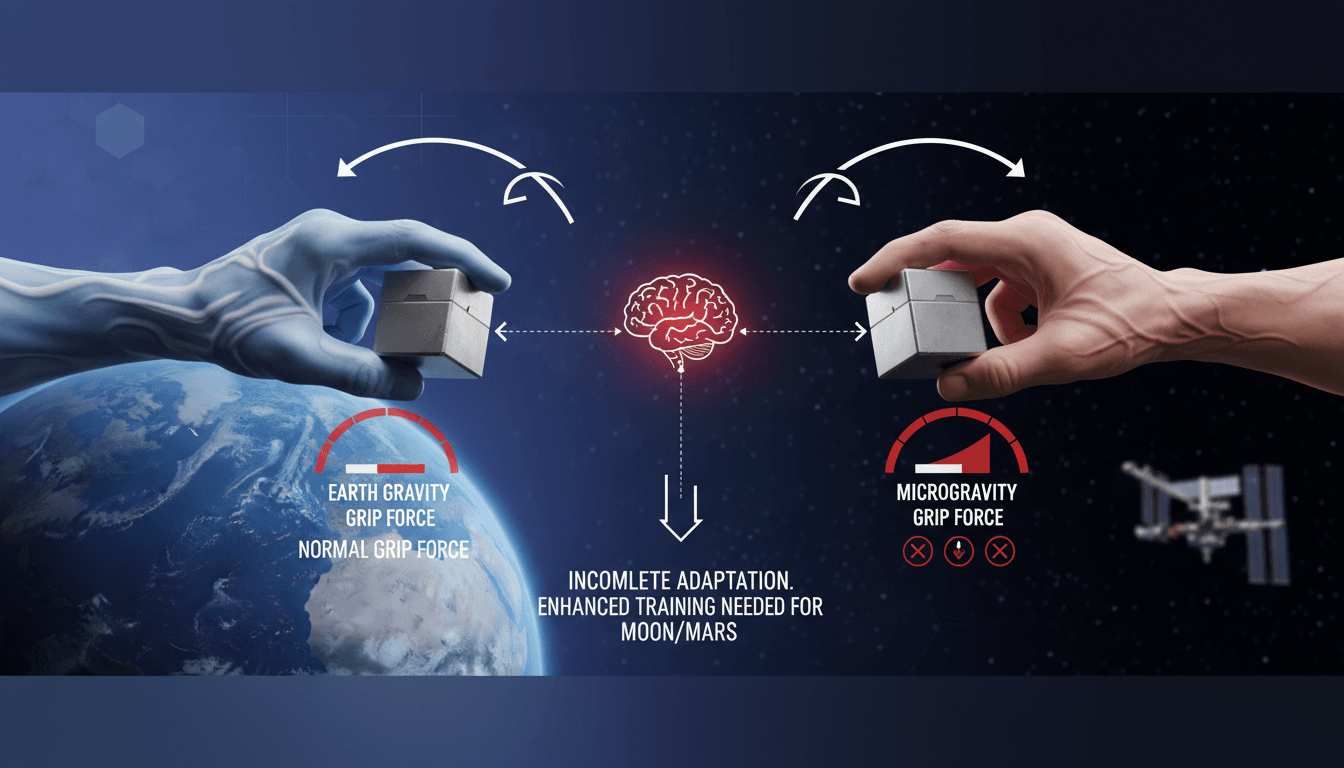
Here's what it means for you.
As space exploration expands, understanding how microgravity affects human physiology is crucial for the safety and effectiveness of future missions.
Why it matters
This research underscores the need for enhanced training protocols and health measures for astronauts, particularly as missions to the Moon and Mars become imminent.
What happened (in 30 seconds)
- On April 20, 2026, a study published in the Journal of Neuroscience revealed that astronauts' brains do not fully adapt to microgravity after five months on the ISS.
- Researchers analyzed grip force in 11 astronauts, finding they over-gripped objects, indicating persistent Earth-gravity predictions.
- The study highlights implications for sensorimotor control in partial-gravity environments, crucial for upcoming lunar and Martian missions.
The context you actually need
- Human brains are conditioned by Earth's gravity, influencing how we interact with objects.
- Prior studies focused on structural changes in the brain and fluid shifts, but grip-force control in microgravity was less understood.
- The GRIP experiment aimed to fill this gap, preparing for future missions that will require astronauts to adapt to varying gravity levels.
What's really happening
The recent study conducted by researchers from Université catholique de Louvain involved 11 astronauts who spent over five months aboard the International Space Station (ISS). The focus was on grip-force adjustments during routine object manipulations in a microgravity environment. The findings revealed that astronauts exhibited a tendency to overcompensate for the absence of weight, gripping objects as if they were heavier than they actually were. This behavior suggests that their brains retained a strong imprint of Earth’s gravitational conditions, which persisted even after extended exposure to microgravity.
The researchers equipped ISS modules with specialized tools to measure grip force and kinematic data during the astronauts' daily tasks. The results indicated that grip forces scaled quadratically with load force and object kinetic energy, reflecting a safety margin against potential slips. Upon returning to Earth, astronauts demonstrated a rapid readaptation to Earth's gravity, but the study highlighted that the gravitational imprint from their childhood experiences remained, affecting their sensorimotor coordination.
This research is particularly relevant as space agencies like NASA and ESA prepare for missions to the Moon and Mars, where astronauts will encounter partial-gravity environments. Understanding how the brain adapts—or fails to adapt—to these conditions is critical for developing effective countermeasures to mitigate risks associated with sensorimotor deficits. The study's findings could inform training protocols and health measures for astronauts, ensuring they are better equipped to handle the challenges of varying gravitational forces.
The implications extend beyond immediate astronaut health; they also touch on the broader goals of space exploration. As nations and private entities invest in space travel, ensuring the safety and performance of astronauts becomes paramount. The GRIP experiment's insights could lead to advancements in training simulations and health protocols, ultimately shaping the future of human spaceflight.
Who feels it first (and how)
- Astronauts: Directly impacted by the findings, as they may require enhanced training and health protocols.
- Space agencies (NASA, ESA): Need to adapt mission planning and astronaut training based on these insights.
- Healthcare professionals: Involved in astronaut health monitoring and rehabilitation upon return to Earth.
- Space industry stakeholders: Companies involved in space exploration may need to invest in new technologies and training methods.
What to watch next
- Training protocol updates: Watch for changes in astronaut training programs that incorporate findings from this study, which could enhance performance in microgravity.
- Health monitoring advancements: Look for innovations in health monitoring technologies that address sensorimotor deficits in astronauts.
- Mission planning adjustments: Keep an eye on how space agencies adjust mission plans for lunar and Martian exploration based on these insights.
Astronauts do not fully adapt to microgravity after five months, leading to persistent gravitational imprints.
Enhanced training protocols and health measures will be developed to address these findings.
The long-term effects of partial-gravity environments on human physiology remain to be fully understood.
Frequently Asked Questions
- Why it matters?
- This research underscores the need for enhanced training protocols and health measures for astronauts, particularly as missions to the Moon and Mars become imminent.
- What happened (in 30 seconds)?
- On April 20, 2026, a study published in the Journal of Neuroscience revealed that astronauts' brains do not fully adapt to microgravity after five months on the ISS. Researchers analyzed grip force in 11 astronauts, finding they over-gripped objects, indicating persistent Earth-gravity predictions. The study highlights implications for sensorimotor control in partial-gravity environments, crucial for upcoming lunar and Martian missions.
- What's really happening?
- The recent study conducted by researchers from Université catholique de Louvain involved 11 astronauts who spent over five months aboard the International Space Station (ISS). The focus was on grip-force adjustments during routine object manipulations in a microgravity environment. The findings revealed that astronauts exhibited a tendency to overcompensate for the absence of weight, gripping objects as if they were heavier than they actually were. This behavior suggests that their brains retain
- Who feels it first (and how)?
- Astronauts: Directly impacted by the findings, as they may require enhanced training and health protocols. Space agencies (NASA, ESA): Need to adapt mission planning and astronaut training based on these insights. Healthcare professionals: Involved in astronaut health monitoring and rehabilitation upon return to Earth. Space industry stakeholders: Companies involved in space exploration may need to invest in new technologies and training methods.
- What to watch next?
- Training protocol updates: Watch for changes in astronaut training programs that incorporate findings from this study, which could enhance performance in microgravity. Health monitoring advancements: Look for innovations in health monitoring technologies that address sensorimotor deficits in astronauts. Mission planning adjustments: Keep an eye on how space agencies adjust mission plans for lunar and Martian exploration based on these insights.
Science and technology stories including AI.
"Longstanding science magazine with thoughtful AI coverage."
— A47 Editor
Astronauts’ brains don’t fully adapt to life in microgravity, new study finds
New research indicates that astronauts' brains do not fully adapt to microgravity, as they tend to grip objects with a perception of weight similar to or heavier than on Earth. This finding sheds light on the cognitive and physical challenges faced b...
Scientific research, technology, environment, and society.
"Scientific American is one of the oldest and most authoritative science magazines, known for deep dives into science, technology, and society."
— A47 Editor
Astronauts’ brains don’t fully adapt to life in microgravity, new study finds
New research indicates that astronauts' brains do not fully adapt to microgravity, as they tend to grip objects with a perception of weight similar to or heavier than on Earth. This finding sheds light on the cognitive and physical challenges faced b...
Space science news, astronomy updates, and spaceflight developments.
"Space.com delivers space science news, astronomy updates, and spaceflight developments with engaging coverage."
— A47 Editor
Astronauts face grip strength challenge in space and on Earth, scientists find
Recent research indicates that astronauts face significant challenges regarding grip strength both in space and on Earth, highlighting the lasting impacts of microgravity on physical capabilities. This study sheds light on how living in space can alt...