
North Korea's UNC4736 Group Executes $270 Million Exploit on Drift Protocol
Here's what it means for you.
If you’re involved in cryptocurrency or decentralized finance, this incident underscores the urgent need to reassess security protocols and human factors in your operations.
Why it matters
This exploit highlights vulnerabilities in decentralized finance, prompting a reevaluation of security practices across the industry.
What happened (in 30 seconds)
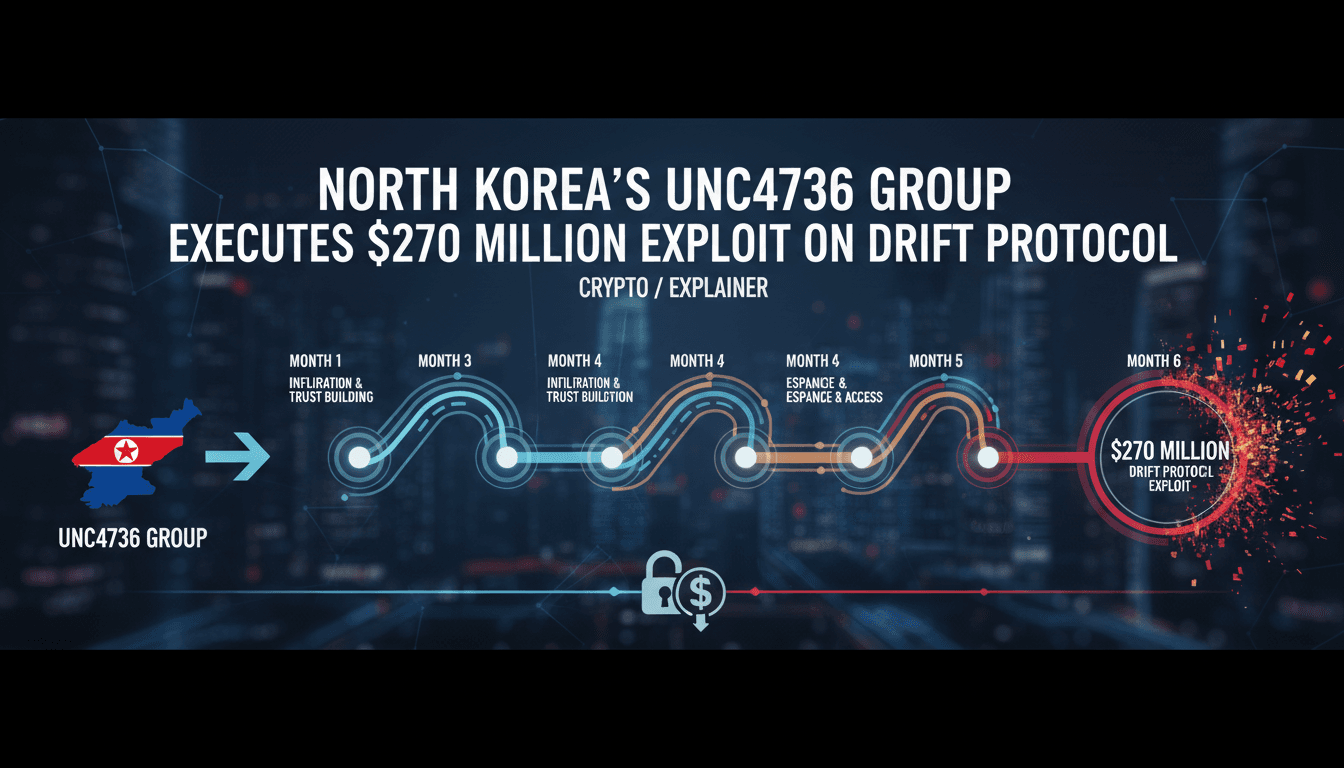
- North Korea's UNC4736 group executed a six-month espionage operation, culminating in a $270 million exploit on April 1, 2026.
- Operatives posed as quantitative traders, building trust through various channels before compromising contributor devices to secure multisig approvals.
- The incident exposed systemic vulnerabilities in human-centric security models within decentralized finance, leading to industry-wide operational pauses and security enhancements.
The context you actually need
- North Korea's hacking groups, including UNC4736, have stolen over $6.75 billion in cryptocurrency since 2025 to fund regime activities and circumvent sanctions.
- Prior tactics included fake job applications and remote IT schemes, but the Drift operation escalated to prolonged social infiltration at industry conferences.
- The exploit's execution involved sophisticated techniques, including malicious apps and device vulnerabilities, demonstrating a shift towards more complex cyber espionage strategies.
What's really happening
The UNC4736 operation against Drift Protocol represents a significant evolution in state-sponsored cyber espionage, particularly in the cryptocurrency sector. By posing as a legitimate quantitative trading firm, the attackers effectively infiltrated a trusted environment, leveraging social engineering to build relationships with key contributors. This six-month operation was meticulously planned, involving multiple touchpoints, including in-person meetings at cryptocurrency conferences, which allowed the operatives to establish credibility and trust.
The attackers integrated into the Drift ecosystem by depositing over $1 million, which not only facilitated their acceptance but also provided them with insights into the operational mechanics of the protocol. This level of infiltration is indicative of a broader trend in cyber attacks, where human factors are increasingly exploited over traditional technical vulnerabilities. The use of a malicious TestFlight app and vulnerabilities in widely used software like VSCode and Cursor to compromise devices for multisig approvals marks a shift towards more sophisticated methods of attack.
The $270 million exploit executed on April 1, 2026, through a durable nonce attack, showcases the potential for significant financial loss in decentralized finance due to human-centric vulnerabilities. Following the exploit, Drift Protocol paused operations and engaged forensic experts to assess the breach. The incident prompted industry leaders to advocate for a reclassification of such events as intelligence operations, emphasizing the need for enhanced threat modeling and operational security training.
In response, the Solana Foundation announced the Stride evaluation program and the Solana Incident Response Network (SIRN), aimed at bolstering security for protocols with substantial total value locked (TVL). This incident serves as a wake-up call for the entire decentralized finance ecosystem, highlighting the necessity for improved security measures that prioritize human factors alongside technical safeguards.
Who feels it first (and how)
- Cryptocurrency exchanges and protocols: Increased scrutiny and potential operational pauses to reassess security measures.
- Investors and contributors: Heightened awareness of security risks, leading to potential shifts in investment strategies.
- Cybersecurity firms: Increased demand for forensic and security enhancement services in the wake of the exploit.
What to watch next
- Security protocol enhancements: Watch for new industry standards and practices emerging as a direct response to this exploit, which could reshape operational security in decentralized finance.
- Regulatory responses: Monitor how regulators may react to increased cyber threats in the cryptocurrency space, potentially leading to new compliance requirements.
- Future espionage tactics: Keep an eye on evolving strategies employed by state-sponsored groups, as they adapt to industry defenses and exploit new vulnerabilities.
The exploit resulted in a $270 million loss for Drift Protocol.
Industry-wide security enhancements will be implemented in response to this incident.
The long-term impacts on investor confidence in decentralized finance remain uncertain.
Frequently Asked Questions
- Why it matters?
- This exploit highlights vulnerabilities in decentralized finance, prompting a reevaluation of security practices across the industry.
- What happened (in 30 seconds)?
- North Korea's UNC4736 group executed a six-month espionage operation, culminating in a $270 million exploit on April 1, 2026. Operatives posed as quantitative traders, building trust through various channels before compromising contributor devices to secure multisig approvals. The incident exposed systemic vulnerabilities in human-centric security models within decentralized finance, leading to industry-wide operational pauses and security enhancements.
- What's really happening?
- The UNC4736 operation against Drift Protocol represents a significant evolution in state-sponsored cyber espionage, particularly in the cryptocurrency sector. By posing as a legitimate quantitative trading firm, the attackers effectively infiltrated a trusted environment, leveraging social engineering to build relationships with key contributors. This six-month operation was meticulously planned, involving multiple touchpoints, including in-person meetings at cryptocurrency conferences, which al
- Who feels it first (and how)?
- Cryptocurrency exchanges and protocols: Increased scrutiny and potential operational pauses to reassess security measures. Investors and contributors: Heightened awareness of security risks, leading to potential shifts in investment strategies. Cybersecurity firms: Increased demand for forensic and security enhancement services in the wake of the exploit.
- What to watch next?
- Security protocol enhancements: Watch for new industry standards and practices emerging as a direct response to this exploit, which could reshape operational security in decentralized finance. Regulatory responses: Monitor how regulators may react to increased cyber threats in the cryptocurrency space, potentially leading to new compliance requirements. Future espionage tactics: Keep an eye on evolving strategies employed by state-sponsored groups, as they adapt to industry defenses and expl
Covers blockchain, cryptocurrency news, project analysis, and market insights.
"CoinDesk is a well-established cryptocurrency and blockchain news provider, offering comprehensive insights, market data, and industry research."
— A47 Editor
How North Korea's 6-month long secret espionage program has crypto community rethinking security
The Drift Protocol, a decentralized finance platform, recently experienced a significant exploit resulting in the loss of approximately $270 million, attributed to a six-month intelligence operation by North Korean hackers who infiltrated the organiz...
Bitcoin news, technical analysis, and forecasts across crypto markets.
"NewsBTC covers Bitcoin news, technical analysis, and forecasts across crypto markets and major blockchain projects."
— A47 Editor
Crypto Trust Crisis — The “Kim Jong‑Un Test” Is Exposing Secret North Korean Moles
The cryptocurrency sector is facing a trust crisis as North Korean-linked hackers have been implicated in a significant exploit of the Drift Protocol, resulting in losses estimated at $285 million. Developers are now implementing a so-called 'Kim Jon...
News and analysis on Bitcoin, altcoins, and blockchain innovation.
"Bitcoinist delivers news and analysis on Bitcoin, altcoins, and blockchain innovation with a focus on market trends and industry updates."
— A47 Editor
North Korean Agents Have Been Inside DeFi For Nearly A Decade, Researcher Says
A recent exploit against Drift Protocol resulted in the loss of approximately $280 million, attributed to North Korean agents who have been infiltrating decentralized finance (DeFi) platforms for nearly a decade. This incident highlights a significan...