
Mexico's Inflation Rises to 4.63% Prompting Central Bank Rate Cut
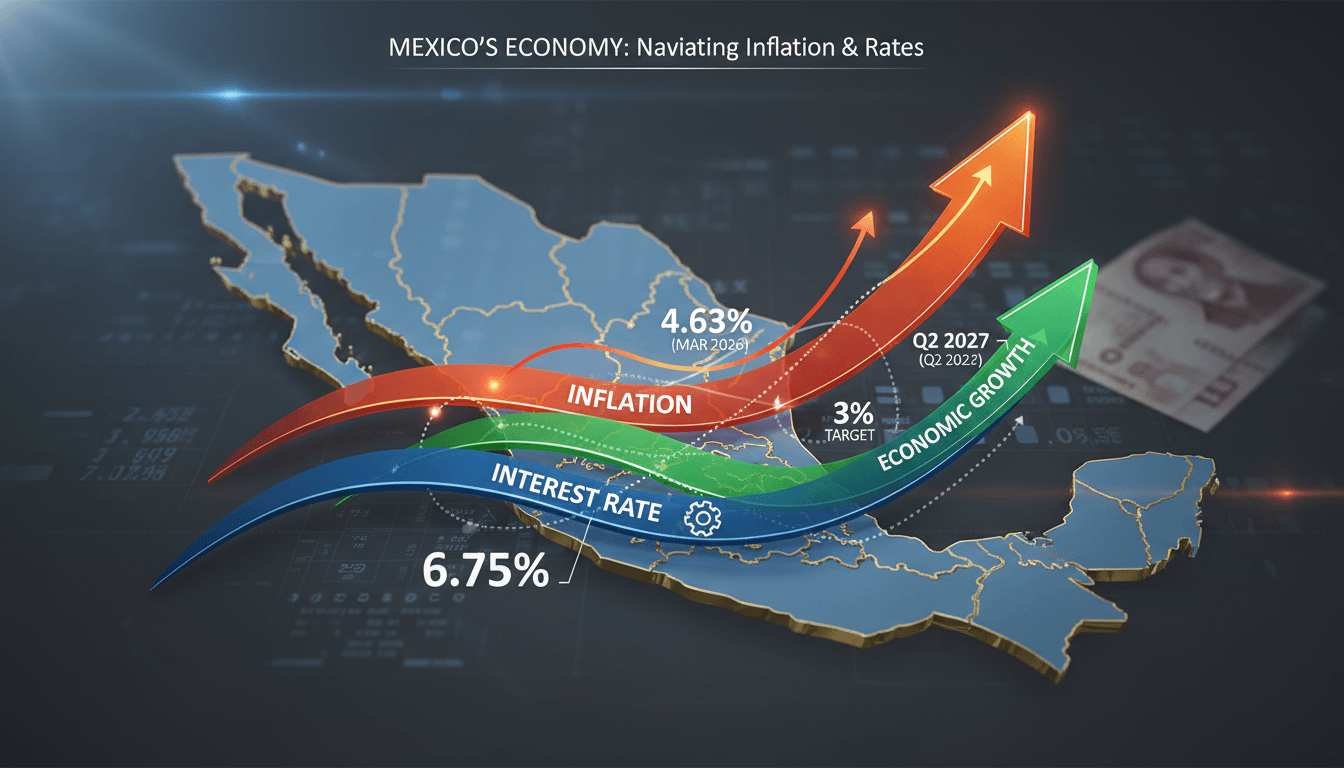
Here's what it means for you.
If you’re involved in international trade or investment, the recent shifts in Mexico's monetary policy could impact your financial strategies.
Why it matters
This inflation increase and subsequent rate cut signal potential volatility in emerging markets, affecting investment decisions globally.
What happened (in 30 seconds)
- Inflation surged: Mexico's annual headline inflation rose to 4.63% in early March 2026, driven by rising food and energy prices.
- Rate cut decision: The Bank of México (Banxico) voted 3-2 to lower the benchmark interest rate to 6.75% amid inflationary pressures.
- Revised forecasts: Inflation forecasts were adjusted upward, with convergence to the target now delayed until Q2 2027.
The context you actually need
- Post-pandemic recovery: Mexico had been experiencing a gradual decline in inflation following a peak of 11%, supported by previous rate cuts.
- Non-core pressures: The recent inflation spike is largely attributed to volatile non-core components, particularly food and energy, exacerbated by global commodity disruptions.
- Internal debates: The split vote within Banxico reflects ongoing debates about the best approach to manage inflation while supporting economic growth.
What's really happening
The latest data from the National Institute of Statistics and Geography (INEGI) revealed that Mexico's annual headline inflation reached 4.63% in the first half of March 2026, a significant increase from 3.77% in January. This rise is primarily driven by non-core components, such as food and energy prices, which have been volatile due to geopolitical tensions affecting global commodity markets. The Bank of México (Banxico) responded to this inflationary pressure with a split decision to lower the benchmark overnight interbank interest rate by 25 basis points to 6.75%. This decision was made by a narrow 3-2 majority, indicating a division among board members regarding the best course of action.
The upward revision of inflation forecasts—now projected at 4.1% for Q1 2026 and 4.0% for Q2—highlights the challenges Banxico faces in achieving its target inflation rate of 3% (with a ±1% tolerance band). The delay in reaching this target until Q2 2027 raises concerns about the potential for sustained inflationary pressures, particularly as core inflation has remained above 4% for 11 consecutive months.
The decision to cut rates, despite rising inflation, reflects a balancing act between stimulating economic growth and controlling inflation. Banxico's Governor, Victoria Rodríguez Ceja, emphasized that the easing cycle is nearing completion, suggesting that future rate cuts may be limited. The market reacted with surprise to the rate cut, as many analysts had anticipated a more cautious approach given the inflationary environment.
As inflation pressures continue, the implications for consumers and businesses are significant. Higher inflation can erode purchasing power, particularly for lower-income households that spend a larger portion of their income on essential goods. Additionally, businesses may face increased costs, which could lead to higher prices for consumers. The overall economic landscape is becoming increasingly complex, with geopolitical risks and commodity price fluctuations adding layers of uncertainty.
Who feels it first (and how)
- Consumers: Households, especially those in lower income brackets, will feel the impact of rising prices on essential goods.
- Businesses: Companies reliant on food and energy inputs may face increased operational costs, affecting pricing strategies.
- Investors: Those with exposure to Mexican markets or commodities may need to reassess risk and return profiles in light of changing economic conditions.
What to watch next
- Inflation trends: Monitor monthly inflation data to see if the upward trend continues or stabilizes, which will influence future monetary policy.
- Banxico's policy signals: Pay attention to Banxico's communications for indications of future rate adjustments and their rationale, particularly in light of inflation forecasts.
- Global commodity prices: Fluctuations in global commodity prices, especially related to food and energy, will be critical in assessing ongoing inflationary pressures.
The inflation rate has increased to 4.63%, driven by non-core components.
Banxico will continue to face pressure to balance rate cuts with inflation control, impacting future monetary policy decisions.
The long-term effects of geopolitical tensions on commodity prices and inflation in Mexico remain uncertain.
Frequently Asked Questions
- Why it matters?
- This inflation increase and subsequent rate cut signal potential volatility in emerging markets, affecting investment decisions globally.
- What happened (in 30 seconds)?
- Inflation surged: Mexico's annual headline inflation rose to 4.63% in early March 2026, driven by rising food and energy prices. Rate cut decision: The Bank of México (Banxico) voted 3-2 to lower the benchmark interest rate to 6.75% amid inflationary pressures. Revised forecasts: Inflation forecasts were adjusted upward, with convergence to the target now delayed until Q2 2027.
- What's really happening?
- The latest data from the National Institute of Statistics and Geography (INEGI) revealed that Mexico's annual headline inflation reached 4.63% in the first half of March 2026, a significant increase from 3.77% in January. This rise is primarily driven by non-core components, such as food and energy prices, which have been volatile due to geopolitical tensions affecting global commodity markets. The Bank of México (Banxico) responded to this inflationary pressure with a split decision to lower th
- Who feels it first (and how)?
- Consumers: Households, especially those in lower income brackets, will feel the impact of rising prices on essential goods. Businesses: Companies reliant on food and energy inputs may face increased operational costs, affecting pricing strategies. Investors: Those with exposure to Mexican markets or commodities may need to reassess risk and return profiles in light of changing economic conditions.
- What to watch next?
- Inflation trends: Monitor monthly inflation data to see if the upward trend continues or stabilizes, which will influence future monetary policy. Banxico's policy signals: Pay attention to Banxico's communications for indications of future rate adjustments and their rationale, particularly in light of inflation forecasts. Global commodity prices: Fluctuations in global commodity prices, especially related to food and energy, will be critical in assessing ongoing inflationary pressures.
Macro commentary, policy analysis, growth/inflation themes, and global outlooks.
"Contextual macro coverage that complements day-to-day market headlines."
— A47 Editor
Mexico inflation spikes in March, fueling debate within divided central bank
Inflation in Mexico spiked in March, prompting discussions within the divided central bank regarding monetary policy responses. This increase in inflation comes on the heels of a previous rise to 4% in February, which had already exceeded market fore...
Global markets, investing, and macroeconomics from a premier financial newsroom.
"Bloomberg is respected for in-depth financial reporting and data-driven analysis."
— A47 Editor
Banxico’s Dissenters Warn of Price Pressures Amid Iran War
Mexico's central bank, Banxico, faced dissent from two board members regarding its recent decision to cut interest rates, citing ongoing inflationary pressures stemming from the war in Iran. This dissent highlights concerns over the economic implicat...