
Final Oil Tankers Reach Asian Refineries Amid Strait of Hormuz Crisis
Here's what it means for you.
Rising oil prices and potential fuel shortages could significantly impact your daily expenses and business operations.
Why it matters
The Strait of Hormuz is a critical chokepoint for global oil supply, and its disruption can lead to widespread economic ramifications.
What happened (in 30 seconds)
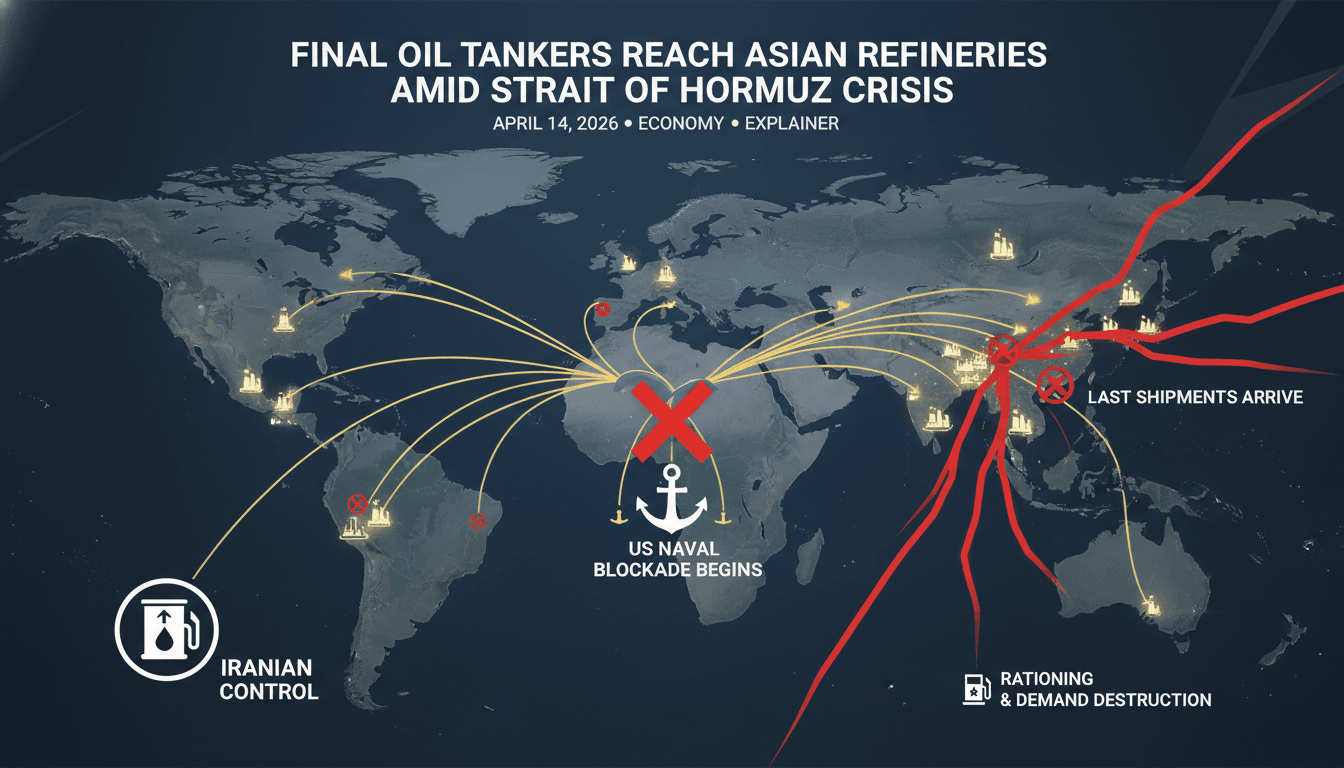
- On April 14, 2026, the last oil tankers reached Asian refineries before US restrictions intensified, marking a critical point in the ongoing oil supply crisis.
- Iran's control over the Strait of Hormuz since February 28, 2026, has severely limited tanker traffic, stranding Gulf oil exports and escalating global shortages.
- The US naval blockade, initiated on April 13, 2026, aims to enforce restrictions on Iranian-controlled traffic, halting further oil outflows.
The context you actually need
- The crisis began with the 2026 Iran war, which started on February 28, 2026, following US-Israeli airstrikes targeting Iranian nuclear sites.
- Iran retaliated by closing the Strait of Hormuz, a vital route for 20% of the world's oil trade, leading to significant disruptions in tanker traffic.
- As of April 14, 2026, oil prices have surged, with Brent exceeding $116 per barrel and Dubai crude nearing $170, prompting Asian refiners to declare force majeure.
What's really happening
The 2026 Strait of Hormuz crisis is rooted in a complex interplay of geopolitical tensions and economic dependencies. The conflict began with US-Israeli airstrikes under Operation Epic Fury, targeting Iranian nuclear facilities and leadership. In retaliation, Iran's Islamic Revolutionary Guard Corps (IRGC) effectively closed the Strait of Hormuz, a critical maritime route for oil transport, through a series of aggressive tactics, including drone strikes and naval mines. This closure has resulted in a staggering 11.1 million barrels per day shortfall in global oil supply, as reported by Bloomberg.
The situation escalated further when a conditional ceasefire on April 8 failed to restore normal traffic, leading to the US announcing a naval blockade on April 13. This blockade aims to intercept Iranian-controlled oil tankers, effectively halting any further oil exports from the Gulf region. The final prewar cargoes reached Asian refineries on April 14, 2026, marking the end of a critical supply buffer and intensifying the global oil supply crunch.
As a result, oil prices have skyrocketed, with Brent crude surpassing $116 per barrel and Dubai crude nearing $170. Asian refiners are now declaring force majeure, cutting back on production runs, and the International Energy Agency (IEA) is coordinating the release of 400 million barrels from strategic reserves to mitigate the impact. OPEC+ has pledged to increase production by 206,000 barrels per day once the situation stabilizes, but the immediate outlook remains grim.
The UAE and Saudi Arabia are attempting to divert oil through alternative pipelines, but attacks on UAE ports and regional strikes have heightened the risks of further supply disruptions. The economic implications are profound, with warnings of spreading shortages to Europe and the US prompting discussions around rationing and demand destruction measures.
Who feels it first (and how)
- Consumers: Higher fuel prices will directly impact daily commuting and transportation costs.
- Businesses: Industries reliant on oil, such as logistics and manufacturing, will face increased operational costs.
- Asian refiners: Declaring force majeure, they will reduce production, affecting supply chains and pricing.
- Governments: Increased inflation and potential public unrest due to rising energy costs may lead to policy shifts.
What to watch next
- Oil price trends: Monitor fluctuations in Brent and Dubai crude prices, as they will indicate the severity of the supply crunch.
- US military actions: Any escalation or de-escalation in US naval operations in the region could significantly impact oil flow and prices.
- OPEC+ responses: Watch for announcements regarding production increases or strategic reserve releases, which will influence market stability.
The Strait of Hormuz remains a critical chokepoint for global oil supply, and its closure has led to significant price increases.
Continued volatility in oil prices and potential shortages in various regions, particularly Asia and Europe.
The duration of the conflict and its long-term impact on global energy markets and geopolitical stability.
This article was generated by AI from 9 verified sources and reviewed by A47 editorial systems.
Editor-curated FT homepage stories spanning markets, business, world, and opinion.
"The Financial Times is a globally respected business publication with a centrist/center-left tone and strong markets focus."
— A47 Editor
Oil supply crunch intensifies as last Hormuz tankers reach refineries
The last oil tankers from the Strait of Hormuz are set to reach refineries, marking a critical moment as global demand for oil intensifies amid escalating geopolitical tensions. This situation follows the U.S. announcement of a blockade, which has le...
Pan-Arab news coverage spanning politics, business, sports, and regional affairs.
"Asharq Al-Awsat reflects a broad Arab editorial perspective with strong attention to regional geopolitics."
— A47 Editor
ناقلتان مرتبطتان بإيران تغادران عبر مضيق هرمز قبل الحصار
Two oil tankers linked to Iran departed the Gulf through the Strait of Hormuz on Monday, as indicated by shipping data from Kepler and LSEG, just before the imposition of U.S. sanctions.
Corporate news, economic trends, and markets with UK and global scope.
"BBC News is widely regarded as reputable and impartial, with a public service mandate."
— A47 Editor
How many ships are crossing the Strait of Hormuz?
Four vessels have crossed the Strait of Hormuz ahead of a US military blockade of Iranian ports set to begin on Monday, highlighting the ongoing maritime tensions in the region.
Pan-Arab news coverage spanning politics, business, sports, and regional affairs.
"Asharq Al-Awsat reflects a broad Arab editorial perspective with strong attention to regional geopolitics."
— A47 Editor
ناقلات نفط غادرت الخليج عبر مضيق هرمز مع بدء المحادثات بين أميركا وإيران
On Saturday, three fully loaded oil tankers crossed the Strait of Hormuz, marking what appears to be the first departure of ships from the Gulf since the ceasefire agreement. This movement comes amid ongoing discussions between the United States and ...
Global markets, investing, and macroeconomics from a premier financial newsroom.
"Bloomberg is respected for in-depth financial reporting and data-driven analysis."
— A47 Editor
Two Supertankers U-Turn in Hormuz as US-Iran Talks Break Down
Two empty supertankers attempted to navigate the Strait of Hormuz on Sunday but made a last-minute U-turn as peace negotiations between the US and Iran collapsed, jeopardizing a fragile ceasefire. This incident underscores the heightened tensions in ...
Global news coverage with extensive reporting on Middle Eastern conflicts and geopolitics.
"Al Jazeera is a Qatar-based broadcaster known for wide regional coverage and alternative perspectives."
— A47 Editor
Oil tankers exit Strait of Hormuz amid fragile US-Iran ceasefire
Three supertankers laden with oil have exited the Strait of Hormuz, a vital maritime route, amid a fragile ceasefire between the United States and Iran. This development comes as shipping data indicates a significant increase in tanker traffic throug...
Comprehensive coverage of Middle Eastern and global issues.
"Al Jazeera is a prominent voice from the Global South, especially the Middle East, with an emphasis on underreported stories."
— A47 Editor
Oil tankers exit Strait of Hormuz amid fragile US-Iran ceasefire
Three supertankers laden with oil have exited the Strait of Hormuz, a vital maritime route, amid a fragile ceasefire between the United States and Iran. This development comes as shipping data indicates a significant increase in tanker traffic throug...
Corporate leadership, finance, technology, and market trends.
"Fortune covers financial trends, leadership, and innovation with a pragmatic editorial approach."
— A47 Editor
Three oil supertankers sail through the Strait of Hormuz
Three oil supertankers successfully navigated the Strait of Hormuz, marking the largest volume of oil exits through this critical waterway since regional conflicts significantly disrupted shipping traffic six weeks ago. This development indicates a p...
Global business headlines with AI angles.
"General business outlet that frequently covers AI."
— A47 Editor
Strait of Hormuz Traffic Remains Near Standstill Despite US-Iran Ceasefire as Iran Limits Access
Shipping traffic through the Strait of Hormuz remains severely restricted as Iran continues to control access, limiting transits to a maximum of twelve vessels per day and imposing fees, despite a fragile ceasefire with the U.S. that began over three...
Global markets, investing, and macroeconomics from a premier financial newsroom.
"Bloomberg is respected for in-depth financial reporting and data-driven analysis."
— A47 Editor
Three Oil Supertankers Sail Through the Strait of Hormuz
Two Chinese supertankers loaded with crude oil successfully navigated the Strait of Hormuz shortly after a Greek vessel passed through, indicating a notable increase in oil shipping traffic following a fragile ceasefire between the U.S. and Iran.
International coverage of politics, culture, and current affairs.
"BBC News is widely regarded as a reputable international news organization, known for its impartial tone and public service mandate."
— A47 Editor
Ships remain cautious approaching Strait of Hormuz amid fragile ceasefire
Following a recent ceasefire agreement between the United States and Iran, only a limited number of vessels have cautiously navigated the Strait of Hormuz, a critical maritime route. This analysis by BBC Verify highlights the ongoing hesitance among ...