
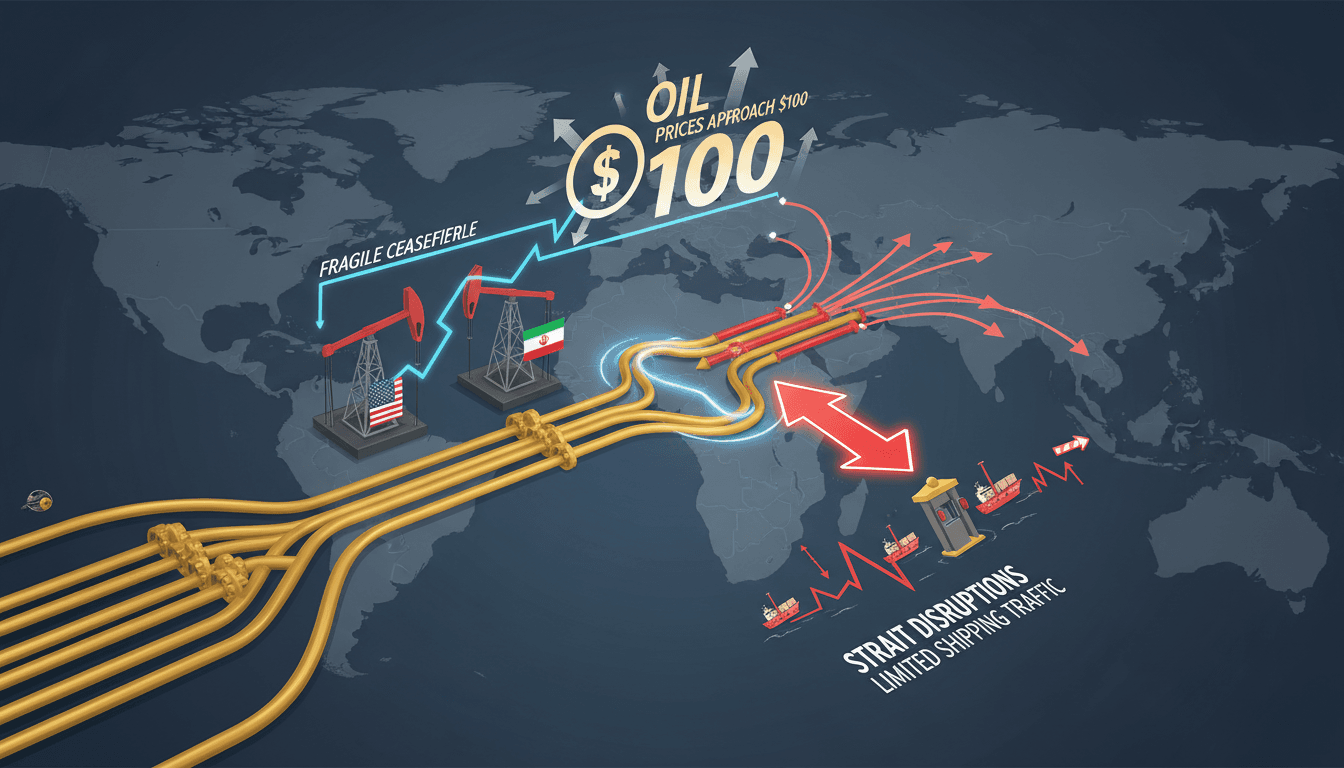
Oil Prices Approach $100 per Barrel Amid US-Iran Ceasefire and Strait of Hormuz Disruptions
Here's what it means for you.
Rising oil prices could inflate your commuting costs and impact global markets.
Why it matters
The surge in oil prices signals potential instability in global energy markets, affecting everything from transportation costs to inflation rates.
What happened (in 30 seconds)
- Oil prices spiked near $100 per barrel on April 9, 2026, amid a fragile US-Iran ceasefire.
- Shipping traffic in the Strait of Hormuz remains severely restricted, with Iranian-imposed tolls exceeding $1 million per vessel.
- Global traders are assessing the sustainability of the ceasefire against ongoing supply risks.
The context you actually need
- The Strait of Hormuz is a critical chokepoint for global oil trade, with approximately 20% of seaborne oil passing through daily.
- Tensions escalated after US-Israeli airstrikes killed Iran's Supreme Leader, leading to retaliatory actions and significant disruptions in oil supply.
- Despite a ceasefire, implementation challenges and ongoing disputes over tolls and violations have left the strait partially closed.
What's really happening
The recent spike in oil prices is rooted in a complex interplay of geopolitical tensions and supply chain disruptions. The crisis began on February 28, 2026, when US-Israeli airstrikes targeted Iran, resulting in the death of Supreme Leader Ali Khamenei. This act escalated tensions, prompting Iran to retaliate with missile attacks and impose restrictions on the Strait of Hormuz, a vital artery for global oil transport. By March 1, Iran's Islamic Revolutionary Guard Corps (IRGC) had confirmed the closure of the strait, leading to a dramatic drop in shipping traffic—by as much as 100% for certain vessels.
The situation worsened as ongoing attacks on merchant vessels resulted in significant casualties and damage, further complicating the logistics of oil transport. With approximately 20% of the world's seaborne oil trade transiting through the strait, the implications of these disruptions were immediate and severe. Oil prices surged, with Brent crude reaching a peak of $126 per barrel and Dubai crude hitting a record $166 on March 19, 2026. Gulf producers, facing the fallout, cut output by over 10 million barrels per day, and several companies declared force majeure, halting operations.
On April 8, a fragile two-week ceasefire was announced, theoretically allowing for the reopening of the strait. However, doubts emerged almost immediately as Abu Dhabi officials declared the strait "not open," citing security concerns and Iranian-imposed tolls that could reach up to $2 million per vessel. This has led to a limited number of vessels being allowed to transit—approximately 15 per day—further constraining supply and pushing prices back toward the $100 mark.
The market's reaction has been cautious, with stock indices reflecting uncertainty. The S&P 500 and Nasdaq both dipped slightly, while energy executives, including ADNOC's CEO Sultan Al Jaber, have called for the unconditional reopening of the strait to ensure energy security. Meanwhile, US President Trump has insisted on full compliance with the ceasefire terms, warning of escalated actions should violations occur. Iran has also issued warnings of retaliation against any breaches, adding to the volatility of the situation.
Who feels it first (and how)
- Commuters in the UAE: Increased fuel prices have surged up to 33.3%, impacting monthly budgets significantly.
- Businesses reliant on logistics: Companies face inflated operational costs due to surcharges and increased fuel prices, affecting profit margins.
- Global consumers: Rising oil prices typically lead to higher costs for goods and services, contributing to inflationary pressures.
What to watch next
- Ceasefire durability: Monitoring the US-Iran ceasefire's effectiveness will be crucial; any violations could lead to renewed conflict and further price spikes.
- Shipping traffic levels: Changes in the number of vessels allowed through the Strait of Hormuz will directly impact oil supply and pricing.
- Market reactions: Watch for fluctuations in stock markets and energy indices as traders respond to geopolitical developments and oil price changes.
Oil prices are currently near $100 per barrel due to geopolitical tensions and supply disruptions.
Continued volatility in oil prices as the situation in the Strait of Hormuz evolves.
The long-term sustainability of the ceasefire and its impact on global oil supply.
Frequently Asked Questions
- Why it matters?
- The surge in oil prices signals potential instability in global energy markets, affecting everything from transportation costs to inflation rates.
- What happened (in 30 seconds)?
- Oil prices spiked near $100 per barrel on April 9, 2026, amid a fragile US-Iran ceasefire. Shipping traffic in the Strait of Hormuz remains severely restricted, with Iranian-imposed tolls exceeding $1 million per vessel. Global traders are assessing the sustainability of the ceasefire against ongoing supply risks.
- What's really happening?
- The recent spike in oil prices is rooted in a complex interplay of geopolitical tensions and supply chain disruptions. The crisis began on February 28, 2026, when US-Israeli airstrikes targeted Iran, resulting in the death of Supreme Leader Ali Khamenei. This act escalated tensions, prompting Iran to retaliate with missile attacks and impose restrictions on the Strait of Hormuz, a vital artery for global oil transport. By March 1, Iran's Islamic Revolutionary Guard Corps (IRGC) had confirmed the
- Who feels it first (and how)?
- Commuters in the UAE: Increased fuel prices have surged up to 33.3%, impacting monthly budgets significantly. Businesses reliant on logistics: Companies face inflated operational costs due to surcharges and increased fuel prices, affecting profit margins. Global consumers: Rising oil prices typically lead to higher costs for goods and services, contributing to inflationary pressures.
- What to watch next?
- Ceasefire durability: Monitoring the US-Iran ceasefire's effectiveness will be crucial; any violations could lead to renewed conflict and further price spikes. Shipping traffic levels: Changes in the number of vessels allowed through the Strait of Hormuz will directly impact oil supply and pricing. Market reactions: Watch for fluctuations in stock markets and energy indices as traders respond to geopolitical developments and oil price changes.
Markets desk coverage, trading insights, and investor updates.
"WSJ’s markets reporting provides in-depth analysis and context for investors."
— A47 Editor
Crude Futures End Volatile Session Higher
Oil futures ended a volatile trading session higher, buoyed by a fragile truce between the U.S. and Iran, despite ongoing tensions that threaten the stability of the Strait of Hormuz. Israel's decision to engage in negotiations with Lebanon has somew...
Global business headlines with AI angles.
"General business outlet that frequently covers AI."
— A47 Editor
Oil Prices Spike Amid Ceasefire Hopes And Strait Of Hormuz Bottlenecks
Oil prices have recently spiked amid renewed hopes for a ceasefire in the Middle East, although initial optimism faded as doubts about the agreement's durability emerged. Prices had dipped below $95 before rebounding, reflecting market volatility inf...
Global markets, investing, and macroeconomics from a premier financial newsroom.
"Bloomberg is respected for in-depth financial reporting and data-driven analysis."
— A47 Editor
Oil Markets Reality vs Expectations
Oil markets are currently experiencing volatility as disruptions in the Strait of Hormuz continue to impact global supply. Despite a recent ceasefire agreement between the U.S. and Iran, physical oil prices remain elevated while futures have declined...