
Study Reveals Microgravity Impairs Mammalian Sperm Function and Fertilization Rates
Here's what it means for you.
The challenges of reproduction in space could impact future workforce planning and family dynamics for those involved in long-term space missions.
Why it matters
This research raises critical questions about the feasibility of human reproduction during extended space missions, impacting future colonization efforts.
What happened (in 30 seconds)
- On March 26, 2026, a study published by researchers at the University of Adelaide revealed that simulated microgravity impairs sperm navigation and fertilization rates.
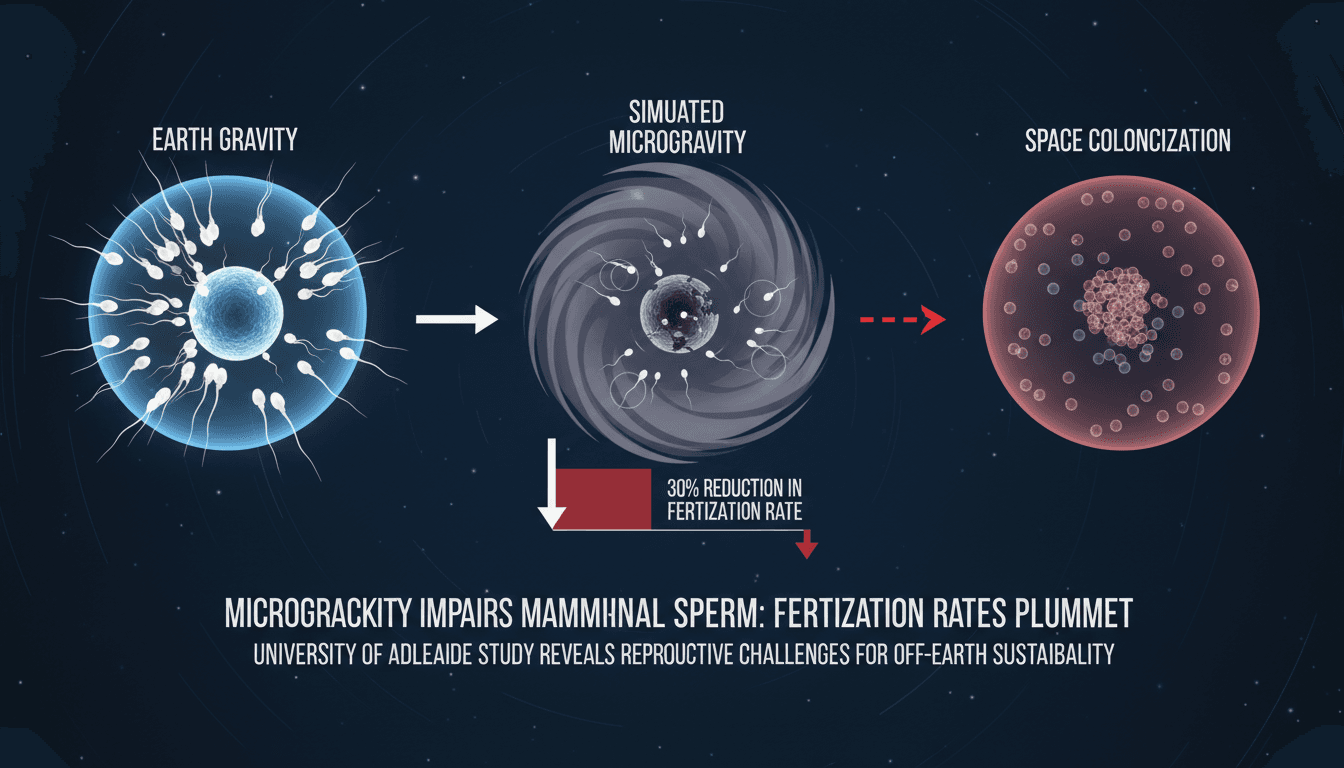
- Mice exposed to 4 hours of microgravity showed a 30% reduction in successful fertilization rates, with significant implications for embryo development.
- Progesterone treatment was found to partially restore human sperm guidance, indicating potential strategies for mitigating these effects.
The context you actually need
- Prior research has documented various physiological challenges astronauts face, including bone density loss and muscle atrophy, but reproductive health has received limited attention.
- As space agencies ramp up plans for long-term missions to Mars and beyond, understanding reproductive viability in microgravity is essential for sustainable human presence off Earth.
- This study fills a critical gap in knowledge regarding how microgravity affects gamete function and early embryogenesis, which is vital for future space colonization.
What's really happening
Researchers led by Nicole O. McPherson utilized a dual-axis 3D clinostat to simulate microgravity conditions (<0.1 g) while conducting in vitro fertilization (IVF) experiments. The findings indicated that human sperm exposed to microgravity for 2-4 hours exhibited impaired navigation through microchannels designed to mimic the female reproductive tract, with statistical significance (P=0.002-0.007) noted. Notably, there was no loss of sperm motility, suggesting that the navigation impairment was not due to a decrease in sperm activity but rather an inability to effectively reach the egg.
In mouse IVF experiments, exposure to microgravity for 4 hours resulted in a 30% reduction in fertilization rates (P=0.03, N=82-156 embryos). Furthermore, embryos that did manage to develop showed an increase in epiblast cells but also exhibited developmental anomalies after 24 hours. Similar experiments with pig gametes under 6-hour exposure revealed reduced fertilization and blastocyst rates (P=0.005-0.01, N=198-203), with altered cell lineage ratios, indicating that the effects of microgravity are not limited to one species.
Interestingly, the study also found that administering progesterone (100 µM) partially restored the guidance of human sperm in microgravity conditions, suggesting that hormonal interventions could be a viable strategy for mitigating the negative impacts of microgravity on reproduction. This finding opens the door to further research into optimized peri-conception protocols that could support human reproduction in space.
As space agencies like NASA, SpaceX, and others push forward with ambitious plans for Mars colonization and lunar bases, this research highlights a critical barrier that must be addressed. The implications extend beyond individual health; they touch on the viability of human communities in space, the planning of future missions, and the overall sustainability of life beyond Earth.
Who feels it first (and how)
- Space agencies: Need to incorporate reproductive health strategies into mission planning.
- Astronauts and their families: May face challenges in family planning and reproductive health during long missions.
- Healthcare professionals: Must adapt protocols for reproductive health in space environments.
- Researchers: Will need to explore further studies on gamete function and embryo development in microgravity.
What to watch next
- Further research outcomes: Look for additional studies exploring hormonal interventions and their effectiveness in microgravity.
- Policy changes from space agencies: Monitor how agencies adapt their mission planning to include reproductive health considerations.
- Technological advancements: Watch for innovations in IVF and reproductive technologies tailored for space environments.
Microgravity negatively impacts sperm navigation and fertilization rates.
Future space missions will need to address reproductive health to ensure sustainable human presence.
The full extent of microgravity's impact on long-term embryo development and human reproduction remains to be explored.
Frequently Asked Questions
- Why it matters?
- This research raises critical questions about the feasibility of human reproduction during extended space missions, impacting future colonization efforts.
- What happened (in 30 seconds)?
- On March 26, 2026, a study published by researchers at the University of Adelaide revealed that simulated microgravity impairs sperm navigation and fertilization rates. Mice exposed to 4 hours of microgravity showed a 30% reduction in successful fertilization rates, with significant implications for embryo development. Progesterone treatment was found to partially restore human sperm guidance, indicating potential strategies for mitigating these effects.
- What's really happening?
- Researchers led by Nicole O. McPherson utilized a dual-axis 3D clinostat to simulate microgravity conditions (<0.1 g) while conducting in vitro fertilization (IVF) experiments. The findings indicated that human sperm exposed to microgravity for 2-4 hours exhibited impaired navigation through microchannels designed to mimic the female reproductive tract, with statistical significance (P=0.002-0.007) noted. Notably, there was no loss of sperm motility, suggesting that the navigation impairment was
- Who feels it first (and how)?
- Space agencies: Need to incorporate reproductive health strategies into mission planning. Astronauts and their families: May face challenges in family planning and reproductive health during long missions. Healthcare professionals: Must adapt protocols for reproductive health in space environments. Researchers: Will need to explore further studies on gamete function and embryo development in microgravity.
- What to watch next?
- Further research outcomes: Look for additional studies exploring hormonal interventions and their effectiveness in microgravity. Policy changes from space agencies: Monitor how agencies adapt their mission planning to include reproductive health considerations. Technological advancements: Watch for innovations in IVF and reproductive technologies tailored for space environments.
Scientific discoveries, health, technology, and natural phenomena.
"Live Science reports on scientific discoveries, health, technology, and natural phenomena with a popular science tone."
— A47 Editor
Astronauts may struggle to reproduce in outer space, study suggests — what does that mean for the future of space colonization?
A new study indicates that microgravity conditions, simulated on Earth, negatively affect sperm cell movement, egg fertilization, and embryo development, raising concerns about reproductive capabilities for astronauts in space.
Science and technology stories including AI.
"Longstanding science magazine with thoughtful AI coverage."
— A47 Editor
Human sperm get lost in space, pioneering study finds
A recent study conducted by researchers revealed that human sperm placed in a uterus-like simulation under microgravity conditions did not perform as expected, indicating significant challenges for reproductive health in space environments.
Scientific research, technology, environment, and society.
"Scientific American is one of the oldest and most authoritative science magazines, known for deep dives into science, technology, and society."
— A47 Editor
Human sperm get lost in space, pioneering study finds
A recent study conducted by researchers revealed that human sperm placed in a uterus-like simulation under microgravity conditions did not perform as expected, indicating significant challenges for reproductive health in space environments.
News in science and technology, with a focus on consumer and innovation stories.
"Popular Science simplifies complex scientific topics for general audiences and celebrates innovation."
— A47 Editor
Sperm loses its sense of direction in space
Recent research indicates that sperm lose their sense of direction in microgravity environments, complicating the potential for fertilization in space. This study highlights the challenges of reproductive biology in extraterrestrial settings, as sper...