
NASA's Artemis II Crew Sets New Record for Farthest Human Distance from Earth
Here's what it means for you.
As humanity pushes the boundaries of space travel, advancements like Artemis II could redefine global collaboration in technology and science.
Why it matters
This milestone in human spaceflight signals a renewed commitment to lunar exploration and potential commercial opportunities in space.
What happened (in 30 seconds)
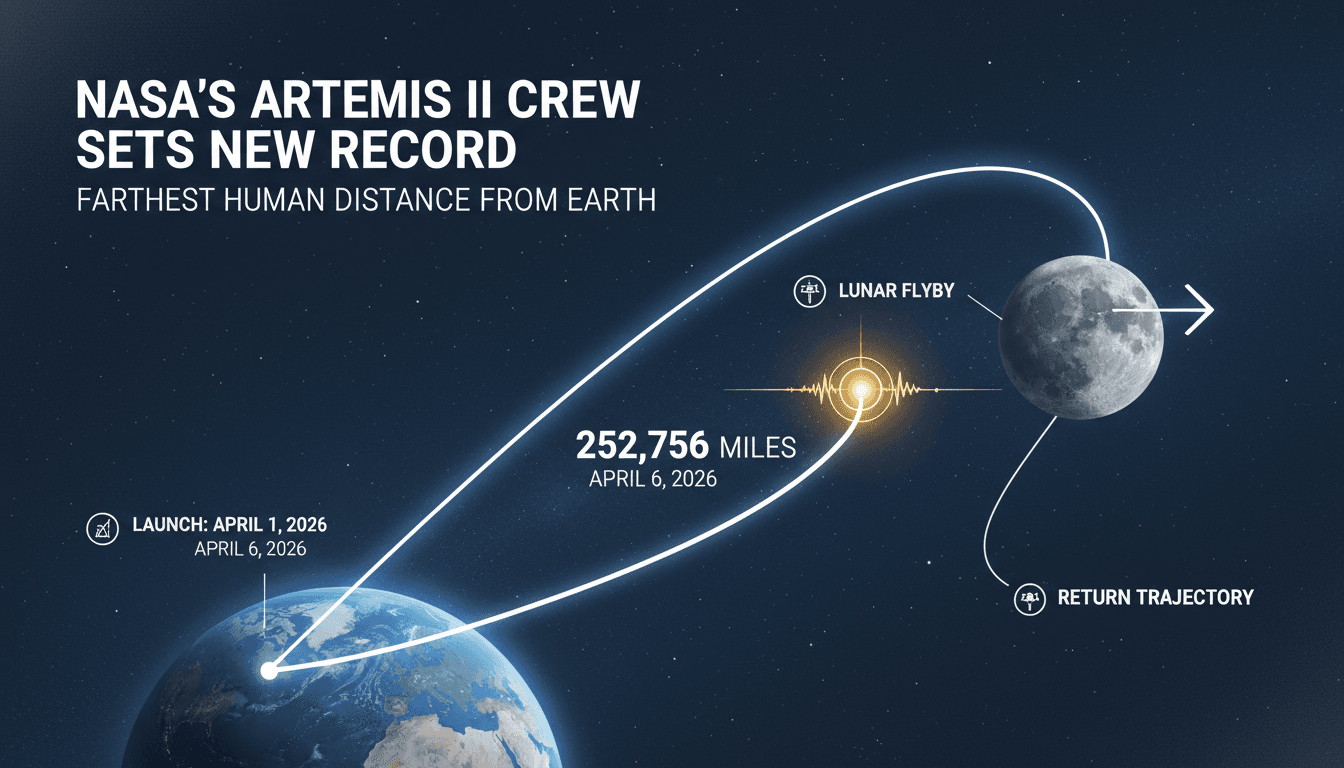
- On April 6, 2026, NASA's Artemis II crew achieved the farthest distance from Earth ever traveled by humans, reaching 252,756 miles during a lunar flyby.
- The crew, consisting of Reid Wiseman, Victor Glover, Christina Koch, and Jeremy Hansen, conducted observations of the Moon's far side aboard the Orion spacecraft Integrity.
- Following the flyby, the crew began their return trajectory to Earth, with splashdown expected on April 10, 2026.
The context you actually need
- The Artemis program, initiated by NASA, aims to establish a sustainable lunar presence and prepare for future Mars missions, following the uncrewed Artemis I mission in 2022.
- Artemis II, launched on April 1, 2026, tested human-rated systems for deep space and involved international collaboration, including Canada’s participation through astronaut Jeremy Hansen.
- The mission's emotional highlights, including naming a lunar crater after Wiseman's late wife, underscore the personal stakes and human stories behind space exploration.
What's really happening
The Artemis II mission represents a critical step in NASA's broader Artemis program, which seeks to return humans to the Moon and establish a sustainable presence there. This mission is not just about breaking records; it’s a testbed for technologies and systems that will be essential for future Mars exploration. By surpassing the Apollo 13 record, the Artemis II crew has set a new benchmark for human spaceflight, demonstrating the capabilities of the Orion spacecraft and the Space Launch System (SLS).
The mission's success is a culmination of years of research, development, and international collaboration. With astronauts conducting real-time observations of the Moon's far side, the mission has provided invaluable data that could inform future lunar landings and scientific studies. The emotional moment of naming a lunar crater after Wiseman's late wife adds a human element to the mission, reminding us that space exploration is as much about human stories as it is about technology.
The implications of this mission extend beyond the technical achievements. It signals a renewed interest in lunar exploration, which could lead to increased investment in space technologies and infrastructure. Countries around the world are watching closely, as the Artemis program could inspire similar initiatives, fostering a new era of international cooperation in space. The UAE, for instance, has already engaged with the Artemis Accords, indicating a commitment to collaborative space exploration.
Moreover, the Artemis II mission is likely to stimulate interest in commercial space ventures. As NASA prepares for future missions, private companies may find opportunities to support lunar infrastructure, research, and tourism. This could lead to a burgeoning space economy, with implications for job creation and technological innovation on Earth.
As the world witnesses these advancements, the Artemis II mission serves as a reminder of the potential for human ingenuity and collaboration in overcoming challenges. The successful execution of this mission lays the groundwork for future explorations, including potential manned missions to Mars, which could redefine humanity's place in the universe.
Who feels it first (and how)
- Aerospace engineers: Increased demand for innovative technologies and systems for deep space missions.
- Investors in space startups: Potential growth in commercial opportunities related to lunar and Martian exploration.
- Educational institutions: Rising interest in STEM fields as students are inspired by space exploration milestones.
- International space agencies: Opportunities for collaboration and shared missions, enhancing global partnerships in space.
What to watch next
- Upcoming Artemis missions: Future Artemis missions will provide insights into NASA's long-term plans for lunar and Martian exploration, shaping the landscape of human spaceflight.
- Commercial partnerships: Watch for announcements from private companies seeking to collaborate with NASA on lunar infrastructure and research, indicating the growth of the space economy.
- International responses: Monitor how other countries react to Artemis II's success, as this could lead to new partnerships or competition in space exploration.
Artemis II successfully surpassed the Apollo 13 distance record, achieving 252,756 miles from Earth.
Increased international collaboration in space exploration as countries respond to the success of Artemis II.
The full impact of Artemis II on commercial space ventures and how quickly the space economy will grow.
Frequently Asked Questions
- Why it matters?
- This milestone in human spaceflight signals a renewed commitment to lunar exploration and potential commercial opportunities in space.
- What happened (in 30 seconds)?
- On April 6, 2026, NASA's Artemis II crew achieved the farthest distance from Earth ever traveled by humans, reaching 252,756 miles during a lunar flyby. The crew, consisting of Reid Wiseman, Victor Glover, Christina Koch, and Jeremy Hansen, conducted observations of the Moon's far side aboard the Orion spacecraft Integrity. Following the flyby, the crew began their return trajectory to Earth, with splashdown expected on April 10, 2026.
- What's really happening?
- The Artemis II mission represents a critical step in NASA's broader Artemis program, which seeks to return humans to the Moon and establish a sustainable presence there. This mission is not just about breaking records; it’s a testbed for technologies and systems that will be essential for future Mars exploration. By surpassing the Apollo 13 record, the Artemis II crew has set a new benchmark for human spaceflight, demonstrating the capabilities of the Orion spacecraft and the Space Launch System
- Who feels it first (and how)?
- Aerospace engineers: Increased demand for innovative technologies and systems for deep space missions. Investors in space startups: Potential growth in commercial opportunities related to lunar and Martian exploration. Educational institutions: Rising interest in STEM fields as students are inspired by space exploration milestones. International space agencies: Opportunities for collaboration and shared missions, enhancing global partnerships in space.
- What to watch next?
- Upcoming Artemis missions: Future Artemis missions will provide insights into NASA's long-term plans for lunar and Martian exploration, shaping the landscape of human spaceflight. Commercial partnerships: Watch for announcements from private companies seeking to collaborate with NASA on lunar infrastructure and research, indicating the growth of the space economy. International responses: Monitor how other countries react to Artemis II's success, as this could lead to new partnerships or com
24/7 international news from a French perspective in multiple languages.
"France 24 is viewed as a globally focused outlet with balanced coverage and a European perspective."
— A47 Editor
'Moving moment' as Artemis II crew flies farther than humans have ever gone before
NASA's Artemis II mission achieved a historic milestone on April 6, 2026, as its crew of four astronauts flew farther from Earth than any humans before, surpassing 406,000 kilometers during a lunar flyby. This momentous event was marked by emotional ...
RT is a Russian state-funded network covering global events from a Russian perspective.
"RT is widely criticized for promoting pro-Kremlin narratives and is considered by many to be a state propaganda outlet."
— A47 Editor
Artemis II breaks record for farthest human travel from Earth
The Artemis II mission has successfully broken the record for the farthest distance humans have traveled from Earth, surpassing the Apollo 13 record during its lunar flyby. This historic achievement occurred on April 6, 2026, as the crew of four astr...
Consumer technology news with AI coverage.
"Gadget and tech site reporting on AI in products."
— A47 Editor
NASA's Artemis II crew just flew farther away from Earth than anyone ever has before
NASA's Artemis II crew has achieved a historic milestone by traveling over 250,000 miles from Earth, surpassing the previous record set by Apollo 13 by approximately 4,000 miles. The mission, which includes astronauts Reid Wiseman, Victor Glover, Chr...
Covers consumer technology, electronics, gadgets, and product reviews.
"Engadget is a trusted source for gadget reviews and consumer tech news, known for its hands-on analysis and industry coverage."
— A47 Editor
NASA's Artemis II crew just flew farther away from Earth than anyone ever has before
NASA's Artemis II crew has achieved a historic milestone by traveling over 250,000 miles from Earth, surpassing the previous record set by Apollo 13 by approximately 4,000 miles. The crew, consisting of Reid Wiseman, Victor Glover, Christina Koch, an...