
Bitcoin Mining and AI Diverge on Decentralization Trajectories
Here's what it means for you.
The evolving dynamics between Bitcoin mining and AI could reshape investment strategies and operational frameworks across tech sectors.
Why it matters
This divergence in decentralization trends could impact network security, investment viability, and operational efficiency in both Bitcoin mining and AI.
What happened (in 30 seconds)
- Alex Thorn of Galaxy Research announced a significant shift in the decentralization trajectories of Bitcoin mining and AI on April 13, 2026.
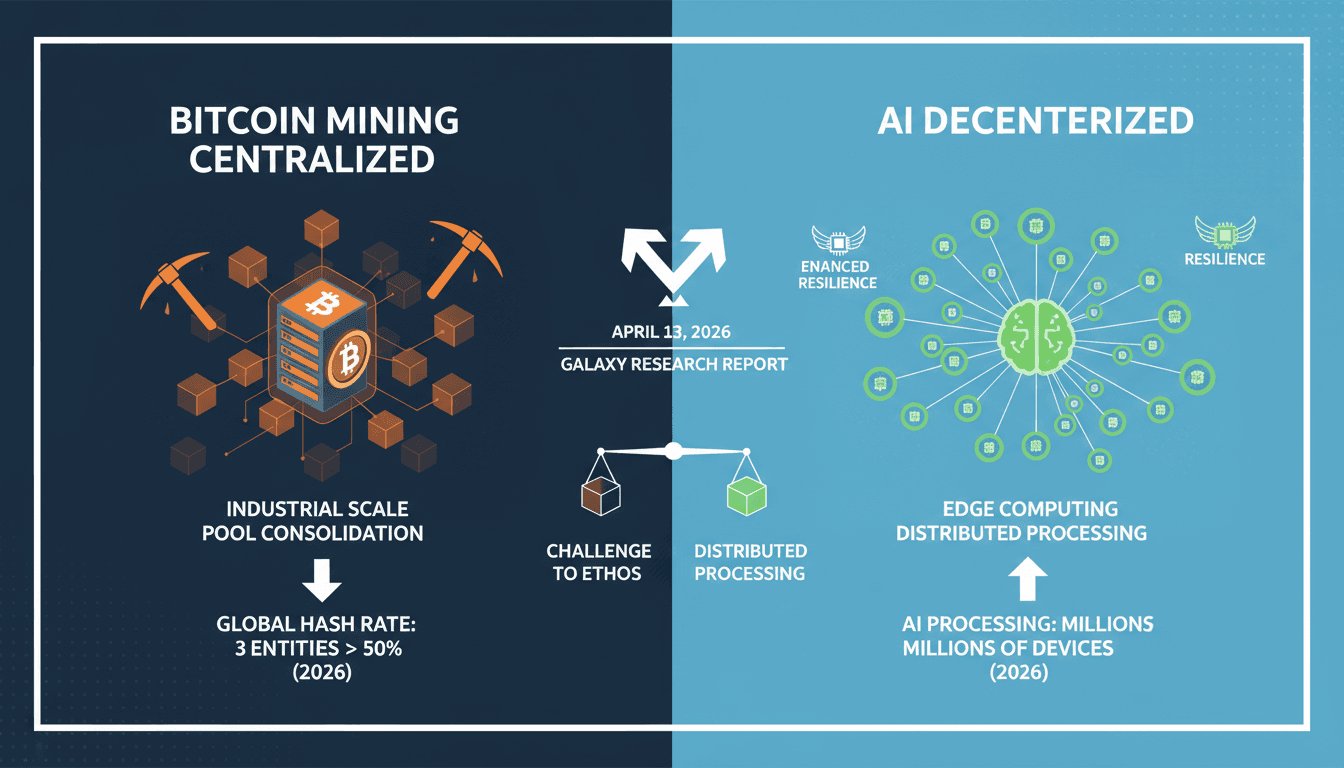
- Bitcoin mining is increasingly centralized due to the rise of industrial-scale ASIC farms, while AI is moving towards decentralization through edge computing.
- Industry reactions have sparked discussions on Bitcoin's network security and the potential for miners to pivot towards AI hosting.
The context you actually need
- Bitcoin mining began as a decentralized process using consumer hardware but has shifted to large facilities due to technological advancements.
- AI development started with centralized computing clusters but is evolving toward decentralized models driven by privacy needs and real-time data processing.
- Geographic diversification in Bitcoin mining, particularly in the Global South, aims to mitigate centralization risks but does not address the technological centralization of operations.
What's really happening
On April 13, 2026, Alex Thorn, Head of Research at Galaxy Research, highlighted a critical divergence between Bitcoin mining and AI computing in terms of decentralization. Bitcoin mining, which once thrived on the principle of decentralization through individual personal computers, has increasingly consolidated into industrial-scale operations driven by advancements in application-specific integrated circuits (ASICs). This shift has led to a concentration of mining power in large facilities, particularly in regions with low energy costs, such as Paraguay and Ethiopia. While geographic diversification has occurred, the technological centralization remains a pressing concern.
Conversely, the AI landscape is moving toward decentralization, primarily through edge computing. This shift is influenced by several factors, including the need for data privacy, reduced latency, and the limitations of centralized cloud computing. As IoT devices proliferate, the demand for local processing capabilities is growing, enabling AI to operate more efficiently and responsively. The projected growth of the global edge AI market, expected to reach $119 billion by 2033, underscores this trend and indicates a significant pivot towards decentralized computing models.
The implications of these diverging paths are profound. For Bitcoin, the centralization of mining operations could threaten the network's resilience and security, raising concerns about the integrity of transactions and the potential for monopolistic control. In contrast, AI's trajectory towards decentralization aligns with broader trends in distributed computing, enhancing flexibility and responsiveness to user needs while fostering innovation through open-source frameworks.
As the industry grapples with these changes, miners are increasingly considering the viability of transitioning to AI hosting services, capitalizing on the growing demand for decentralized AI solutions. This pivot not only reflects the changing landscape of technology but also highlights the need for miners to adapt to a more competitive and evolving market.
Who feels it first (and how)
- Bitcoin Miners: Facing increased operational costs and potential network security risks due to centralization.
- AI Developers: Benefiting from decentralized models that enhance data privacy and processing efficiency.
- Investors in Tech: Adjusting strategies based on the shifting dynamics between centralized and decentralized technologies.
- Geographies like the UAE: Emerging as key players in Bitcoin mining, potentially influencing global mining trends.
What to watch next
- Market Reactions: Monitor how Bitcoin miners adapt to rising costs and whether they pivot towards AI services, which could redefine their business models.
- Regulatory Developments: Keep an eye on how governments respond to the centralization of Bitcoin mining and the push for decentralized AI, as this could influence operational frameworks.
- Technological Innovations: Watch for advancements in edge computing technologies that could further accelerate AI decentralization and impact competitive dynamics in the tech sector.
Bitcoin mining is becoming technologically centralized despite geographic diversification.
AI will continue to decentralize through edge computing, driven by privacy and efficiency needs.
The long-term implications of these trends on network security and investment viability in both sectors.
Frequently Asked Questions
- Why it matters?
- This divergence in decentralization trends could impact network security, investment viability, and operational efficiency in both Bitcoin mining and AI.
- What happened (in 30 seconds)?
- Alex Thorn of Galaxy Research announced a significant shift in the decentralization trajectories of Bitcoin mining and AI on April 13, 2026. Bitcoin mining is increasingly centralized due to the rise of industrial-scale ASIC farms, while AI is moving towards decentralization through edge computing. Industry reactions have sparked discussions on Bitcoin's network security and the potential for miners to pivot towards AI hosting.
- What's really happening?
- On April 13, 2026, Alex Thorn, Head of Research at Galaxy Research, highlighted a critical divergence between Bitcoin mining and AI computing in terms of decentralization. Bitcoin mining, which once thrived on the principle of decentralization through individual personal computers, has increasingly consolidated into industrial-scale operations driven by advancements in application-specific integrated circuits (ASICs). This shift has led to a concentration of mining power in large facilities, par
- Who feels it first (and how)?
- Bitcoin Miners: Facing increased operational costs and potential network security risks due to centralization. AI Developers: Benefiting from decentralized models that enhance data privacy and processing efficiency. Investors in Tech: Adjusting strategies based on the shifting dynamics between centralized and decentralized technologies. Geographies like the UAE: Emerging as key players in Bitcoin mining, potentially influencing global mining trends.
- What to watch next?
- Market Reactions: Monitor how Bitcoin miners adapt to rising costs and whether they pivot towards AI services, which could redefine their business models. Regulatory Developments: Keep an eye on how governments respond to the centralization of Bitcoin mining and the push for decentralized AI, as this could influence operational frameworks. Technological Innovations: Watch for advancements in edge computing technologies that could further accelerate AI decentralization and impact competitive
News and analysis on Bitcoin, altcoins, and blockchain innovation.
"Bitcoinist delivers news and analysis on Bitcoin, altcoins, and blockchain innovation with a focus on market trends and industry updates."
— A47 Editor
Bitcoin And AI Are No Longer Aligned On Decentralization, Study Finds
A recent study indicates that Bitcoin mining and artificial intelligence (AI) are diverging in their paths toward decentralization, with mining costs in parts of the US exceeding $100,000 for a single bitcoin. This has prompted operators to relocate ...
Real-time updates, analysis, and reports on the blockchain and cryptocurrency sectors.
"Crypto News delivers real-time updates, analysis, and reports on the blockchain and cryptocurrency sectors."
— A47 Editor
Researcher suggests AI may decentralize just as Bitcoin mining turns industrial
Alex Thorn, head of Galaxy Research, indicated that Bitcoin mining is becoming increasingly centralized, transitioning from individual home computers to large industrial operations. This shift contrasts with the potential for artificial intelligence ...